


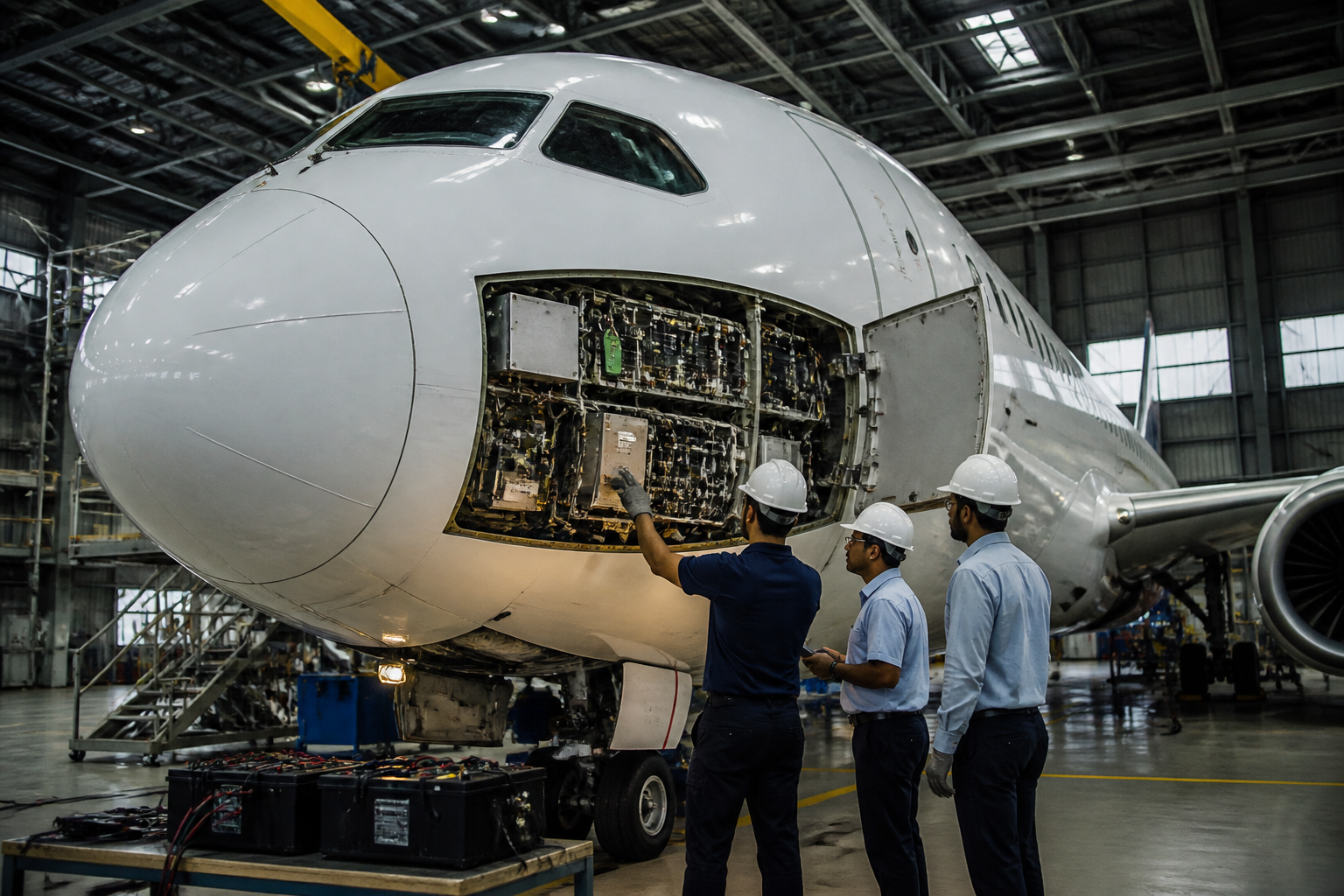
The Federation of Indian Pilots has asked India’s aircraft accident investigation authority to conduct a detailed technical examination of the Boeing 787’s electrical, electronic, avionics and integrated systems as part of the investigation into Air India flight AI-171’s crash in Ahmedabad. The demand, made in a letter sent to the Director General of the Aircraft Accident Investigation Bureau on 18 September, comes shortly before the final investigation report is expected in October.
The request does not establish that a fault in any particular Boeing 787 system caused the crash. It does, however, place the scope and completeness of the investigation under renewed attention. The Federation of Indian Pilots has argued that every technical aspect connected with the aircraft must be examined in an evidence-based and detailed manner, given the scale of the accident and the short interval between take-off and the crash.
The AI-171 aircraft crashed in the premises of a medical college in Ahmedabad within minutes of departure in June last year. The accident killed 260 people, according to the report published by Loksatta. The location and timing of the crash make the reconstruction of the aircraft’s systems, flight data and maintenance history central to understanding what happened, although the supplied material does not state the investigators’ findings or identify a confirmed cause.
The federation’s intervention is significant because it focuses on the Boeing 787’s architecture rather than on a single component. The aircraft is described as a “more electric aircraft”, a design approach in which several important systems rely more extensively on electrical power than in conventional aircraft. That makes the investigation of power generation, distribution and backup arrangements relevant to determining whether the aircraft’s systems operated as intended before the crash.
The federation has specifically called for the examination of the aircraft’s electrical generation and distribution systems, main and standby power, integrated modular avionics, flight-management systems, flight-control computers, data networks, batteries, sensors and aircraft-monitoring systems. It has also sought scrutiny of the crashed aircraft’s earlier maintenance records.
These areas cover different layers of an aircraft’s operation. Electrical systems supply power, avionics process and exchange information, flight-management systems support navigation and operational inputs, while flight-control computers are involved in the commands that govern the aircraft’s response. Sensors and monitoring systems provide information about the aircraft’s condition. The fact that the federation has listed these systems together reflects its demand for an integrated technical review rather than an examination limited to one isolated part.
### What a Boeing 787 inspection must establish
A complete inquiry would need to establish, through evidence, which systems were functioning, what signals they received, what information was available to the crew and whether any abnormal condition was recorded before the aircraft went down. The supplied report does not provide those answers. It only records the federation’s request that investigators examine the systems in detail.
That distinction matters in an accident investigation. A demand for a technical inspection is not the same as a finding of technical failure. Nor does the reference to the aircraft’s “more electric” design, by itself, indicate that its electrical architecture was responsible for the crash. The purpose of the investigation is to test possible explanations against flight data, cockpit information, component evidence and maintenance records.
The federation’s emphasis on maintenance records adds another layer to the inquiry. Previous maintenance documentation can help investigators understand what work was carried out, which components were inspected or replaced, whether recurring issues were recorded and how the aircraft’s technical condition was managed before the flight. The source material does not say that the aircraft had a known maintenance defect or that any earlier record has been linked to the crash. It says only that the federation wants those records examined.
This is also why the independence and technical breadth of an accident investigation matter. The federation has asked for an inquiry that is independent, technically comprehensive and impartial. Such a framework is intended to prevent the investigation from stopping at an early explanation before all relevant evidence has been assessed. The letter’s timing, with the final report expected in October, indicates that the pilots’ body wants the requested areas to be considered before the inquiry reaches its final stage.
### The institutional question behind the demand
The Aircraft Accident Investigation Bureau is the authority addressed by the federation. The supplied report does not disclose the bureau’s response to the letter, nor does it say whether the requested inspections have been ordered or completed. It also does not provide the investigation’s interim conclusions. Those limitations are important because the final report, rather than the federation’s request, will determine what the official investigation establishes.
The institutional question is therefore not simply whether the Boeing 787’s systems will be inspected. It is whether the final process will show clearly how investigators evaluated the aircraft’s electrical, avionics, control, data and maintenance evidence. For a major accident, transparency about the investigative method can be almost as important as the eventual finding. Families, aviation professionals, regulators and passengers need to know not only the conclusion but also the evidence supporting it.
The source report provides no details about the aircraft’s flight data, cockpit voice recording, wreckage examination, weather, air-traffic communication or emergency response. It would be inappropriate to draw conclusions about any of these factors from the federation’s technical request. The demand should instead be understood as a call to widen or confirm the technical scope of the examination before the final report is issued.
The crash also raises questions about how technical information is carried across the aviation system. Aircraft manufacturers design and document complex systems; airlines operate and maintain them; pilots interact with them; and accident investigators reconstruct their performance after an event. Each institution holds a different part of the evidence. A credible investigation must bring those records together without allowing any one account to substitute for the full technical record.
### What the available evidence confirms—and what it does not
The available material confirms five central facts. Air India flight AI-171, a Boeing aircraft, crashed in Ahmedabad in June last year. The crash occurred within minutes of take-off and killed 260 people. The Federation of Indian Pilots sent a letter to the Aircraft Accident Investigation Bureau’s Director General on 18 September. The federation asked for a detailed examination of several electrical and avionics systems, as well as earlier maintenance records. The final investigation report is expected in October.
The material does not confirm that the aircraft’s electrical system failed. It does not identify a defective component, report a warning received by the crew, describe a maintenance lapse or disclose any preliminary finding by investigators. It also does not indicate whether the final report’s expected publication date has changed.
That evidence boundary should shape the public discussion. Technical complexity can encourage premature explanations, especially when a crash involves a modern aircraft with multiple interconnected systems. But a list of systems proposed for inspection is not a list of proven causes. The final report will need to distinguish between equipment that was examined, equipment that malfunctioned, equipment that operated normally and evidence that remains inconclusive.
The coming stage of the process is therefore defined by documentation. The key developments to monitor are the response of the Aircraft Accident Investigation Bureau to the federation’s letter, the extent to which the requested systems and maintenance history are included in the inquiry, and the contents and timing of the final report expected in October. Until those steps occur, the Boeing 787 inspection demand remains a request for a broader evidence-based examination, not a confirmed explanation for the Ahmedabad crash.

