


Jefferies expects India’s real GDP growth to remain between 6.5 per cent and 7 per cent in the current fiscal, but the more consequential signal for cities may be elsewhere: credit is expanding, residential real estate sales have recovered across the largest urban markets and corporate lending is beginning to point towards a possible revival in private investment. Together, these indicators suggest that the next phase of growth could be shaped not only by consumption, but also by the financing and construction activity that cities depend on.
The brokerage’s latest report projects nominal GDP growth of around 11-12 per cent and expects corporate earnings growth to accelerate from 14 per cent in the current fiscal to 17 per cent in the fiscal year beginning April 2027. Jefferies said India’s structural growth story remained intact despite geopolitical challenges and elevated energy risks. The assessment is not a government forecast or an official economic release; it is an interpretation by a brokerage of recent economic indicators.
For the built environment, the significance of the report lies in the interaction between financial conditions and physical development. Urban construction requires credit for developers, businesses, suppliers and homebuyers. It also depends on household demand, corporate investment and the confidence to commit capital to projects that take time to complete. The indicators cited by Jefferies show movement across each of these channels, although they do not by themselves establish that a broad private-sector capital expenditure cycle has already begun.
The strongest credit signal is the expansion of bank lending. Bank credit grew 19.1 per cent year-on-year at the end of August, while corporate lending increased 21.6 per cent in July. Lending to micro, small and medium industrial enterprises rose 24.9 per cent, and deposits grew 17.8 per cent in August. These numbers point to a banking system supplying more credit to businesses, particularly smaller industrial firms.
That matters to cities because urban economies are not driven only by large developers or listed companies. Smaller industrial enterprises support construction supply chains, contracting, manufacturing, logistics and local employment. A sustained increase in lending to these firms could improve their ability to purchase equipment, expand production or participate in larger investment programmes. The supplied evidence does not identify how much of this credit is flowing into construction or urban infrastructure, but it does indicate a broader improvement in business financing.
Jefferies linked the rise in SME lending to recent goods and services tax and labour reforms, as well as efforts to improve the ease of doing business. The report said these measures could be beginning to generate benefits. That is an attribution to the brokerage’s analysis, not an independently established causal finding in the material supplied. The distinction is important because credit growth can reflect several factors, including demand for loans, banks’ willingness to lend and the financial position of borrowers.
Corporate lending provides a second signal. The 21.6 per cent increase in July, according to the report, may indicate that companies are preparing to invest after a period in which the expected private-sector capital expenditure cycle had remained uncertain. If that investment expands, its urban consequences could include greater demand for industrial premises, offices, warehouses, worker housing, transport links and supporting municipal services. At present, Jefferies described the increase as pointing to a possible revival rather than confirming that the cycle has fully returned.
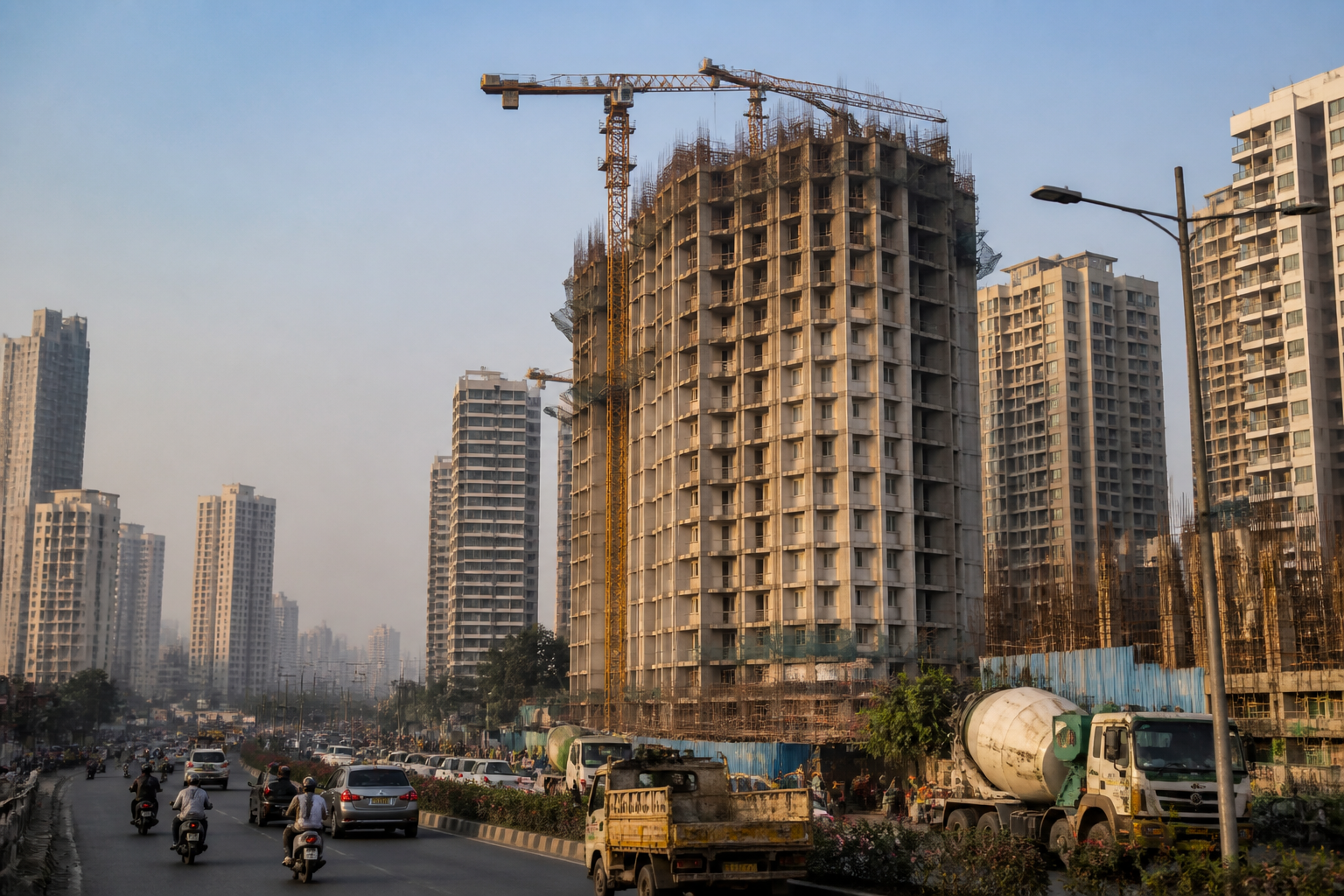
The housing market offers a more direct urban indicator. Residential real estate sales across India’s top seven cities rose 7 per cent year-on-year in the first seven months of 2026, compared with a 1 per cent decline in 2025. The change marks an improvement in the direction of urban housing demand, but the figure alone does not show whether the recovery is evenly distributed across cities, income groups or housing segments.
It also does not establish whether stronger sales will translate into a matching increase in new construction. That conversion depends on inventory, land costs, financing conditions, approvals, construction costs and the ability of households to sustain purchases. The report does not provide those details. What it does show is that residential real estate, one of the clearest links between household demand and urban economic activity, has moved from contraction in the comparable period of 2025 to growth in the first seven months of 2026.
The broader domestic-demand picture is also strengthening according to the indicators cited by Jefferies. Goods and services tax receipts increased 14.8 per cent year-on-year in August. Power demand growth accelerated to 9.4 per cent during April-August, compared with 1.8 per cent in January-March. Tax receipts and electricity demand are not direct measures of urban prosperity, but they provide signals about the scale of economic transactions and activity. Higher power demand can accompany greater industrial and commercial use, although the supplied report does not break the increase down by sector or geography.
For urban planners and infrastructure agencies, these indicators matter because economic expansion places pressure on systems that are often planned and built more slowly than demand changes. New housing, industrial activity and commercial investment require roads, power connections, water supply, waste management and public transport. The Jefferies report does not quantify infrastructure capacity or identify specific projects. Its evidence instead points to the economic conditions that can increase demand for such systems.
The potential transmission from growth to urban investment is therefore institutional as much as financial. Banks provide credit, companies decide whether to invest, households purchase homes and public agencies manage approvals and infrastructure. A rise in one part of the chain does not automatically guarantee progress across the others. The reported increase in corporate and SME lending is encouraging for investment, but whether it becomes completed construction depends on how firms deploy the funds and whether urban institutions can support that activity.
The fiscal and monetary backdrop described in the report introduces another layer of uncertainty. Jefferies expects the Reserve Bank of India to raise rates by 50 basis points by the end of 2026 from the current repo rate of 5.25 per cent. Higher rates can affect the cost of borrowing for companies, homebuyers and developers. The report’s growth outlook therefore contains a tension: credit and demand indicators are strengthening, while the expected interest-rate path could make future borrowing more expensive.
Energy prices create a separate risk for the construction and real estate ecosystem. Brent crude was around USD 106 per barrel when the report was prepared, while disruptions around key oil routes were adding pressure to energy markets. India had, according to Jefferies, avoided significant energy supply disruptions by continuing to source discounted Russian crude and increasing purchases of US energy. The brokerage nevertheless identified developments in the Middle East and energy prices as important risks to the outlook.
Energy costs can affect transport, materials, logistics and household budgets, but the supplied report does not estimate the impact on construction costs or housing affordability. That limitation prevents a precise assessment of how the energy risk could alter the urban investment cycle. It does, however, show why a strong headline growth forecast does not remove the need to track input prices and financing conditions.
The report’s data presents a cautiously positive urban economic picture. Growth is projected at 6.5-7 per cent, nominal GDP growth at 11-12 per cent, bank credit at 19.1 per cent year-on-year growth in August, corporate lending at 21.6 per cent in July and SME industrial lending at 24.9 per cent. Residential sales in the top seven cities increased 7 per cent in the first seven months of 2026 after declining 1 per cent in 2025. These figures describe momentum across the economy, business finance and housing, but they do not prove that growth is equally broad-based or that all cities are benefiting in the same way.
The central urban question is whether financial momentum can become durable, productive investment. A housing recovery can support construction and related employment, while corporate and SME credit can expand the productive base that cities need. But the transition requires more than demand. It requires projects to receive approvals, businesses to invest the borrowed capital, infrastructure networks to keep pace and households to remain able to afford homes and services.
What the evidence confirms is that India entered the current fiscal with several stronger indicators than the previous year: economic growth is projected to remain high, credit expansion has accelerated, power demand has improved, tax receipts have risen and housing sales in the largest cities have returned to growth. What remains uncertain is the quality and distribution of that expansion, the scale of any private capital expenditure revival and the effect of energy prices and expected rate increases. Those are the indicators that will determine whether the current recovery becomes a sustained urban investment cycle.

