


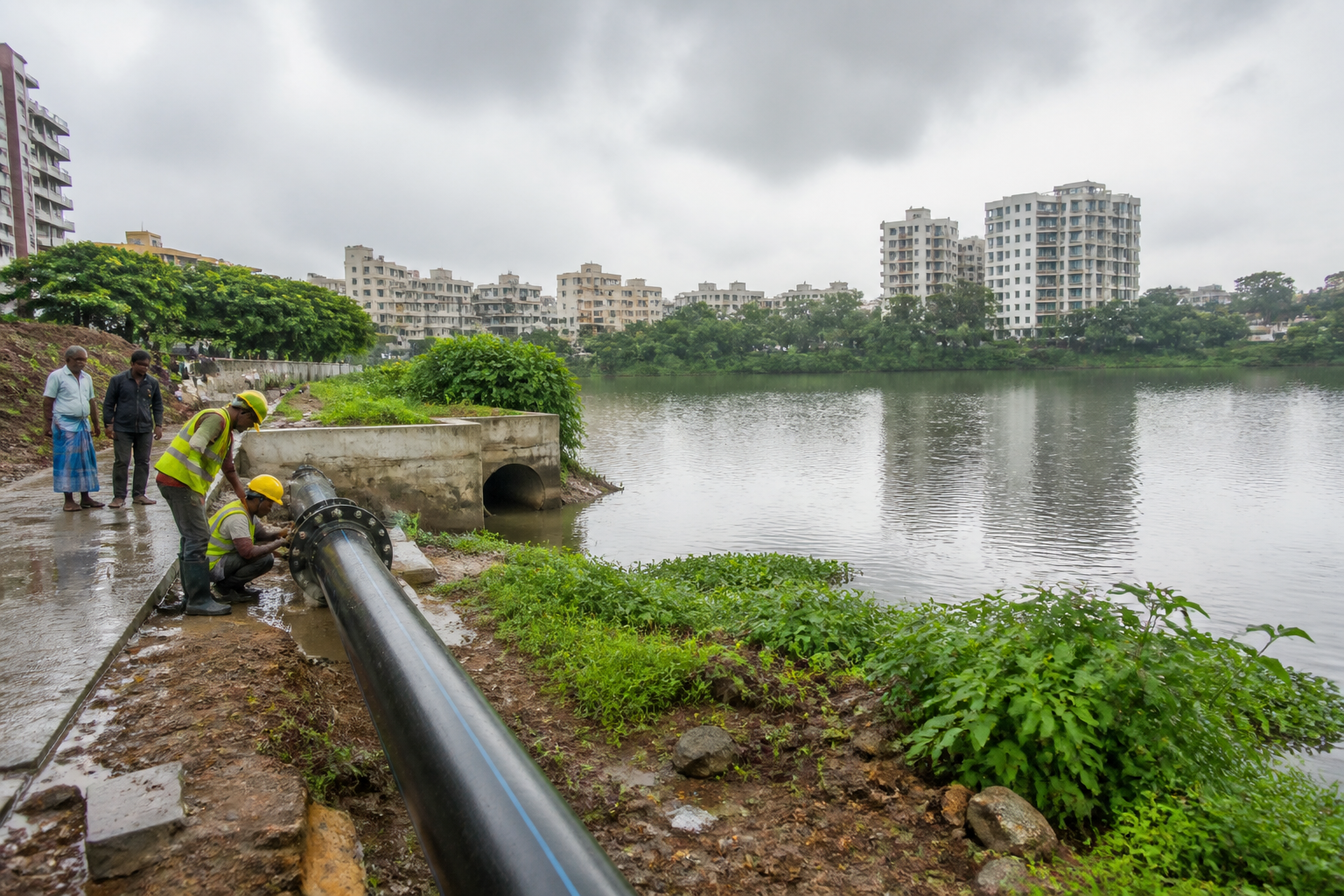
A Rs 75-crore treated wastewater project intended to replenish 18 lakes in and around Bengaluru is nearing completion, but four pending pipe connections have exposed the administrative and environmental conditions that will determine whether the intervention produces lasting results. The Minor Irrigation Department says most of the work is complete, yet local resistance has delayed connections at four locations, including Byappanahalli and Mandur near Kithaganur in the Mahadevapura Assembly constituency.
The project is significant because it treats lakes not merely as isolated water bodies, but as part of Bengaluru’s broader water-management system. The plan is to use treated wastewater to replenish lakes that do not have enough water. However, the reporting also records continuing sewage inflows into several lakes, raising a basic implementation question: can treated water improve lake ecology if polluted water continues to enter the same water bodies?
The answer is not established by the available project update. What the evidence does show is that lake filling, sewage diversion, stormwater-drain maintenance and regular upkeep are closely connected. The project may increase water availability in the identified lakes, but the condition of those lakes will also depend on whether other agencies prevent untreated sewage from entering them.
The Minor Irrigation Department initiated the project two years ago. Its executive engineer, Manunath, said the remaining works were expected to be completed within a few days, provided local residents cooperated with pipe-laying at the four pending locations. He said officials had been counselling residents about the importance of laying the pipes to fill Bidarahalli and other lakes with treated water.
That detail points to one of the project’s immediate institutional challenges. Infrastructure completion is not determined only by engineering progress. Pipe connections also require access to local sites, agreement from residents and coordination between implementing agencies and communities. Until the final links are laid, a project that is largely complete cannot deliver its intended network-wide outcome.
The 18 lakes named for replenishment are Kittanur Lake, Kithaganur Lake, Bidarahalli Lake, Byappanahalli Lake, Cheemasandra Lake, Nimbekaipura Lake, Gundur Lake, Doddagubbi Lake, Yarappanahalli Lake, Chikkagubbi Lake, Kannuru Lake, Manduru Lake, Jyothipura Cross Lake, Jyothipura Lake, Selankunte Lake and Andrahalli Lake. The spread of these water bodies across eastern Bengaluru makes the project a local infrastructure intervention with wider implications for the city’s expanding urban edges.
Lake activist Balaji Rathotham welcomed the plan, saying that treated water could help the flora and fauna of the lakes. He also said that Bidarahalli and other lakes did not have enough water and that filling them could help raise the groundwater table. These claims describe the expected ecological and water-security benefits of maintaining water in the lakes, but the supplied report does not provide groundwater measurements or an independent assessment of the project’s likely impact.
Rathotham separately identified Kithaganur Lake as a warning case. He said its water quality was poor because sewage was flowing into the lake and urged the department to drain the polluted water before refilling it with treated wastewater. This creates a distinction between adding water to a lake and restoring a lake. The first is a supply operation; the second requires control over inflows, water quality and ongoing maintenance.
That distinction is central to Bengaluru’s lake-management challenge. According to the activists cited in the report, authorities have spent heavily on lake rejuvenation but have not maintained the water bodies adequately. Their demand is not simply for more restoration spending. It is for the infrastructure that protects the restoration work from being undone, including diversion channels that prevent sewage from reaching lakes.
The Bengaluru Water Supply and Sewerage Board has a separate but essential role in this chain. Lake activists and environmentalists have appealed to BWSSB engineers to construct diversion channels. Resident Narayana Swamy P of Seegehalli said sewage was flowing into Yele Mallappa Shetty Lake, Seegehalli Lake, Vengaiah Lake and Gangashetty Lake. He argued that the sewage problem should be fixed before the lakes are filled with treated water.
The report therefore presents a coordination problem between at least two public responsibilities. The Minor Irrigation Department is advancing a project to convey treated wastewater to 18 lakes. BWSSB engineers are being asked to address sewage flows and build diversion channels. Residents and local communities influence whether pipe connections can be completed. If these responsibilities are handled separately, one agency’s intervention may be weakened by another unresolved source of pollution.
Stormwater infrastructure adds another layer. Narayana Swamy also called for the regular maintenance of stormwater drains that carry rainwater into lakes. These drains are part of the hydrological connection between the city and its water bodies, but their function depends on maintenance and on preventing sewage from entering the system. The supplied material does not establish how many drains require repair, how much sewage is entering the named lakes or whether diversion works have been sanctioned.
The project’s numbers show both its scale and its limits. The planned network covers 18 lakes and carries a stated cost of Rs 75 crore. Four pipe connections remain pending. The report does not provide the total length of the pipeline network, the volume of treated wastewater available, the treatment standards, the source treatment plants, the expected filling schedule or the operating cost after completion. Those omissions matter because physical completion alone cannot show whether the system will reliably supply water or sustain lake levels.
The same evidence also limits what can be concluded about outcomes. The project is described as nearing completion, not as fully operational. The engineer expects the pending works to be completed within a few days, subject to local cooperation. No completion certificate, water-quality data or post-commissioning monitoring results are cited. It is therefore possible to assess the project’s intended design and current obstacles, but not yet its performance.
The policy landscape visible in the report is one of linked urban systems rather than a single lake-rejuvenation programme. Treated wastewater reuse addresses water availability. Sewage diversion addresses pollution. Stormwater-drain maintenance supports natural inflows. Lake maintenance protects the assets after restoration. The departments and communities involved may have different responsibilities, but the lakes experience the combined result.
This is also why public participation appears in the project’s final stage. The department’s request for cooperation is presented in the context of laying pipes at four locations. However, the broader relationship between residents and lake infrastructure is more complex than acceptance of a pipeline. Communities living near lakes are also directly affected by odour, flooding, access, construction activity and water quality. The source material records resistance to pipe-laying but does not identify its reasons or the process used to address it.
For Bengaluru, the larger question is whether lake restoration will be treated as a continuing urban utility function or as a series of one-time capital works. The 18-lake project can create a treated-water supply link, but activists’ concerns suggest that the value of that link depends on preventing new pollution and maintaining the connected drainage system. A lake can receive treated water and still remain vulnerable if sewage inflows continue.
The available evidence confirms that the Minor Irrigation Department’s project is close to a major implementation milestone, with four pipe connections pending and local cooperation still required. It also confirms that the project’s environmental and groundwater benefits remain contingent on sewage control, stormwater-drain maintenance and regular lake upkeep. The next developments to monitor are completion of the four connections, the condition of Kithaganur Lake, action by BWSSB on sewage diversion and evidence of water quality and lake maintenance after treated-water supply begins.
