


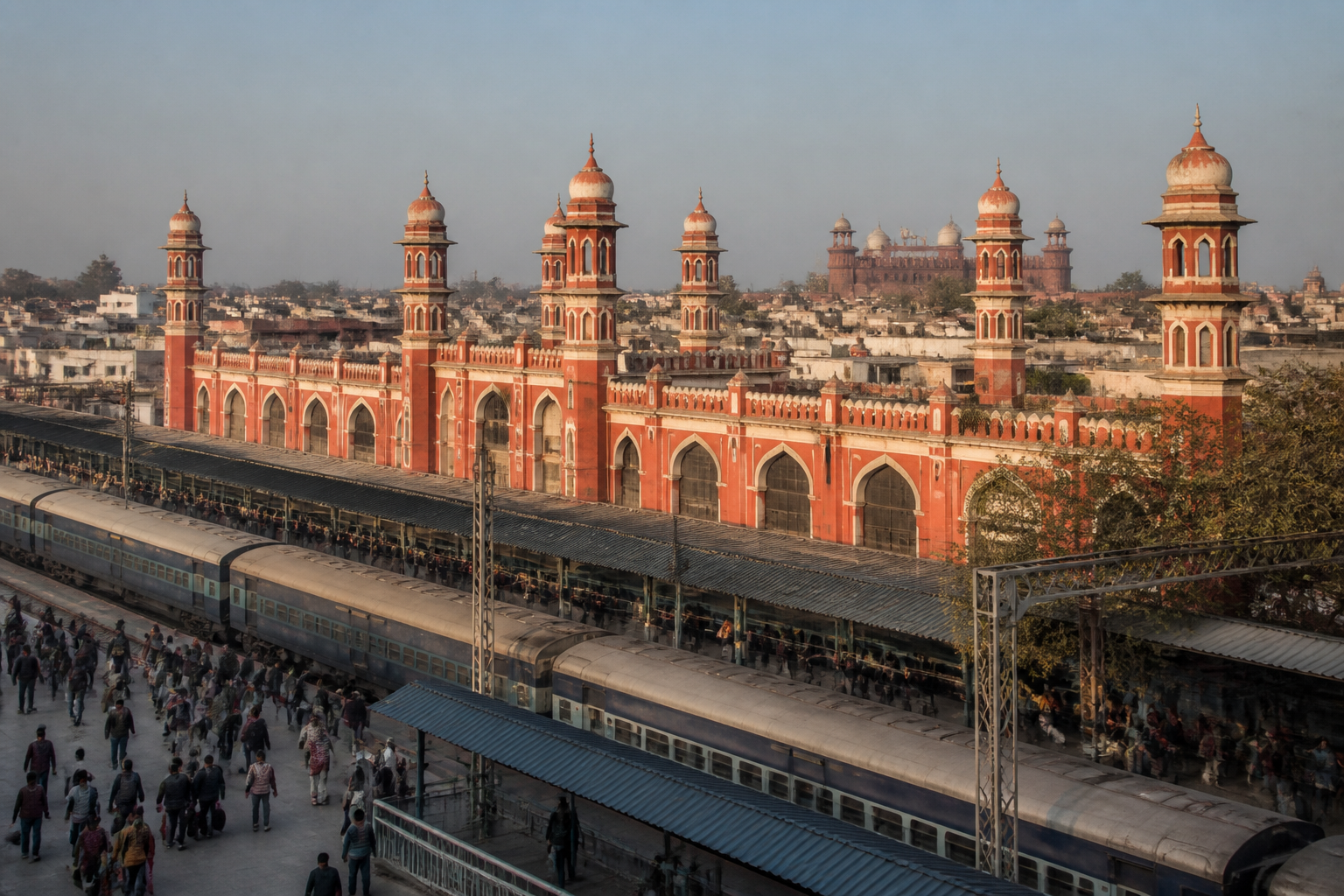
Old Delhi Railway Station will host a station festival on 25 September, marking its 160-year journey from a small railway building to one of the country’s major passenger stations. The event is scheduled to include a photographic exhibition, the unveiling of a heritage souvenir and recognition for railway employees who contributed to the station’s development. But the larger story is the way this station has grown alongside Delhi itself: from an instrument of nineteenth-century rail expansion to a heavily used urban transport interchange serving nearly three lakh passengers a day.
The festival is part of the Railways’ decision to organise similar events at 103 historically significant railway stations across the country by December. At Old Delhi, the programme will present the station’s history, development and architectural character. The event therefore places a working transport facility inside a heritage framework, a difficult balance for stations that must preserve their identity while handling contemporary passenger volumes.
## Old Delhi Railway Station’s long urban evolution
The station’s origins date to 1864, when railway operations began from a small building. Its first major connection to the wider rail network came after the construction of the railway bridge over the Yamuna. On the last day of 1866, a train operated on the East Indian Railway Company’s Calcutta–Delhi line reached the station. That connection placed Delhi on a railway route linking it with other parts of the country.
For approximately four decades, railway operations continued from the small building. Construction of a new station building began in 1893, and the structure was completed over the following ten years. The new building, with two platforms, opened to passengers in 1903. According to the report, its design drew on Mughal-era architectural forms and visually related it to nearby historic buildings such as the Red Fort and Jama Masjid.
The architectural reference was not incidental to the station’s location. The building was created within a historic part of Delhi, close to some of the city’s most recognisable monuments. Its six minarets and red exterior gave it a distinctive identity, while its position connected railway infrastructure with the older urban fabric around the Red Fort and the walled city.
The station’s location also reflected the political and administrative logic of the period. The report says that after the failure of the 1857 uprising, the authorities selected a site near Seelampur and the Red Fort rather than placing the station farther from the built-up city. An earlier proposal had considered a location near Ghaziabad. The stated strategic reasoning was that a station within the populated area could be more easily controlled if another violent movement occurred.
That history shows that railway infrastructure was never only about movement. Station locations also reflected questions of access, surveillance, commerce and control. In Delhi, the railway was inserted into an already important political and historic landscape rather than being built as a disconnected peripheral facility.
## From colonial gateway to high-volume interchange
The station’s importance increased after Delhi became the capital in 1931. Expansion followed in 1934–35, when the premises were enlarged, the number of platforms was increased and electric signalling was introduced. These changes marked a shift from a nineteenth-century railway stop to a larger metropolitan transport facility serving a capital city.
The station now has 16 platforms and handles more than 250 trains a day, according to the report. Nearly three lakh passengers arrive at or use the station daily. Those figures illustrate the operational pressure placed on a building whose architectural identity belongs to an earlier period. The station is simultaneously a heritage structure, a major railway asset and a daily public service used by a large and diverse passenger population.
Its development also records changes in railway technology. A steam locomotive shed once stood on the Zorawar Singh Marg side of the station. The shed closed after steam locomotives were discontinued in Northern Railway on 15 May 1994. A second entrance to the station was built at that location in 1995.
This transition is significant because it shows how railway sites are repeatedly repurposed. Facilities created for steam operations can become passenger access points; old operational spaces can be absorbed into the station’s contemporary circulation system. The physical station may retain historic features, but its functions continue to change as railway technology and passenger demand evolve.
## Old Delhi Railway Station and the challenge of modernisation
The station’s recent history has involved another layer of change. Renovation work began in 2016, and additional passenger facilities were introduced. During this process, the building’s colour was changed from red to ochre. The modification altered one of the station’s most visible external characteristics while retaining the broader architectural form associated with the historic structure.
This is the central management challenge for an old station: modernisation cannot be treated simply as the addition of new equipment. It also changes how the building is seen, used and understood. Entrances, platforms, signalling, passenger amenities and circulation routes must respond to present-day demand, while the station’s architectural and historical associations remain legible.
The source material does not specify the full list of facilities added during the renovation or provide a detailed conservation plan. It does, however, establish that the station has undergone repeated expansion and upgrading, from the platform additions and electric signalling of the 1930s to the renovation initiated in 2016. The history is therefore one of continuous adaptation rather than a simple divide between an old building and a new transport system.
The nearly three lakh daily passengers also make the station’s heritage status a practical urban issue. A building used by such a large number of people cannot be managed only as a monument. Its value depends on remaining functional, accessible and capable of supporting railway operations. At the same time, high footfall can place pressure on historic fabric, visual character and the surrounding public realm.
## Why the festival matters beyond commemoration
The 25 September festival will use exhibitions, a heritage souvenir and recognition of railway staff to present the station’s institutional history. That approach is important because railway heritage is often reduced to architecture. At Old Delhi, the story also includes the workers who operated the station, the engineers who expanded it, the signalling systems that changed its capacity and the passengers who made it a central part of Delhi’s transport network.
The decision to recognise employees who contributed to the station’s development connects the building to the public institution behind it. Stations do not function because of architecture alone. Their daily operation depends on staff, timetables, signalling, maintenance, passenger management and the continuing coordination of trains and platforms. A heritage narrative that includes those systems provides a more complete account of how the station has survived and expanded.
The wider programme involving 103 historically significant stations also suggests an attempt by the Railways to frame station history as part of the country’s public infrastructure story. The source does not state how each station will be conserved or whether the festivals will lead to permanent heritage-management measures. It does establish that the Railways intends to bring these histories into public view through events held up to December.
For Old Delhi, the exercise is especially relevant because the station sits within one of the capital’s most historically dense areas while continuing to perform a high-intensity transport function. Its relationship with the Red Fort and Jama Masjid gives it a strong architectural setting, but its daily importance comes from the trains and passengers moving through it.
## The larger urban question
Old Delhi Railway Station demonstrates how transport infrastructure can become part of a city’s historical identity without ceasing to be operational infrastructure. Its six minarets, Mughal-inspired design and location near the Red Fort represent one layer of the city. Its 16 platforms, more than 250 daily trains and nearly three lakh passengers represent another.
The station’s 160-year history also shows that urban infrastructure is cumulative. A small nineteenth-century building became a larger station; a railway bridge connected Delhi to a wider network; the capital’s expansion required more platforms and electric signalling; the decline of steam operations freed space for another entrance; and recent renovation added modern facilities. Each stage left a physical or institutional trace.
The festival can document that evolution, but the continuing question is how a busy public facility can preserve historical meaning while meeting present-day transport needs. The available information confirms the station’s long development and current scale, but it does not establish what future conservation, circulation or capacity measures will be adopted. Those issues will determine whether heritage recognition remains ceremonial or becomes part of the station’s long-term management.
For now, the 25 September event will mark Old Delhi Railway Station as both a historic building and a living railway interchange. Its story is not only about 160 years of architecture. It is about how Delhi repeatedly adapted infrastructure built for one era to serve the demands of the next.
