


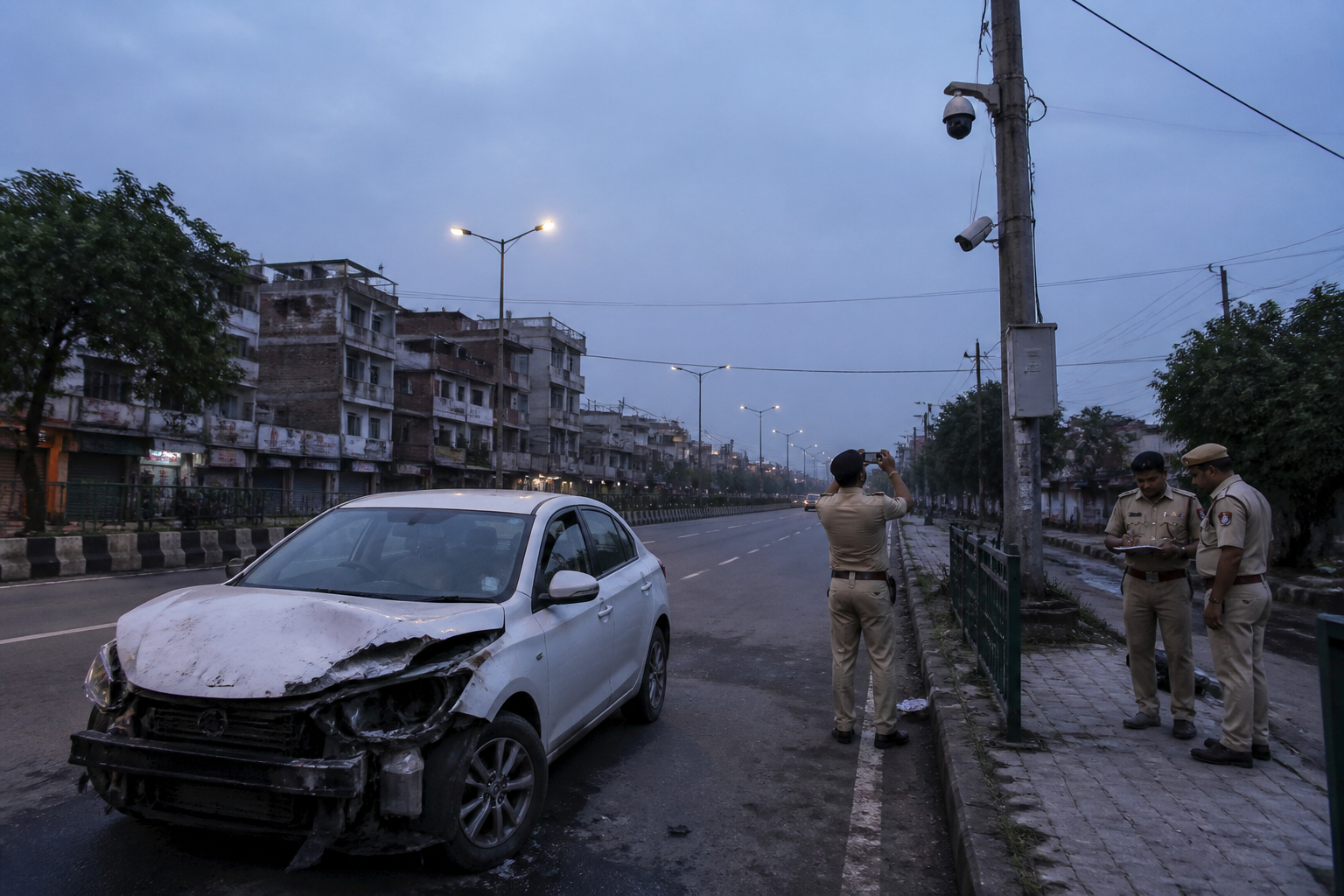
The Nangloi hit-and-run that killed 35-year-old Mahesh Kumar on September 15 is more than a police case involving one driver and one damaged car. It also shows how a pedestrian’s safety can depend on the visibility of the road, the speed of vehicles, the availability of witnesses and the ability of investigators to reconstruct an incident after the fact. In this case, police said CCTV footage became central to identifying what happened on Main Rohtak Road in outer Delhi.
According to the police account reported by the Times of India, a PCR call about a road accident was received at about 5.11am. Officers reached the location and found a white car in a damaged condition on the roadside. An unconscious man was lying nearby. Kumar was taken to Sanjay Gandhi Memorial Hospital in Mangolpuri, where doctors declared him brought dead at 6.14am.
Police said the collision itself was recorded at 4.54am. The footage reportedly showed a speeding car hitting a pedestrian walking along the side of the road. It also showed passers-by moving towards the victim after the impact. The sequence places the incident in the difficult interval before sunrise, when a road may still be in use but pedestrian visibility, traffic volumes and immediate assistance can vary sharply.
The accused driver, identified by police as 22-year-old Rinku Goyal, a student and resident of Nangloi, was arrested. Police also seized the vehicle. Investigators said Goyal was travelling to Noida to pick up his sister when the incident occurred. The police registered a case after the accident, while the person who initially alerted the authorities could not later be contacted because the phone was unreachable.
That sequence highlights three separate systems that must work after a serious road crash: emergency notification, medical response and evidence collection. The PCR call brought officers to the location. The injured pedestrian was taken to a hospital, where the time of death was recorded. CCTV footage then provided investigators with a visual record of the collision and the movement of people immediately afterwards. None of these steps reverses the loss of life, but each affects whether an incident can be properly documented and investigated.
## What the Nangloi case reveals about road investigations
The most significant evidence described in the report is not a statement from an eyewitness but the CCTV footage cited by police. The footage reportedly carried a timestamp of 4.54am and showed both the impact and the reaction of passers-by. That matters because hit-and-run investigations can begin with incomplete information: a damaged vehicle, an injured person and a caller who may not remain available to investigators.
In the Nangloi case, the vehicle was found near the site in a damaged condition. The combination of the vehicle, the CCTV recording and the police investigation led to the arrest of the alleged driver. The report does not provide details of the charges, the sections of law invoked, the vehicle’s registration history, the driver’s licence status or the results of any mechanical or forensic examination. Those details will determine how the case proceeds, but they are not established in the supplied account.
The report also does not state whether the road had functioning street lighting at the time, whether Kumar was walking on a footpath or the carriageway edge, what the traffic conditions were, or whether the location had pedestrian crossings or other protective infrastructure. Those omissions are important because the police account establishes the collision and arrest, but does not by itself explain the full physical context in which the crash occurred.
This distinction is central to understanding urban road safety. A criminal investigation focuses on the conduct connected to a particular crash. A road-safety inquiry must additionally examine the street: how pedestrians are expected to move, whether they can be seen by approaching drivers, how fast vehicles can travel, and how quickly help can reach an injured person. The supplied report confirms that a pedestrian was walking along the side of Main Rohtak Road, but it does not establish whether the road design offered a safe alternative.
## The early-morning vulnerability
The timing of the Nangloi collision is one of the few broader clues available in the case. The reported impact occurred at 4.54am, while the PCR call came at 5.11am. The 17-minute interval between the two recorded times cannot, on its own, show how quickly help was summoned or how long the victim remained at the site. It does, however, show the importance of reliable detection and immediate communication when a crash occurs during low-activity hours.
The report says passers-by rushed to the victim after the collision. It does not identify them, describe the assistance provided or explain whether any witness later gave a statement. The caller who contacted the police could not subsequently be reached. This creates a familiar investigative problem without requiring assumptions about the people involved: the initial account may be available to emergency services, while follow-up testimony can become difficult if contact details are incomplete or a phone is unreachable.
CCTV therefore becomes especially valuable in incidents where a witness trail is uncertain. In this case, the footage reportedly captured the vehicle striking Kumar and showed the immediate response. It gave investigators a time-stamped account that could be compared with the damaged car and the location where it was found. The report does not say whether additional cameras, vehicle data or forensic evidence were used.
## The institutional chain after a fatal crash
The institutions named in the report perform different roles. Police received the PCR alert, reached the road, documented the scene, registered a case and arrested the alleged driver. Sanjay Gandhi Memorial Hospital received the injured pedestrian and recorded that he was brought dead. CCTV footage supplied an evidentiary record. The vehicle seizure preserved an object directly connected to the investigation.
The case also illustrates why the first hours after a crash matter administratively. The condition of the car, the position of the vehicle and victim, available footage and accounts from people at the scene can all influence the reconstruction of events. Once a location changes or witnesses leave, some evidence becomes harder to recover. The report does not describe the scene examination in detail, but it confirms that officers found the damaged car and victim after the PCR call and that police subsequently registered a case.
For the family, the official process begins with identification, hospital documentation, the police case and the investigation into the driver’s alleged conduct. The report identifies Kumar as a Nangloi resident and says his father works with the Secretariat Security Force under the central government. It does not provide information about compensation, legal representation, the family’s account or the next court hearing. Those are significant parts of the aftermath but remain outside the supplied evidence.
## What remains unknown about the road itself
The available facts establish a fatal collision on Main Rohtak Road, but they do not establish whether the location had infrastructure that could reduce pedestrian exposure. There is no information in the report about footpaths, streetlights, speed limits, road markings, crossings, traffic-calming measures or the condition of the road edge. There is also no data on previous crashes at the same location.
Those missing details prevent a definitive conclusion about whether the incident reflects a design failure, a lighting problem, excessive speed, driver behaviour, pedestrian infrastructure gaps or a combination of factors. The police description of a speeding car is relevant to the investigation, but it is not a complete road-safety diagnosis.
This is where a single crash can raise a larger urban question without answering it: when a pedestrian is walking beside a major road before dawn, what protections does the street provide, and which agency is responsible for them? The current report identifies the police investigation but does not name the road-owning or traffic-engineering authority, nor does it indicate whether any inspection of the location followed the crash.
The distinction matters because enforcement after a collision and prevention before one are separate responsibilities. Arresting an alleged driver addresses the case before the police. Improving visibility, pedestrian space or speed management, if deficiencies are found, would involve a different administrative process. The supplied material confirms the first response but provides no evidence about the second.
The Nangloi case therefore offers a limited but clear evidence trail. A pedestrian was killed on September 15; police received an alert shortly after the reported impact; the victim was taken to hospital and declared dead; CCTV reportedly showed a speeding car striking him; the vehicle was found damaged nearby; and police arrested a 22-year-old alleged driver. The investigation has moved beyond an unidentified hit-and-run, but the public record supplied here does not yet explain the road conditions or the full chain of responsibility.
The next developments to watch are the formal investigation, the evidence placed before the court, any forensic findings from the seized vehicle, and whether authorities examine Main Rohtak Road for pedestrian safety conditions. Those steps will determine whether the case remains only an individual prosecution or also produces a documented assessment of the street where Kumar died.
