


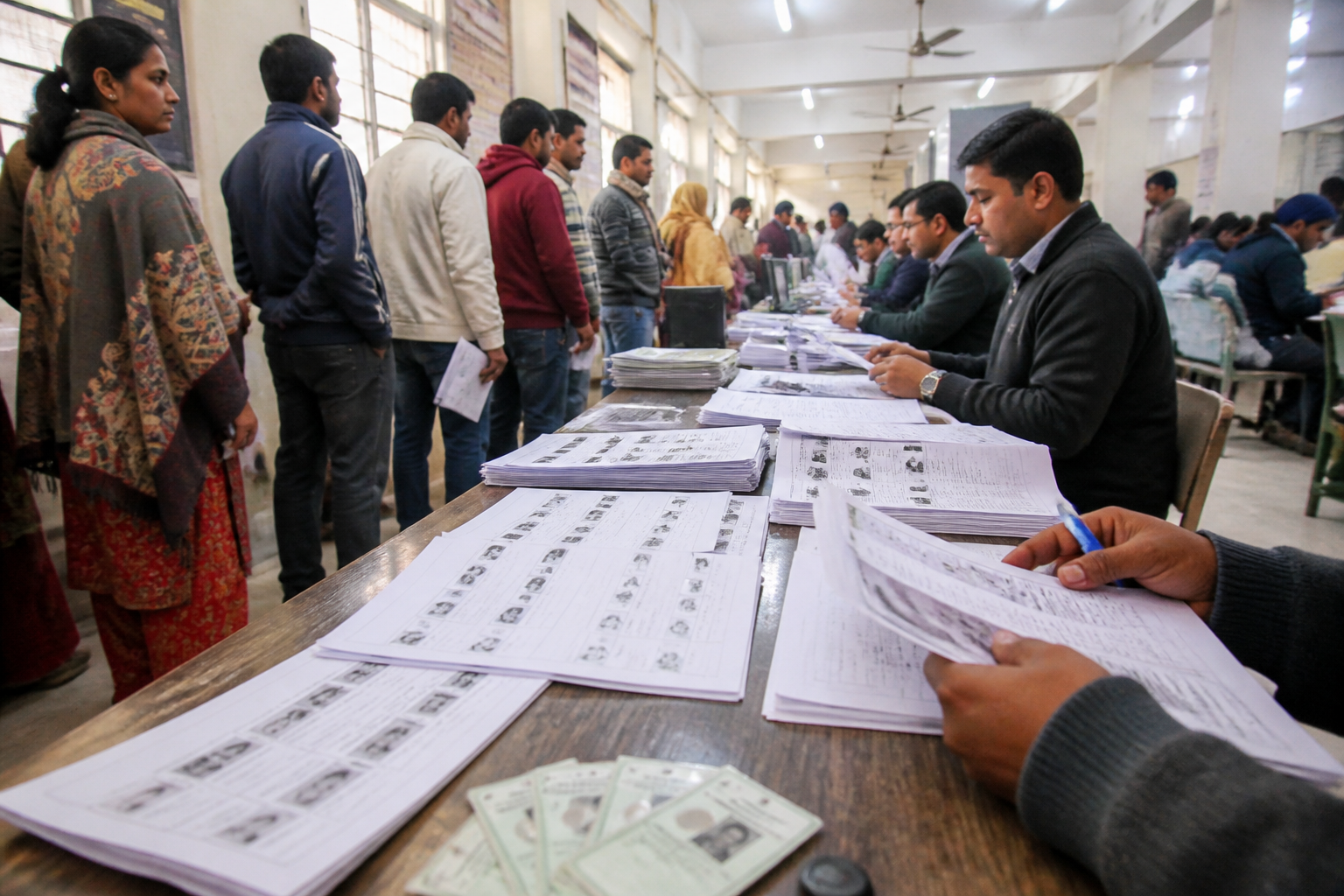
The notices issued to former Delhi chief minister Arvind Kejriwal and members of his family under the Special Intensive Revision (SIR) of electoral rolls have brought a large administrative exercise into sharp public focus. The Delhi election authorities say the notices do not mean that the family members have been removed from the voter list or found ineligible. They were issued because their details could not be mapped to the previous SIR records.
That distinction is central to understanding the controversy. The Aam Aadmi Party alleged that the names of Kejriwal and his family had disappeared from Delhi’s voter list. The election authorities rejected that interpretation, saying the names remain on the rolls and that the notices were part of a verification process for voters who could not be matched with earlier records. The dispute therefore concerns not only one prominent household, but also how electoral databases classify, verify and restore the details of ordinary residents.
According to the report, notices were issued to Kejriwal, his wife Sunita Kejriwal, his father Gobind Ram Kejriwal, his mother Geeta Devi and his 25-year-old son Pulkit Kejriwal. They were placed in the category of voters who could not be mapped to the previous SIR. The notices were issued to 110 people in a particular part of Assembly Constituency 40, which includes the New Delhi constituency.
The Delhi election office has described the unmapped category as a procedural classification. It covers voters whose information could not be matched with records from the previous revision. The authorities have also identified another group: mapped voters whose names, dates of birth or other details contain minor discrepancies. Delhi Chief Electoral Officer Ashok Kumar said teams were organising camps for hearings and that voters would have to respond with the required documents.
The administration’s explanation changes the meaning of the original political allegation. A name not appearing in a draft roll, or being placed in an unmapped category, is not automatically the same as a person losing voting rights. The New Delhi Assembly constituency’s Electoral Registration Officer has said that omission from the draft roll does not by itself establish ineligibility. Eligible voters whose names are absent from the draft list have been given an opportunity to file claims through Form 6 between 31 August and 30 September.
This process places the burden of correction partly on the voter. The electoral authority may identify a mismatch, issue a notice and provide a hearing, but the individual must still respond and submit documents within the prescribed process. That creates a significant administrative question: whether residents with stable addresses, older records or documentation difficulties can navigate the verification system as easily as politically prominent citizens.
The scale of the exercise makes that question more important. The Delhi election office said that 31,63,930 notices had been issued so far. These notices are being delivered to voters whose names could not be connected to the electoral roll during the previous revision or whose records require clarification. The number indicates that the exercise is not limited to a small set of disputed entries. It is a mass administrative process involving millions of records and potentially large numbers of residents.
The draft electoral roll published on 31 August reportedly contained around 1.45 crore voters, after 47 lakh names were removed from the list. The Election Commission’s explanation, as reported, was that more than 43.32 lakh voters had either shifted elsewhere or were found absent, while more than 2.82 lakh voters were deceased. More than 1.41 lakh names were also identified as being registered at multiple locations.
These figures show why electoral-roll revision is institutionally necessary. Voter lists can contain duplicate entries, records of deceased persons and details linked to residents who have moved. A revision process is intended to improve the accuracy of the roll and reduce the possibility of duplicate or obsolete records. At the same time, the same process can create a risk of wrongful exclusion if a genuine voter is categorised as absent, unmapped or inconsistent and does not complete the correction procedure.
The administrative challenge lies in managing both objectives at once. Removing records that no longer represent active voters can improve the quality of the roll. But a draft list is also a living document that must allow genuine voters to establish their eligibility. The distinction between cleaning the database and excluding a person is therefore not merely technical. It determines how easily a resident can continue to exercise a legal and constitutional right.
The Delhi case also illustrates how electoral administration depends on data continuity. The notices were triggered not necessarily by a new allegation about the voters, but by an inability to establish a match with an earlier record. A voter may continue to live at the same address, yet still become part of the unmapped category if the available information does not correspond across revisions. The source report does not establish why the individual records of the Kejwal family could not be mapped, but it does show how the system responds when the linkage is incomplete.
For residents, the practical consequence is that a familiar name on an earlier roll may not be sufficient if the current record requires verification. The authority’s process depends on notices reaching the concerned voters, hearings being held, documents being accepted and corrections being completed within the stated schedule. Each stage is an administrative point at which information can be clarified or remain unresolved.
The notice process also creates a communication problem. Political statements can describe a name as having disappeared, while election officials can describe the same record as present but unmapped. Both descriptions refer to different stages of the electoral-roll process. Without explaining the difference between the draft roll, the previous SIR record, the mapped category and the notice procedure, residents may not know whether they have been deleted, flagged for verification or simply asked to correct an inconsistency.
That communication gap is especially significant in a mass exercise. The Delhi election office has said that the list of records requiring attention was published online and that teams were holding camps for hearings. However, the source material does not provide details about the number of camps, their locations, the documents accepted in each category or the number of cases already resolved. Those details would be necessary to assess whether the verification mechanism is accessible across the city.
The timeline is another important administrative safeguard. The report says that eligible voters missing from the draft roll can submit claims through Form 6 from 31 August to 30 September. The Chief Electoral Officer has also said that action on the notices will be completed by 10 October. These dates turn the revision into a defined sequence: publication of the draft roll, submission of claims and objections, hearings for flagged voters, and completion of action on notices.
The process therefore needs to be understood as more than a dispute involving a former chief minister. It is a test of how a large urban electorate is maintained through repeated data revisions. Delhi’s population is mobile, households change composition and records can contain variations in names, dates of birth and addresses. The source does not provide a detailed demographic analysis of these changes, but the number of notices and deleted entries demonstrates the administrative scale of reconciling electoral records in the capital.
The controversy also shows why institutional language matters. An electoral authority’s statement that names remain on the list addresses the allegation of deletion, but it does not by itself answer whether every affected voter will be able to complete verification. Conversely, a political claim that names are missing draws attention to a possible exclusion risk, but it does not establish that the authority has formally disqualified those voters. The evidence supplied in the report supports the narrower conclusion: the family members received notices because they were not mapped to the previous SIR, while the authorities say this does not amount to a finding of ineligibility.
The larger urban question is whether a city’s administrative systems can correct inaccurate records without making genuine residents responsible for solving opaque data problems. In this case, the formal remedy exists through notices, hearings and Form 6 claims. The effectiveness of that remedy will depend on whether affected voters receive the notices, understand the category assigned to them, produce the required documents and obtain a decision before the stated deadlines.
The available information confirms the scale of the Delhi SIR exercise and the authorities’ explanation for the notices issued to Kejriwal’s family. It does not establish how many unmapped voters will ultimately be restored, how many notices relate to genuine duplicates or relocations, or whether all affected residents have equal access to the verification process. The next milestones are the 30 September deadline for claims through Form 6 and the election office’s stated target of completing action on notices by 10 October.
