


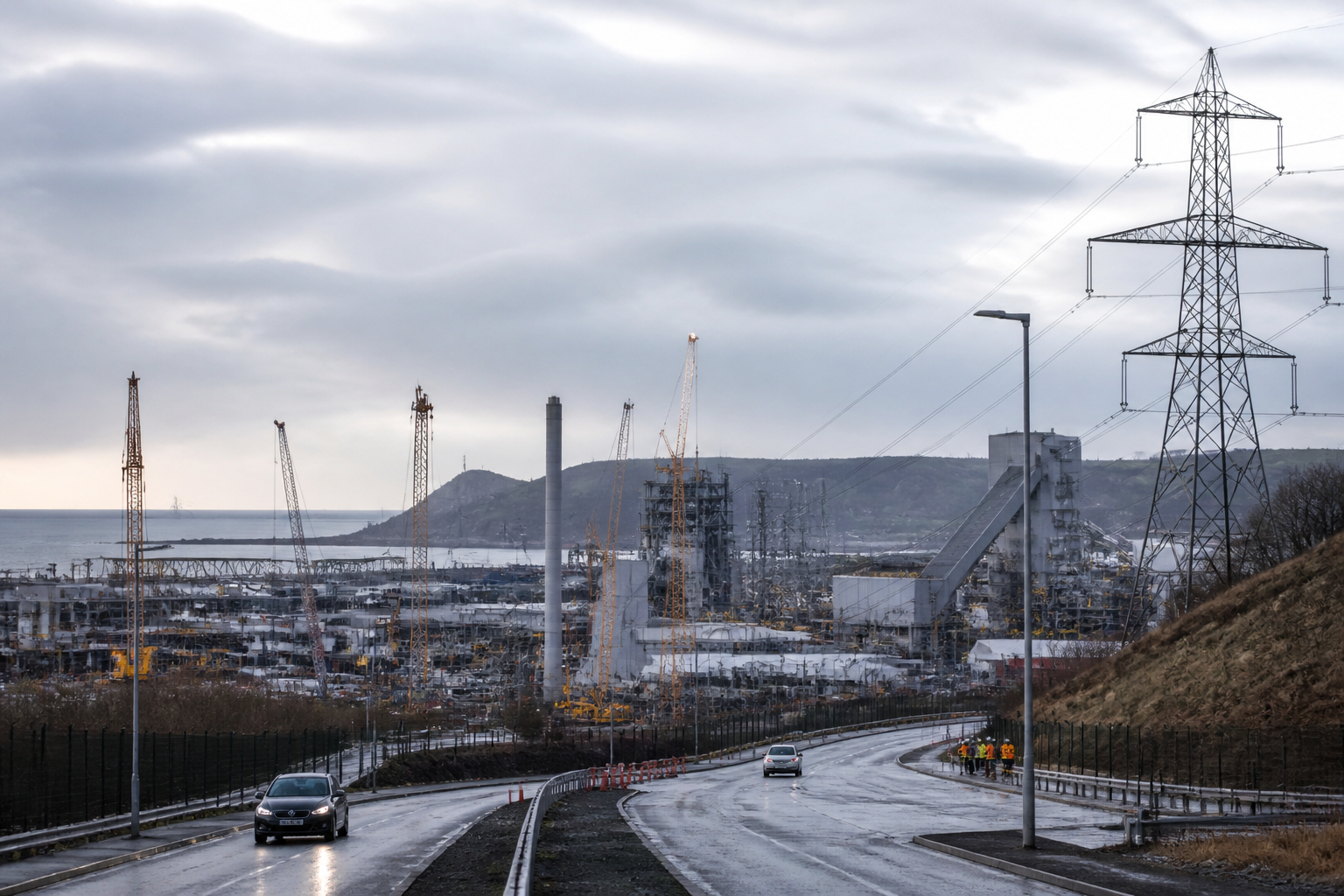
Tata Steel’s request for additional UK government funding for its delayed Port Talbot electric arc furnace (EAF) project is more than a dispute over a construction timetable. It exposes the difficult institutional bargain behind industrial decarbonisation: governments want to preserve strategic manufacturing and employment while companies need public support to manage the cost of replacing established production systems with lower-emission technology.
According to a Sky News report cited by the Economic Times, Tata Steel approached the UK Department for Business, Innovation, Science and Technology in recent weeks to discuss a fresh multimillion-pound support package. The precise amount has not been disclosed, although industry sources cited in the report said the request could run into hundreds of millions of pounds. Business Secretary Jonathan Reynolds has been briefed on the approach, the report said.
The request follows a £500 million UK government grant awarded to Tata Steel in 2023 as part of a £1.25 billion investment to build an EAF at Port Talbot, one of Britain’s largest steelmaking sites. The project was originally expected to become operational by early 2028, within three years of construction beginning. Delays in securing the site’s grid connection have now pushed the expected commissioning date to late 2028 or early 2029.
That shift matters because the project is not simply a new piece of equipment being added to an operating plant. Port Talbot’s final blast furnace was shut down in 2024, ending traditional blast-furnace steelmaking at the site. The replacement EAF is therefore central to the plant’s future production model. The interval between the closure of the old system and the availability of the new one creates financial exposure for the company and uncertainty for workers and the surrounding industrial economy.
The company is understood to have calculated that the delay, rising project costs and sales foregone while the furnace remains unavailable could significantly increase the overall cost of the transformation. The funding request consequently highlights a less visible component of infrastructure delivery: the cost of waiting for enabling systems. In this case, electricity access is not a supporting detail. It is a condition for commissioning the new industrial facility.
For major industrial projects, the construction schedule is shaped by more than the main structure, machinery or contractor performance. A functioning grid connection, approvals, procurement, financing and the transition between old and new assets must align. A delay in one of these systems can affect the financial viability of the entire project. The Port Talbot case shows how decarbonisation projects can become exposed when industrial investment depends on infrastructure that is outside the direct control of the company making the investment.
The project was presented as a way to preserve large-scale steel production in Britain while moving towards lower-emission manufacturing. When the public-private funding package was confirmed in 2023, Tata Steel chief executive T V Narendran said government support could help transform Port Talbot into a leading European centre for green steelmaking. He also said the company would work with the Transition Board and the UK and Welsh governments to support economic regeneration and job creation in South Wales.
The employment consequences have already become visible. The project was designed to preserve steelmaking in Britain and around 5,000 jobs across the UK, but about 2,500 positions have already been lost during the transition. That contrast is important. Public funding is being asked to support a lower-emission industrial future, but the transition itself has reduced employment before the replacement production system is fully operational.
This creates a difficult policy test. The government is not funding an isolated private expansion. It is supporting the continuity of a strategic industrial site whose closure or contraction could affect skilled employment, supply chains and the economic role of South Wales. At the same time, further public support would renew questions about how much financial risk should be carried by the state when a privately owned company faces delays, higher costs and weaker market conditions.
Those market conditions are also part of the Port Talbot problem. Tata Steel has repeatedly warned about the viability of its UK operations and has faced competition from cheaper imported steel. A senior executive warned late last year that Britain had become an unfairly priced dumping ground for cheap imports, according to the report. Union leaders have separately raised concerns about competitive pressure, including larger-than-expected quotas for Indian steel imports under the UK-India free trade agreement signed earlier this year. Imports from Vietnam and South Korea have also added to pricing pressure on galvanised steel produced by Tata Steel.
The result is a convergence of pressures rather than a single project failure. The EAF is delayed because of grid access problems, while the project’s financial position is affected by rising costs and lost sales. The company is also operating in a market where imported steel is putting pressure on prices. Each issue belongs to a different policy domain: electricity infrastructure, industrial finance, trade policy and employment protection. Their combined effect is being felt at one industrial site.
The wider British steel sector shows why the government’s decision will be closely watched. British Steel, described in the report as the country’s second-largest steelmaker, was nationalised during the summer after its previous Chinese owner, Jingye Group, threatened to close its blast furnaces at Scunthorpe. The government has faced criticism from MPs over the absence of what they described as a credible long-term financial plan for the company. British Steel is costing taxpayers around £1.3 million a day to keep afloat, according to the report.
The government is also working towards the possible public acquisition of Speciality Steel UK, just over a year after the country’s third-largest producer entered insolvency proceedings. Against that background, any additional support for Tata Steel would not be assessed only as a site-level intervention. It would form part of a broader argument about whether Britain should continue to support domestic steelmaking directly, and how industrial policy should divide responsibility between the public sector and private owners.
Port Talbot also demonstrates the administrative complexity of green industrial policy. The project involves Tata Steel, the UK government, the Welsh government, the Transition Board, electricity network infrastructure and workers represented by unions. The public grant has already established a partnership model in which the state helps finance the transition while the company executes it. A request for more support tests whether that arrangement can absorb delays without shifting too much of the risk to taxpayers.
The grid connection issue is particularly significant because it links climate policy to electricity planning. Replacing a blast furnace with an electric arc furnace changes the plant’s relationship with the power system. The new technology depends on reliable electricity access at the required scale and on a connection delivered in time for the production schedule. The report does not establish the precise cause of the grid delay, the technical capacity required or which institution is responsible for the slippage. It does establish that electricity access has become a critical milestone for the project.
The numbers show the scale of the transition. The government grant amounted to £500 million, within a wider £1.25 billion investment. The commissioning target has moved from early 2028 to late 2028 or early 2029. About 2,500 positions have already been lost, even as the project was intended to preserve around 5,000 jobs across the UK. The new funding request may reach hundreds of millions of pounds, although its precise value remains unclear.
Together, these figures underline the gap between announcing a transition and completing one. A public funding package can establish a project, but it cannot by itself guarantee that the necessary infrastructure, market conditions and operating economics will arrive on the same timetable. The Port Talbot experience also shows why job numbers attached to industrial investments need to be read alongside the employment costs of restructuring.
The central question is therefore not simply whether Tata Steel receives more money. It is whether Britain’s industrial transition can coordinate capital, electricity, trade protection, employment and public accountability closely enough to keep strategic production viable. The answer will depend on decisions that extend beyond the furnace itself, including the government’s approach to steel-sector support and the implementation of the project’s delayed grid connection.
For now, the supplied report leaves several details unresolved: the amount of additional funding sought, the final cost of the EAF project and the precise timetable for electricity access. What is established is that Port Talbot’s transition has become more expensive and slower than originally planned, while the site remains central to Britain’s effort to retain domestic steelmaking and reduce emissions. The next important developments will be the government’s response to Tata Steel’s request and the progress of the grid connection towards the late-2028 or early-2029 commissioning window.
