


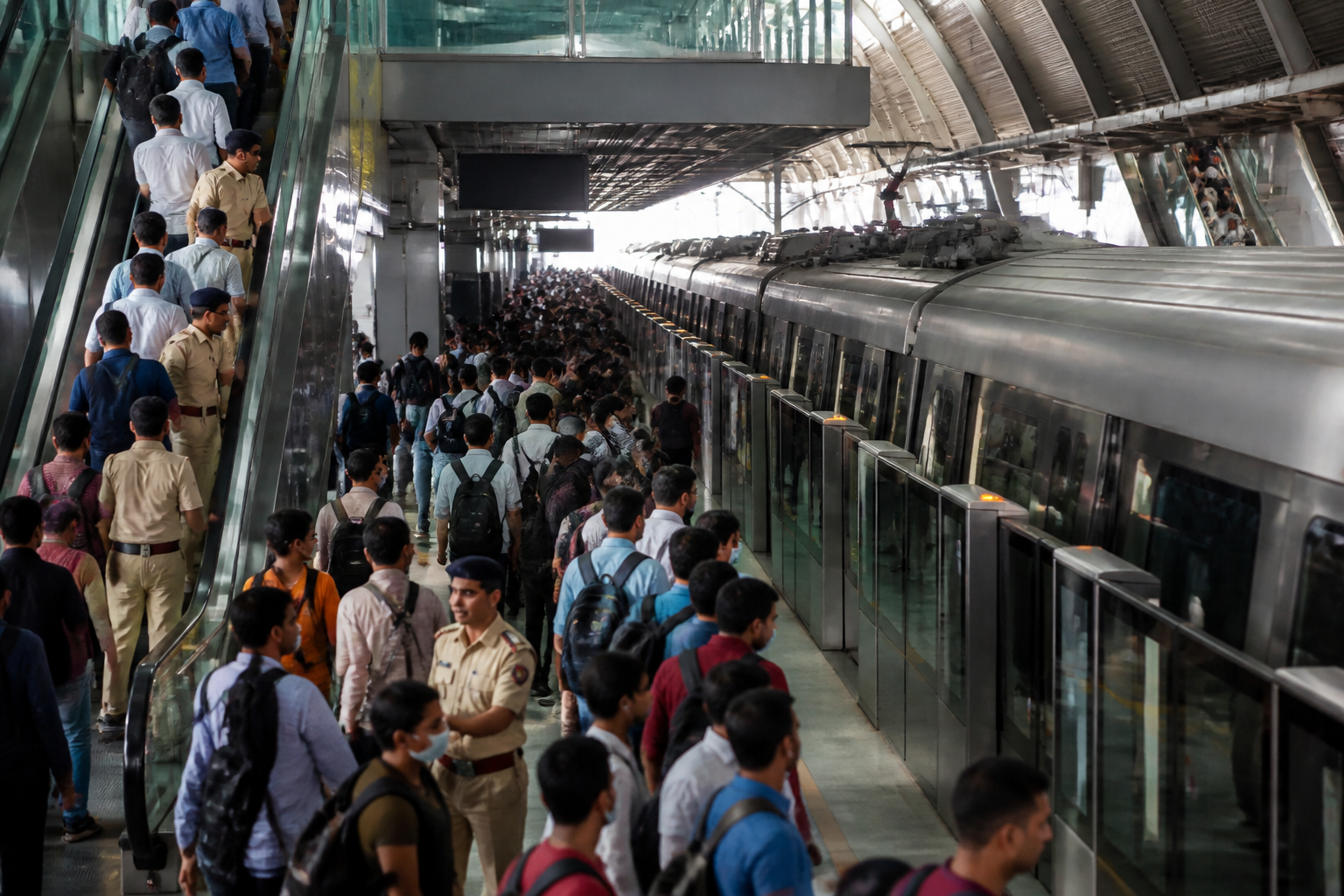
The Delhi Metro’s record 82,44,903 passenger boardings on September 17 were not simply a milestone for the rail network. They were also a measure of how quickly the National Capital Region’s commuters turn to high-capacity public transport when a major surface transport service is disrupted. The record was set as the ongoing strike by contractual Delhi Transport Corporation drivers entered its fourth day, placing unusual pressure on the Metro to absorb passengers who would ordinarily use buses.
According to figures released by the Delhi Metro Rail Corporation, the September 17 total exceeded the previous single-day record of 81,88,115 boardings recorded on August 8, 2025, by 56,788. It was also higher than the 81,01,159 boardings recorded on August 27 this year. The numbers show that the latest peak was not an isolated rise above a normal day, but part of a period of unusually high demand.
The increase was particularly sharp over a 24-hour period. The Metro recorded 80,71,630 passenger boardings on September 16. The following day’s total was therefore more than 1.7 lakh higher. The timing coincided with the continuation of the DTC contractual drivers’ strike, which was linked to demands including higher wages and medical and social security benefits.
The figures offer a clear view of the Metro’s role in Delhi’s transport system. It is not merely one option among several for commuters. When bus services are constrained, the rail network becomes the principal alternative for a large number of journeys, particularly across corridors where road congestion, distance and the absence of reliable substitutes make private vehicles or informal options less practical.
That dependence also explains why a ridership record can be both a success for the Metro and a warning about the wider transport system. The Metro was able to carry more passengers, but the surge was produced by a disruption elsewhere. A high passenger count therefore does not, by itself, indicate that the system has become more comfortable or more resilient. It indicates that the network is essential enough to receive displaced demand at very short notice.
The response described by the DMRC shows how the organisation managed that additional pressure. On September 16, the corporation increased train trips by 20 across its network and operated eight additional trains according to operational requirements. The enhanced arrangement continued on September 17, with eight extra trains deployed between 8 am and 8 pm, particularly during peak hours.
This operational adjustment is significant because the Metro’s ability to absorb additional passengers depends on more than its total route length. Train frequency, rolling stock availability, station management, security deployment and passenger circulation all affect how much demand can be handled safely. The DMRC’s decision to add services within a day indicates that the network retains some short-term operating flexibility, at least under the conditions described in the report.
However, the record also exposes the limits of looking at transport capacity through a single system. The Metro’s total passenger boardings are counted across its network, which extends across Delhi and adjoining parts of the National Capital Region. The DMRC operates around 416 km of lines and 303 stations, including the Noida-Greater Noida corridor and Gurugram’s Rapid Metro. Its scale allows it to serve journeys that cross municipal and state boundaries, but the strike-related surge also demonstrates that regional mobility remains interconnected even when services are managed by different institutions.
The commuters affected by the disruption do not experience the transport system as separate administrative entities. A DTC bus route, a Metro station, a feeder journey and the road network may all form part of one daily trip. When one component fails or becomes unavailable, the pressure moves to another. In this case, the pressure was visible in Metro boardings, but the source of the disruption lay in the employment and service conditions of contractual bus drivers.
That institutional separation is important. The DMRC is a joint venture between the Centre and the Delhi government, established in 1995. DTC services and their contracted workforce fall within a different administrative and operational framework. The report does not establish how many bus services were cancelled or how many commuters shifted to the Metro, so the precise share of the record attributable to the strike cannot be calculated from the available figures. It does, however, establish a strong temporal connection between the strike and the additional demand, as well as the DMRC’s decision to introduce extra services.
The episode also shows why public transport planning cannot be based only on average ridership. Average demand may guide routine scheduling, but a city needs spare capacity and operating procedures for disruptions. Strikes, breakdowns, extreme weather, road closures and other interruptions can rapidly change travel patterns. The Metro’s additional trains provided one response to that change, while the presence of CISF personnel and passenger facilitation measures addressed the associated station and security pressures.
Santosh Chalke, IPS, DIG, CISF Unit DMRC, described the record as the result of coordinated efforts by security personnel and Metro authorities. “Handling 82,44,903 passenger boardings in a single day is not just a milestone number; it is a true reflection of the joint commitment of the CISF and the DMRC in providing seamless security and passenger facilitation across the National Capital Region,” he said.
The statement places security and passenger facilitation alongside train operations. That combination matters during demand spikes because a transport network can add services without fully resolving crowding at entrances, platforms, interchange points and exits. The report does not provide station-level counts or information on crowding incidents, so it cannot establish how evenly the additional demand was distributed. A network-wide record may conceal very different experiences at individual stations and corridors.
The numbers nevertheless provide a short sequence of demand growth. On August 8, 2025, the Metro recorded 81,88,115 boardings. On August 27 this year, it recorded 81,01,159. The September 16 total was 80,71,630, before rising to 82,44,903 on September 17. These figures show that the network was already operating at a very high level of use before the new record was established.
They also underline the difference between passenger boardings and unique passengers. A boarding is recorded when a passenger uses the system, and one journey may involve more than one boarding if it includes transfers. The supplied report uses the DMRC’s passenger-boarding measure; it does not provide a count of unique individuals or an estimate of journeys shifted from buses. The record should therefore be read as a measure of network usage rather than a direct count of people who changed modes.
The larger urban question is whether Delhi’s transport system can provide reliable alternatives when one mode is disrupted. The latest event suggests that the Metro can respond quickly through additional services, but it also shows that the city’s resilience depends on coordination between rail, bus operations, security agencies and the institutions responsible for workforce conditions. A disruption in one part of the system can become a capacity challenge in another within a single day.
The DMRC’s structure and regional reach give it a central role in that system. Beyond operating its own network, the organisation also undertakes Metro operations and maintenance in cities including Mumbai, Chennai and Patna. The Delhi episode therefore offers a concrete example of how a large urban rail operator becomes a fallback for a wider metropolitan transport network, even when the immediate cause of increased demand lies outside the rail system.
What the evidence confirms is limited but important: Delhi Metro ridership reached a new single-day high during the fourth day of the DTC contractual drivers’ strike; the DMRC recorded 82,44,903 boardings; demand had risen sharply from the previous day; and the corporation deployed additional services between September 16 and 17. What remains unestablished in the supplied material is the exact number of disrupted bus trips, the proportion of Metro users who shifted from buses and the station-level distribution of pressure. The next developments to monitor are the continuation of the strike, the restoration of normal bus services and whether Metro demand falls after the disruption ends.
