


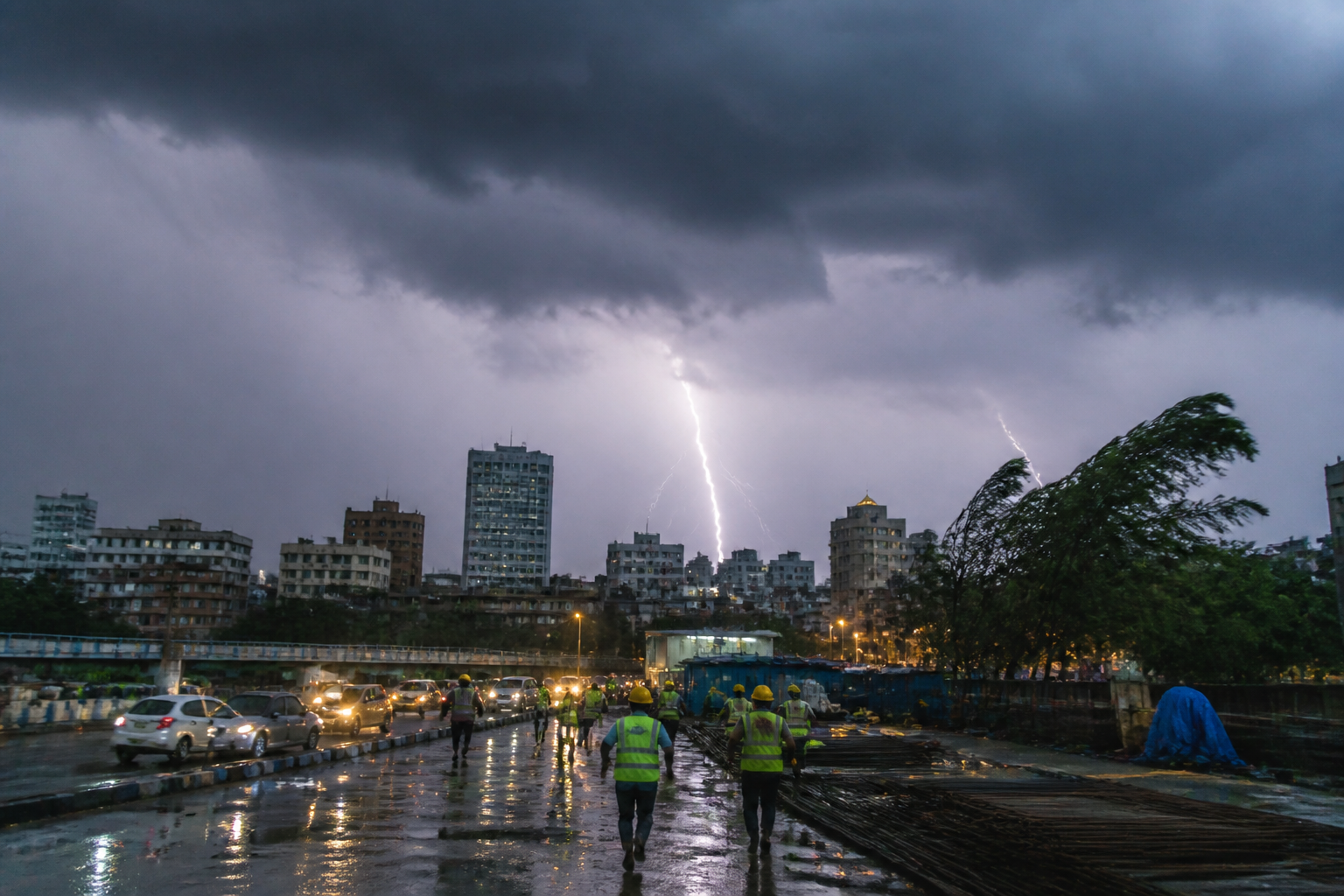
Kolkata’s position near one of India’s most intense lightning belts is not simply a weather statistic. It places a large metropolitan population, surrounding settlements and exposed workers at the intersection of a storm-friendly atmosphere and uneven protection from fast-moving thunderstorms. Studies cited in a Times of India report identify the south Bengal–north Odisha belt as the country’s largest lightning hotspot, while newer mapping shows eastern and central India accounting for nearly 88% of India’s lightning mortality.
The evidence points to a risk that is both geographic and urban. Kolkata is close to the centre of the identified hotspot, and a four-decade study of atmospheric conditions across Bengal found the coastal belt particularly favourable for severe thunderstorms. The city recorded 61 disastrous thunderstorms between 1980 and 2020, the highest among locations examined in this zone. IITM-Pune scientist Partha Sarathi Mukherjee described Kolkata and its suburbs as increasingly lightning-prone.
That finding changes the way the hazard needs to be understood. Lightning is often treated as an isolated natural event: a sudden flash, a short burst of thunder and a risk that appears difficult to plan for. But the pattern described in the available evidence is more persistent. The geography repeatedly creates the atmospheric conditions for severe storms, while the scale and form of human activity determine who is most exposed when those storms develop.
Bengal’s vulnerability begins with the relationship between land and sea. During the hot months, the land heats rapidly while the Bay of Bengal supplies abundant moisture. Warm, humid air rises sharply, forming tall cumulonimbus clouds. Within these clouds, powerful updrafts and downdrafts drive collisions among water droplets, ice crystals and graupel, or soft hail. Those collisions separate electrical charges. When the difference becomes too large for the surrounding air to contain, the charge is released as lightning.
The 2025 study cited in the report found high convective available potential energy, abundant moisture and relatively weak atmospheric inhibition over southern Bengal. In practical terms, the atmosphere has substantial energy to push air upwards and relatively little resistance to prevent that movement. These are not conditions created by a single storm. They describe a recurring atmospheric setup that helps explain why the region appears repeatedly in lightning and thunderstorm records.
The seasonal pattern reinforces the risk. A 2026 Kolkata study based on India Meteorological Department observations from 2015 to 2024 recorded a sharp increase in lightning days from 17 in March to 70 in May. The rise during the pre-monsoon period shows that the danger is concentrated within a predictable part of the year, even though the exact timing and location of an individual strike cannot be reduced to a simple calendar rule.
This distinction matters because lightning frequency alone does not determine fatalities. The report’s data shows that the human cost is shaped by exposure. Farmers, fishermen, construction workers and other people working in open spaces face particular danger because their activities continue outdoors, often with limited access to substantial shelter. A storm may last only a short time, but workers and commuters can be caught between the first warning signs and the arrival of a safe refuge.
The state-level death figures show the scale of the problem. Bengal recorded 304 lightning deaths in 2018, 265 in 2019, 295 in 2020, 260 in 2021 and 229 in 2022. A further 106 people had died by July 31, 2023, taking the reported toll since 2018 to 1,459 at that point. Separate datasets indicate 143 lightning deaths in Bengal in 2023, while the IMD’s disastrous-weather records recorded 60 deaths and 315 injuries linked to lightning and thunderstorms in 2024. State authorities reported 139 lightning deaths in 2025.
These figures should not be added together without qualification. The report notes that the datasets use different reporting systems and are therefore not strictly comparable. That limitation is important for public administration. A death count is not only a measure of the hazard; it is also a product of how incidents are recorded, classified and reported by different agencies. Variations between datasets can obscure trends unless authorities maintain a consistent system for identifying lightning deaths and injuries.
The urban dimension adds another layer. Kolkata’s built environment may influence the conditions under which storms develop, although the evidence does not establish a simple cause-and-effect relationship. Concrete and asphalt retain heat, contributing to the city’s urban heat island. Aerosols from pollution can influence cloud formation, but scientists cited in the report caution that the relationship between pollution and lightning is complex.
That caution is central to interpreting the city’s risk. It would be inaccurate to treat Kolkata’s urbanisation or pollution as a single explanation for increasing lightning activity. The stronger evidence is that the city is located within a naturally vulnerable regional geography, while urban heat and atmospheric pollutants may interact with storm formation in ways that require further study. The report therefore supports a layered understanding rather than a single urban culprit.
The most significant institutional issue is the gap between meteorological knowledge and everyday protection. Scientists have identified the regional belt, the atmospheric ingredients and the months when lightning days rise sharply. Yet the people most at risk are often those whose work cannot be moved indoors: agricultural labourers, fishermen, construction workers and others in open areas. This makes lightning safety partly a question of warning systems and partly a question of how quickly warnings can change behaviour at worksites, farms, waterfronts and roads.
Kolkata’s metropolitan character also complicates the boundary between city and region. The most dangerous atmospheric system does not stop at the municipal edge. It covers south Bengal and adjoining north Odisha, while the people exposed to it move across administrative boundaries for work, transport and trade. A response organised only around Kolkata’s municipal limits would not reflect the geography described by the studies. The hotspot is regional, even when the public conversation focuses on the city.
The data also suggests that urban resilience cannot be measured only through large infrastructure. Roads, buildings and drainage systems are visible parts of storm preparedness, but lightning protection depends heavily on information, access and the safety of outdoor activity. The report does not provide evidence on the reach or effectiveness of local warning systems, shelter availability or workplace safety protocols. Those remain important gaps in assessing how well the region is translating scientific knowledge into protection.
What is established is the convergence of several facts: Kolkata lies near a major lightning hotspot; southern Bengal has atmospheric conditions favourable to severe thunderstorms; lightning days rise steeply during the pre-monsoon months; and the state has recorded a substantial number of deaths over several years. What is less certain from the available material is the precise contribution of urban heat, pollution and changing exposure patterns to the reported increase in risk.
That distinction should guide how the issue is monitored. The central challenge is not merely predicting more lightning. It is connecting regional weather science with consistent mortality data and with the people who face the greatest exposure. Kolkata’s lightning risk is therefore an urban governance issue as much as a meteorological one: the hazard forms in the atmosphere, but its consequences are determined on the ground. Further attention will need to focus on the seasonal pre-monsoon rise, the quality of local reporting and the protection available to workers and residents caught outdoors during severe thunderstorms.
