


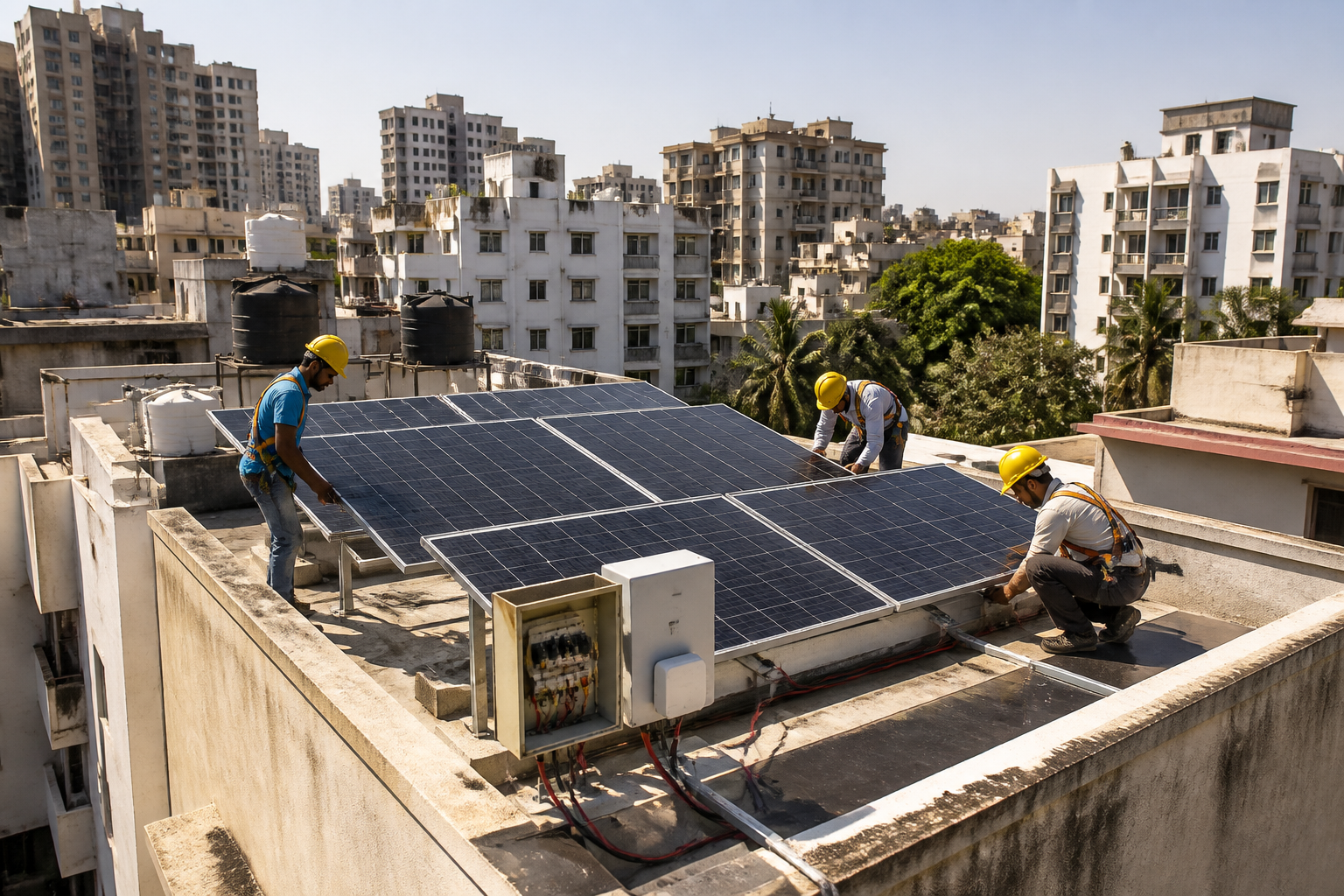
Borosil Renewables’ decision to pilot branded rooftop solar solutions marks a significant shift in India’s distributed energy market: a solar-glass manufacturer is moving downstream to sell, install and service complete systems for households. The company expects the pilot business to generate ₹100 crore in its first year, but the larger significance lies in whether rooftop solar can move from a government-supported installation drive to a dependable consumer service.
The company’s plan includes solar panels, inverters and lithium-ion batteries. While Borosil Renewables currently makes the solar glass used in panels, it is sourcing the inverters and batteries for the new offering. It will also handle installation and after-sales service, placing the company in direct contact with consumers rather than limiting its role to an industrial component in the solar supply chain.
According to Pradeep Kumar Kheruka, Chairman of Borosil Renewables, demand for solar rooftops is increasing because of the National Solar Mission and the PM Surya Ghar Muft Bijli Yojana, launched in February 2024. The company has described the scheme-led residential demand as a major opportunity for its entry into a direct consumer-facing industry.
The government aims to solarise 10 million households by March next year through rooftop solar, according to the information reported by The Hindu BusinessLine. That target changes the nature of the market opportunity. Rooftop solar is no longer only a question of whether panels can be manufactured or whether a household has sufficient roof space. It also depends on whether companies can offer financing, equipment integration, installation quality, maintenance and clear service responsibility at a scale that ordinary households can manage.
Borosil Renewables’ proposed model addresses several of those requirements in a single package. Instead of selling one component, the company intends to provide a complete system and remain involved after installation. That approach could make rooftop solar easier for consumers to purchase, particularly when a household does not want to coordinate separately with a panel supplier, an inverter provider and an installer. However, the material supplied for this report does not establish how the offering will be priced, which cities or consumer segments will be covered, or how the company will manage the operational demands of a large residential service network.
The scale of the opportunity is substantial. Data from the Council on Energy, Environment and Water and the government indicates that India has the potential to generate 796 GW of solar power. Residential rooftops account for the majority of that potential, at 637 GW, including 363 GW in rural areas and 274 GW in urban areas. The urban figure underlines the importance of rooftops as an energy asset in cities, where land is constrained and electricity demand is concentrated across homes, apartment buildings and other built-up areas.
Yet potential is not the same as installed capacity. The figures cited in the report describe the amount of solar power that could potentially be generated from rooftops, not the capacity already connected to the grid. The gap between those two conditions is where the implementation challenge sits. Converting a technical rooftop estimate into working systems requires suitable roofs, structural and electrical compatibility, consumer willingness, installation access, grid connections and continuing maintenance.
Urban housing adds another layer of complexity. A detached house may have a single owner who can decide to install panels, while an apartment building may involve multiple residents, shared roofs, common-area electricity consumption and collective decision-making. The supplied report does not detail how Borosil Renewables will address these different ownership and usage patterns. Its consumer-facing model, therefore, will have to operate across a housing market in which the person paying for a system may not always control the roof or the building’s common infrastructure.
The inclusion of batteries is also important to the proposed product structure. Borosil Renewables plans to offer lithium-ion batteries, but currently sources them rather than manufacturing them. This means the company’s complete rooftop solution will depend partly on external suppliers for key equipment. The same applies to inverters. The solar panel may be linked to the company’s existing manufacturing strength, but system performance for consumers will rely on the interaction between panels, inverters, batteries, installation and after-sales support.
That integration is central to the difference between selling equipment and selling an energy service. A household does not experience solar glass, panels, inverters and batteries as separate industrial categories. It experiences whether the system produces electricity, whether the equipment works together, whether faults are resolved and whether the installation delivers the expected value. Borosil Renewables’ decision to include installation and after-sales service indicates that the company recognises this shift, although the report does not provide details of its service standards or warranty structure.
The company is simultaneously expanding its solar-glass manufacturing capacity. Borosil Renewables currently produces 1,000 tonnes per day of solar glass and is increasing this to 1,600 tonnes per day after adding two 300-tonne-per-day furnaces. The additional capacity is expected to be commissioned between December and March, with the full benefits visible in 2027-28.
Kheruka said the increase in capacity could raise revenue by about 60 per cent once the additional capacity is fully utilised. He also said earnings before interest, depreciation, taxes and amortisation, or EBITDA, would increase substantially from the current level of 32 per cent after the two furnaces become operational. These projections relate to the company’s broader manufacturing expansion, while the rooftop pilot represents a separate downstream opportunity expected to contribute ₹100 crore in its first year.
The manufacturing numbers reveal the two sides of the company’s strategy. The first is scale: increasing domestic production of a material used in solar panels. The second is market access: reaching the household that ultimately installs the system. The combination could allow Borosil Renewables to participate in more stages of the value chain, from solar glass to a packaged rooftop installation. But it also exposes the company to a different set of capabilities, including consumer acquisition, site assessment, installation management and service delivery.
The move is taking place against a major import gap in solar glass. India imports about 8,500 tonnes of solar glass every day, while local production is reported at 1,700 tonnes. The difference indicates strong demand for domestic production, but it also shows that the country’s solar manufacturing ecosystem remains dependent on imports for a large share of this input. Borosil Renewables’ furnace expansion is intended to respond to that gap, while its rooftop pilot seeks to capture value closer to the point of use.
The policy landscape is therefore working through both demand and supply. On the demand side, the PM Surya Ghar Muft Bijli Yojana is cited as a driver of residential rooftop demand, with the government targeting 10 million solarised households by March next year. On the supply side, domestic solar-glass manufacturing is expanding because imports remain much larger than local production. The company’s strategy sits at the intersection of these two policy and industry developments.
For cities, the most important question is not simply how many rooftops can carry panels. It is how residential buildings can participate in a distributed energy system. The 274 GW urban rooftop potential cited in the report gives cities a significant role in India’s solar transition, but urban buildings vary sharply in ownership, design and access. The report establishes the size of the opportunity, but not the institutional arrangements that will determine how much of it can be realised.
Borosil Renewables’ pilot will offer an early indication of whether the rooftop market can support a branded, end-to-end model. Its first-year revenue target provides a commercial measure of the pilot, while the planned manufacturing expansion provides a parallel measure of industrial scale. The information available does not yet show the pilot’s geographic footprint, installation targets, pricing, customer acquisition strategy or performance results.
What is established is that the company is moving beyond solar-glass manufacturing at a time when government policy is pushing rooftop solar towards millions of households. The evidence also confirms a large gap between India’s domestic solar-glass production and imports, alongside substantial estimated rooftop potential in urban and rural areas. The developments to monitor are the commissioning of the two furnaces, the rollout and performance of the rooftop pilot, and the company’s ability to provide installation and after-sales service at household scale.
