


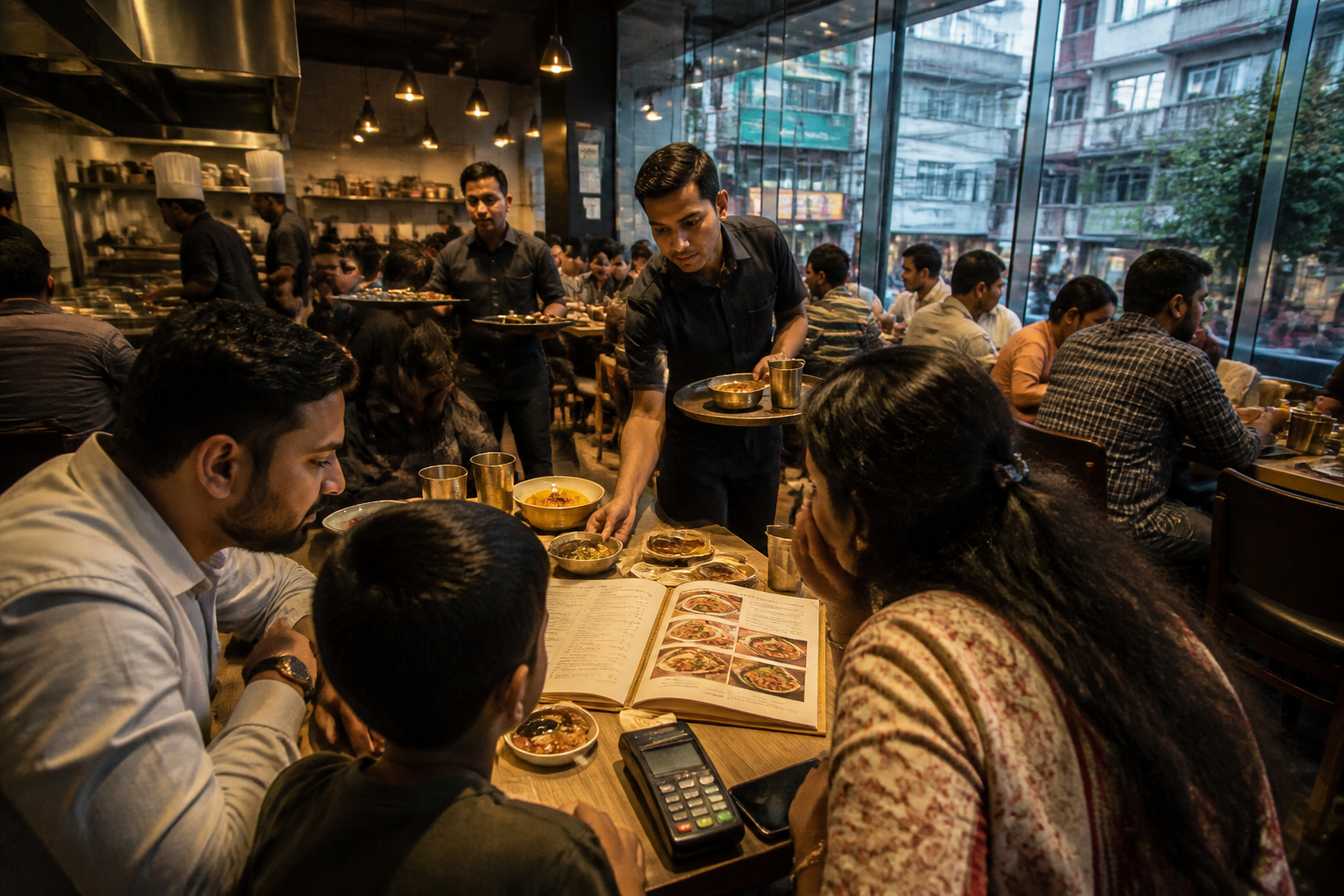
Restaurants and cafes are choosing to hold restaurant menu prices through the October-December festive quarter even as food inflation, operating costs and a proposed charge on some UPI transactions put further pressure on already thin margins. The decision offers a window into a larger urban economic trade-off: food-service businesses are trying to protect customer footfall by absorbing part of the cost of operating in India’s cities.
The Economic Times reported that cafes, restaurants, pubs and bars are unlikely to raise prices further during the industry’s busiest quarter. The report linked the decision to several pressures, including an announced 0.4% merchant discount rate, or MDR, on UPI-driven transactions above Rs 2,000 from the following month, higher ingredient costs, manpower expenses, rentals and commercial liquefied petroleum gas costs.
This is not simply a pricing decision. For organised food-service businesses, the menu is the point at which multiple urban costs meet the consumer. Restaurants pay for real estate, staff, ingredients, energy, logistics and digital payments, but they can recover those costs only if customers continue to visit and spend. Raising prices may protect the margin on each order while weakening demand; holding prices may preserve demand while reducing the amount retained by the business.
That tension is becoming more visible because eating out has developed into a significant part of urban consumption. Chirag Chhajer, co-founder of Burma Burma, told the newspaper that consumption was strong and that people were going out frequently. He said the chain expected its best-ever October-December quarter in revenue terms and would not raise prices because of the MDR levy.
The statement captures the immediate calculation businesses are making. The festive quarter is expected to bring stronger demand, but that demand cannot be treated as unlimited. Customers may continue to eat out while becoming more selective about where and how they spend. A price increase at a time of rising household costs could make restaurants less attractive, particularly when customers can reduce the frequency of visits or choose lower-priced alternatives.
The available figures point to a sector facing cost pressure alongside demand resilience. Food and beverage services recorded inflation of 8.4% year-on-year in August, up from 7.8% in July and 2.9% in January, according to the report. The increase was linked in part to the impact of the West Asia crisis on commercial liquefied petroleum gas. Food inflation also rose to 6% year-on-year in August from 5.5% in July, while overall retail inflation increased to 4.8% from 4.5%.
These figures matter because restaurants do not operate with one input cost. A rise in food prices affects ingredients, while higher fuel costs affect kitchens and supply chains. Labour and rent add relatively fixed commitments that cannot be reduced as quickly when demand changes. The result is a cost structure in which businesses may have limited room to absorb repeated increases without affecting profitability, staffing or expansion.
Roshan Banan, managing director of Sagar Ratna Restaurants, said the chain had raised prices by 5% after two years because of higher input costs, but would not consider another increase. His comments suggest that businesses are distinguishing between an occasional price revision and continuous pass-through of costs. A chain that has already adjusted its menu may now be attempting to give customers a period of stability, even as its cost base remains under pressure.
The proposed UPI MDR adds a different kind of pressure. It is not an ingredient or rental expense, but a transaction-linked charge that can affect the cost of collecting payment. The impact would depend on the share of eligible transactions and the business’s ability to absorb the charge. For restaurants operating on thin margins, even a small cost attached to a high-value payment can become significant when combined with other expenses.
Rahul Singh, founder of The Beer Cafe, said restaurants could not continue passing every cost increase to customers because consumers eventually push back. He expected the October-December quarter to remain healthy, while also acknowledging that inflation would make customers more discerning. His assessment presents the central contradiction in the sector: demand can remain strong without customers becoming insensitive to price.
The UPI data cited in the report supports the view that digital payments and consumption are expanding together. UPI transactions reached 21.8 billion in the first eight months of the year, compared with 17.8 billion in the same period last year, a rise of 22.2%. The growth does not by itself establish how much of the increase came from restaurants, but it indicates the scale of the digital payment system through which urban businesses increasingly collect revenue.
That matters for restaurants because payment infrastructure has become part of everyday commercial operations. A customer’s ability to pay digitally supports faster transactions and reduces dependence on cash handling, but any new charge attached to a payment method introduces a question about who ultimately bears the cost: the restaurant, the payment ecosystem or the consumer. The present response from restaurant operators is to avoid putting that cost directly on the menu.
The choice also exposes the difference between organised and less-organised businesses. Zorawar Kalra, managing director of Massive Restaurants, which operates brands including Farzi Cafe and Sly Granny, said the 8.4% food and beverage services inflation was significant and that the sector faced pressure across ingredients, manpower and rentals. At the same time, he described eating out as an increasingly experience-led discretionary spend and said resilience was visible particularly in organised and premium segments.
This distinction is important for understanding the urban food economy. A premium or organised chain may have stronger brand loyalty, more diversified locations or greater ability to manage procurement and operations. It may therefore be able to hold prices for longer than a small independent outlet. However, the supplied evidence does not establish how different categories of restaurants are performing financially or whether the decision to avoid a menu increase is equally feasible across the sector.
The institutional issue behind the pricing debate is the distribution of operating risk. Customers are being protected from an immediate price increase, but that does not remove the pressure faced by businesses. Restaurants can respond through tighter procurement, changes to portion sizes, staffing decisions, promotional offers or reductions in other expenses, but the report does not provide evidence on which of these responses individual chains are pursuing.
Nor does holding prices mean that the sector has solved its inflation problem. It means that businesses are prioritising customer flow during a period they expect to be commercially important. Saurabh Khanijo, managing director of the Kylin chain of restaurants, also ruled out price increases for the upcoming quarter, saying that higher prices could dent demand. This reinforces the idea that the menu is being used as a demand-management tool as much as a cost-recovery mechanism.
For cities, the issue extends beyond restaurant bills. Food-service businesses are part of the urban employment, commercial-property and consumption ecosystem. Their performance affects the viability of high-street premises, shopping districts and mixed-use neighbourhoods, while their costs are tied to energy, logistics and digital-payment systems. A decision taken by a restaurant chain can therefore reflect broader conditions in the urban economy, even when the immediate question is whether a meal becomes more expensive.
The evidence confirms that restaurant operators are confronting simultaneous inflation in food and beverage services, food inputs and other operating costs while expecting strong festive-quarter demand. It also shows why they are reluctant to pass every increase to consumers. What remains unclear is how long businesses can absorb these pressures, how the proposed UPI MDR will be implemented in practice and whether smaller establishments will face the same choices as organised and premium chains. The next quarter will show whether stable menus can coexist with rising costs without forcing changes elsewhere in the food-service business.
