


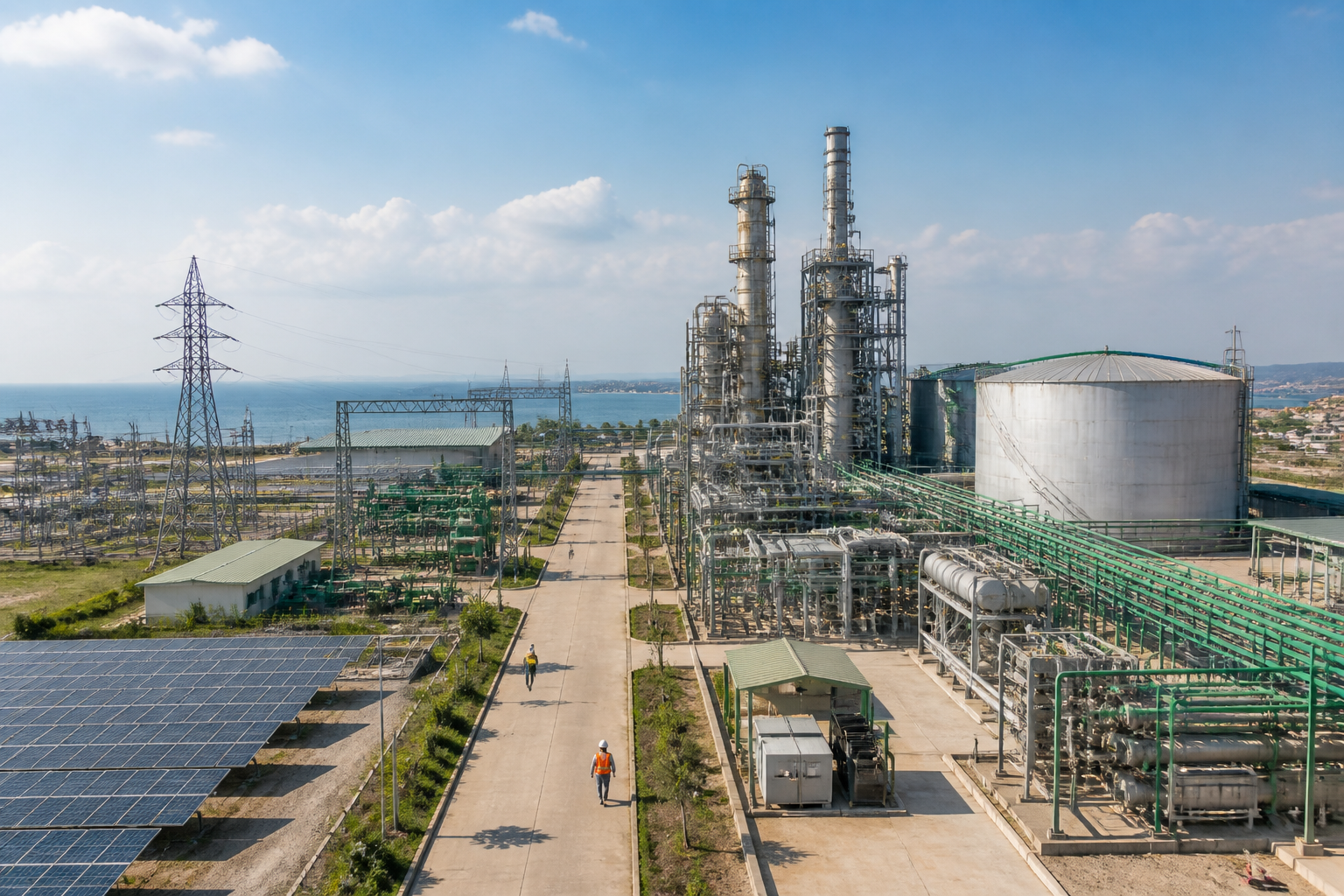
Brookfield’s proposed investment of up to $600 million in ACME Cleantech Ventures is more than a funding announcement for one renewable-energy developer. It is a test of whether India’s green-molecule industry can move from individual demonstration projects to a portfolio of commercially bankable plants serving domestic and overseas customers.
ACME Group Chairman Manoj Kumar Upadhyay told The Hindu BusinessLine that the structured-equity investment would support four projects: Oman Phase 2, two green-ammonia projects in Odisha and a green-methanol project in Odisha. The deal’s equity valuation is expected to be decided by the end of 2026, while ACME is expected to retain a significant majority in its projects and business entities.
The distinction between this arrangement and conventional project finance is central to understanding its significance. Project finance is generally tied to a specific asset, while ACME describes the Brookfield investment as a platform-level transaction. In practical terms, the capital is intended to support a portfolio of projects rather than a single plant. That structure could give the developer greater flexibility as different projects move through construction, offtake agreements, commissioning and operations.
It also addresses one of the main problems that has slowed green-hydrogen and green-ammonia development globally: projects have struggled to demonstrate bankability, secure long-term buyers and assemble the supporting infrastructure required for production and export. Upadhyay said these issues, along with project complexity, had delayed developments worldwide even as interest in hydrogen and green ammonia surged three or four years ago.
The financing therefore matters not only because of its size, but because it places institutional capital behind an operating model. ACME’s immediate challenge is to show that a company can combine renewable-energy resources, conversion technology, industrial facilities, logistics and customer contracts into a repeatable system.
## From a pilot facility to a project platform
ACME’s Bikaner facility was presented by Upadhyay as a proof-of-concept site. The plant demonstrated what the company described as the complete conversion chain from photons to electrons to molecules, while also helping establish the costs associated with the process. For customers, that demonstration was intended to show that the technical model was workable rather than merely theoretical.
The next stage is considerably more demanding. A pilot facility can establish technical feasibility, but a commercial portfolio must deliver reliable production at a price customers will accept. It must also coordinate land, renewable power, water, equipment, storage, transport, export arrangements and long-term offtake. The source material does not establish the full infrastructure design or cost structure of each project, but Upadhyay’s description of bankability and infrastructure gaps indicates that these issues remain decisive for the sector.
ACME’s plans span India and Oman, giving the company both a domestic industrial base and an export-oriented component. The Oman project is intended to supply green molecules to an overseas customer, while projects in Odisha are linked to domestic and international market opportunities. ACME also has a joint venture with Japan’s IHI, and Upadhyay said Indian developers are now addressing markets including Europe, Korea and Japan.
This geography reflects the way green molecules are being positioned in the company’s business model. The production site may be located where renewable-energy resources and project conditions are favourable, while consumption may take place in fertiliser, industrial or energy markets elsewhere. That makes the sector dependent on more than generation capacity. It requires a chain connecting production, conversion, storage, shipping, contracts and end users.
## The demand problem behind the investment
Green-ammonia projects cannot be scaled merely by adding production capacity. They need customers willing to sign contracts and, ultimately, pay for the product. Upadhyay said global projects had been delayed because of offtake problems, and that fertiliser companies that were previously hesitant to enter long-term green-ammonia contracts were now approaching the Solar Energy Corporation of India for more tenders.
That change, if sustained, would be important for the sector because offtake agreements can provide the demand visibility needed to support project development. ACME’s Paradeep green-ammonia project in Odisha has an offtake agreement with SECI and is targeted to become operational in 2028, according to Upadhyay.
The company’s argument is that green ammonia must eventually compete on its own economics rather than rely indefinitely on customers paying a green premium. The relative price relationship with conventional, or grey, ammonia has also changed, Upadhyay said. He attributed this to higher gas prices linked to the Middle East war, noting that gas is the main raw material for producing grey ammonia.
That claim is an important part of ACME’s commercial case, but it is also a reminder that competitiveness can be affected by external markets. A temporary or sustained change in gas prices may alter the comparison between grey and green ammonia, while the cost of renewable power, electrolyser technology, financing and logistics will influence the green product’s own economics. The supplied material does not provide a full cost comparison or establish whether the current price relationship will persist.
Upadhyay compared the desired trajectory for green ammonia with the development of solar power. In his account, solar moved from high tariffs to a point at which developers began thinking in gigawatts rather than megawatts. ACME wants green ammonia to undergo a similar transition, with scale, technology and the selection of locations with strong renewable-energy resources lowering costs.
The comparison captures the industry’s ambition, but the projects are not identical. Green ammonia combines renewable generation with hydrogen production and ammonia synthesis, and its commercial success also depends on industrial demand and the movement of molecules to customers. The platform structure may help ACME manage those interdependencies across multiple sites, but the investment does not by itself demonstrate that the model has reached cost competitiveness.
## Oman and Odisha provide the implementation test
The first major milestone is Oman Phase 1. Upadhyay said the project was almost 90 per cent ready, with commissioning expected to begin around November-December and operations targeted for March 2027. He said the project had been delayed by around two to three months because of the war. Oman Phase 1 is already fully funded, according to the interview.
The project’s importance lies in what it is expected to demonstrate: the first export of green molecules from Oman to an ACME customer. Until that happens, the company’s export proposition remains a planned operating model rather than a completed commercial chain. Commissioning, production and delivery will provide the first direct test of whether the project can connect a green-molecule plant to an overseas buyer.
The Odisha projects create a second implementation track. The Paradeep green-ammonia project and the green-methanol project are both targeted for 2028. The ACME-IHI joint-venture green-ammonia project is expected to become operational in 2029. These dates indicate a staged build-out rather than a single commissioning event.
The sequencing also shows why platform-level finance could be strategically useful. A portfolio allows the developer to pursue projects at different stages and in different markets, while the success or delay of one asset need not define the entire business. At the same time, a portfolio creates a broader execution burden. The company will need to maintain progress across Oman, Odisha and the joint venture while securing customers and managing different project conditions.
## Policy support is necessary but not sufficient
Upadhyay credited India’s National Green Hydrogen Mission with creating policy consistency and giving developers greater confidence when approaching global customers. He also pointed to SECI’s green-ammonia tenders as a source of domestic demand. These institutional mechanisms are significant because the industry requires both policy clarity and a route to market.
The government’s role, as described in the interview, is not limited to announcing a target or supporting technology. Tender design, offtake arrangements and the credibility of long-term demand can influence whether developers and financiers are prepared to commit capital. For companies such as ACME, the policy framework is linked directly to their ability to present solutions to customers in India and abroad.
However, the projects still depend on execution at the company level. Policy consistency cannot replace construction progress, commissioning, cost control or customer delivery. Nor can a financing agreement remove the need for supporting infrastructure. The challenges that delayed green-molecule projects globally—bankability, offtake, complexity and infrastructure—remain the tests that the new capital must help resolve.
The information currently available confirms the scale and intended deployment of the Brookfield investment, but not the final equity valuation, the complete financial structure of each project or the full cost and capacity details of the planned plants. Those details will be important for judging whether the transaction has produced a scalable operating platform or only financed a larger collection of individual projects.
The central question for India’s green-molecule industry is therefore not whether it can announce large projects. It is whether projects can move through the entire chain from renewable power and molecule production to contracted demand and reliable delivery. Oman Phase 1’s commissioning, the first export, the 2028 Odisha milestones and the 2029 joint-venture project will provide the clearest evidence of whether ACME’s platform strategy is working. Until then, Brookfield’s investment represents a substantial vote of confidence in the model, but the model will be judged by operating plants, competitive prices and customers receiving the product.
