


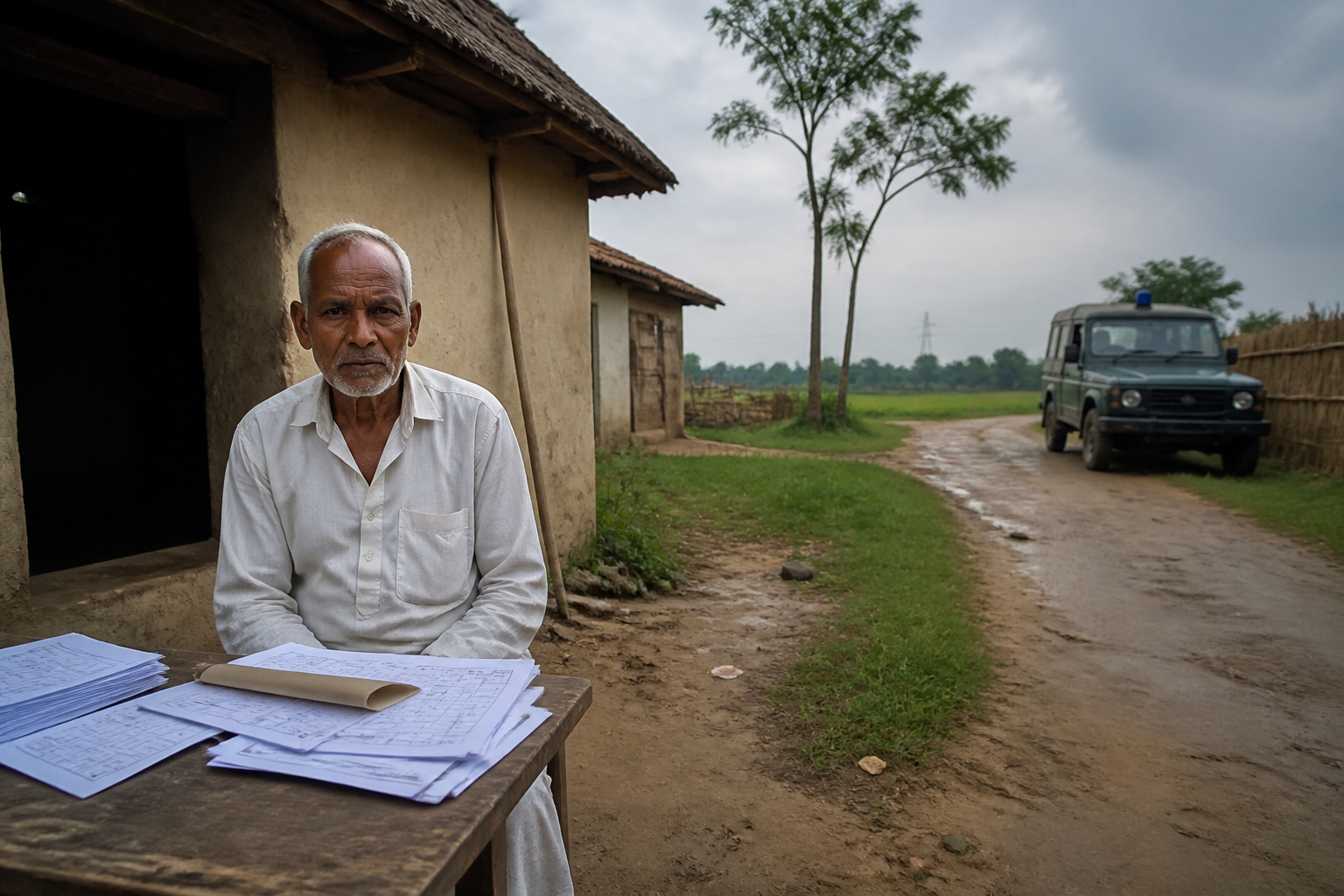
The 87-day detention of 70-year-old Jalil Akhtar in West Bengal is not only a story about one villager’s bail. It exposes how a citizenship dispute can move through the machinery of policing, detention, documentation and courts before the burden of proof reaches the person whose freedom is at stake. Akhtar was picked up from outside his home in Bagroi village in Uttar Dinajpur district on June 19 after police suspected that he was a Bangladeshi national. He was released on September 15 after a court noted that several government records relied upon by him had been verified as genuine, while the question of citizenship remained formally unresolved.
The account, reported by The Indian Express, shows the distance between possessing official documents and being able to rely on them when the state questions a person’s identity. Akhtar’s family said his name appeared in the 1995 voters’ list and in the 2002 and 2026 electoral rolls following the Special Intensive Revision exercise. His legal team also pointed to voter records dating back to 1982, as recorded in police case diaries. The investigating officer eventually confirmed that Akhtar’s voter ID, PAN card, 1995 electoral-list entry and 2002 records were authentic Indian documents.
Yet those records did not prevent his detention. The case therefore raises a structural question for India’s urban and rural governance systems: what happens when the administrative state has already issued multiple identity and electoral documents, but enforcement agencies treat citizenship as unsettled or suspect? The evidence in Akhtar’s case does not establish the broader frequency of such incidents. It does, however, show how administrative uncertainty can become a prolonged loss of liberty even when documentary evidence is available.
The chain of events began with a night-time police operation, according to Akhtar’s family. Police officers from Dalkhola station allegedly took him away while he was sleeping outside his house. His cousin, Motiur Rahman, told the newspaper that the family could not initially locate him and was later informed that he was allegedly from Bangladesh. The family said it received no clear explanation of the grounds on which he had been taken into custody.
The FIR reportedly claimed that Akhtar was an illegal immigrant from AndhaRahamatpur village in Bangladesh’s Thakurgaon district who had entered India through the Hili-Malda border around 24 years earlier. Akhtar rejected that account and consistently maintained that he was an Indian citizen. He told The Indian Express that he was held near the Bangladesh border for four or five days, spent more than a month in a detention centre and spent the remaining period in jail.
That movement between facilities is significant because detention becomes more than a single police action when the person is repeatedly transferred between a holding centre, a border location and a jail. Akhtar’s family said he was initially allowed a few meetings but was later denied access and could not keep a mobile phone. The supplied report does not establish the precise administrative orders governing each transfer or the reason for every change of location. It does show that the family struggled to obtain information while trying to assemble documents that were already part of the official record.
The legal dispute turned on two separate questions that are often collapsed in public debate: whether Akhtar could be detained on suspicion of being a foreign national, and whether his citizenship had been finally determined by the competent authority. The Islampur court’s bail order, as quoted in the report, did not conclusively settle the second question. Instead, the additional chief judicial magistrate found that continued detention would serve no useful purpose in the circumstances before the court.
The order referred to Akhtar’s age, the absence of criminal antecedents, the verified existence of government records, his appearance in consecutive electoral rolls, the lack of evidence that those documents were fabricated, the absence of a request for custodial interrogation and the absence of a reasonable apprehension that he would abscond or tamper with the investigation. The court also noted that repeated deportation attempts had not been completed and that Akhtar had consistently asserted his Indian citizenship.
The distinction matters institutionally. Bail is not the same as a final declaration of citizenship. At the same time, the court’s reasoning indicates that detention cannot automatically continue simply because the citizenship question has not yet been finally determined. The legal system must weigh the unresolved status against age, criminal history, documentary evidence, flight risk, investigation requirements and the actual purpose of custody.
Akhtar’s defence counsel also argued that, under the Indian Citizenship Act, people born before 1987 are not required to produce their parents’ birth records to establish citizenship. The report does not reproduce the full legal arguments or the complete statutory record, so the scope of that provision cannot be independently assessed from the supplied material. But the argument highlights a recurring administrative problem: documentation requirements can become difficult for older, landless or economically vulnerable residents whose lives have not generated the same paper trail as those of wealthier citizens.
A document is useful only when institutions accept, verify and act on it. In Akhtar’s case, the family had to produce voter records, identity documents and electoral-roll entries; lawyers and a fact-finding team had to press for verification; and the magistrate directed the investigating officer to report on the authenticity of the documents. The investigating officer ultimately confirmed that the records were genuine, according to the report. The central administrative question is why those checks were not resolved before 87 days of detention had elapsed.
This is also a question of access to justice. Akhtar was a daily-wage worker who depended partly on money sent by sons working as migrant labourers in other states. His economic position shaped the consequences of detention. Lost work, travel between institutions, legal costs and the effort required to retrieve records all fall more heavily on a household with limited income. The report does not quantify those losses, but Akhtar himself asked who would compensate him for the humiliation and harassment he said he experienced.
The case further demonstrates how electoral records can function as both proof and a source of scrutiny. Akhtar’s family relied on his presence in the 1995, 2002 and 2026 rolls, while the police case diaries reportedly recorded that he had voted as early as 1982. The family also said that his sons and daughters appeared on electoral records and that family members voted in 2026. These records do not, by themselves, resolve every question that a citizenship authority may examine. They do show that the state had repeatedly recorded Akhtar and his family within formal electoral processes.
The larger governance issue is coordination. Police, election authorities, detention facilities, courts and citizenship-related authorities may hold different records and operate under different mandates. When those systems do not reconcile their information quickly, the citizen is left to bridge the gap. In Akhtar’s case, the family, legal-aid lawyer, high court counsel and a civil-rights fact-finding team became the mechanism through which records were assembled and tested.
The evidence supplied does not establish whether the police action resulted from an error, a disputed investigation, a broader verification exercise or another administrative process. It also does not establish whether any official faced disciplinary or administrative consequences. Those uncertainties should not be filled with assumptions. What is clear is that the court found the continued detention unjustified at that stage, after the existence of several government records had been verified.
Akhtar’s release therefore closes only one part of the process. His bail order does not finally determine the citizenship question, and the report does not state what further proceedings or verification will follow. The case deserves attention because it places a precise institutional problem before the public: how should authorities respond when nationality is questioned, but the person has long-standing government records, no criminal antecedents and a strong claim to protection from unnecessary detention? The answer will depend on the competent authority’s next steps, the handling of the pending citizenship question and whether the agencies involved explain why the verification process took 87 days.
