


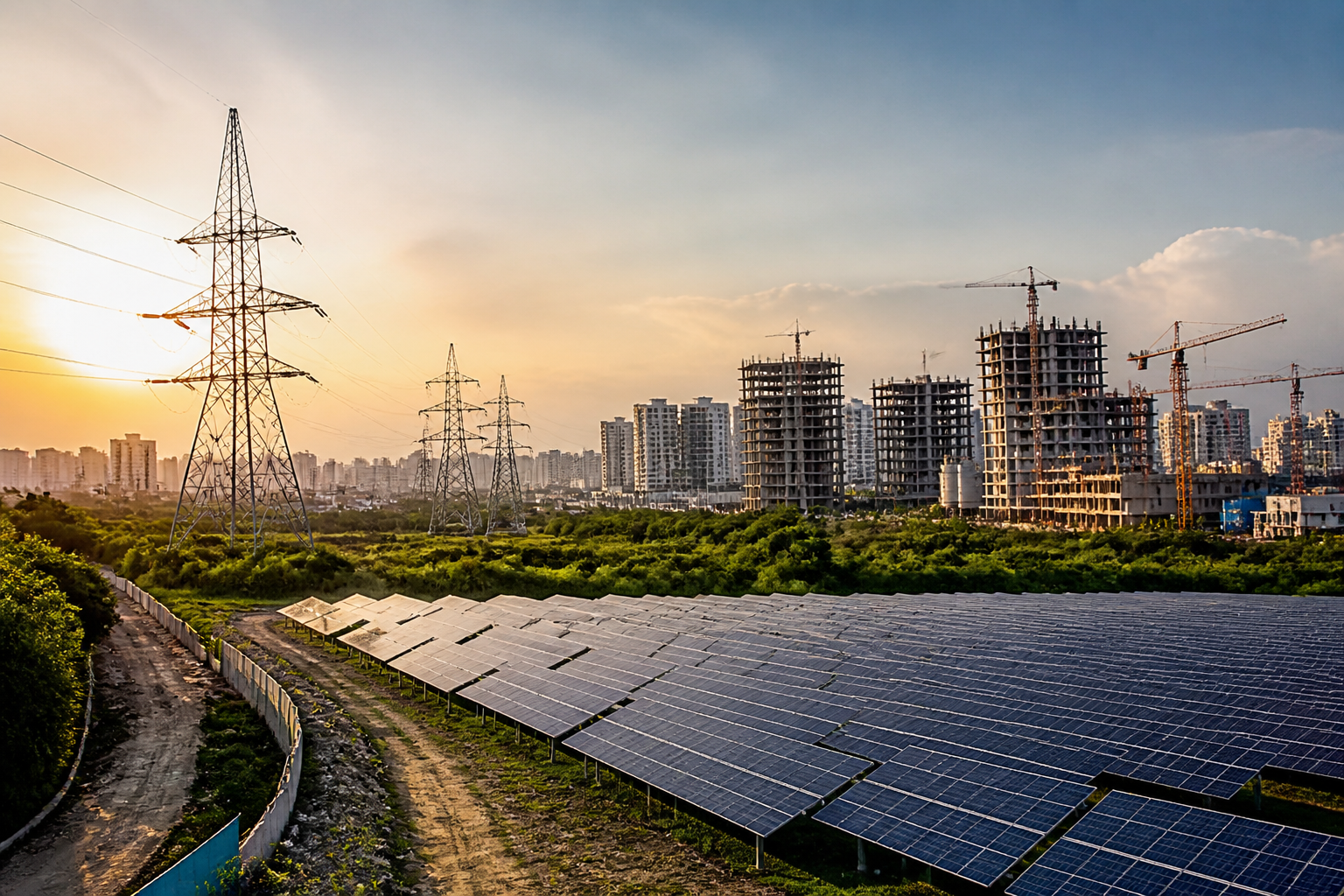
India’s power-sector emissions remained flat between the first halves of 2024 and 2026 even as electricity demand increased by 7%, according to a Centre for Research on Energy and Clean Air analysis. The shift was driven by a record increase in non-fossil power generation, but the same period also exposed a harder urban transition: emissions from steel and cement rose sharply as real-estate investment gathered pace.
The contrast matters because India’s built environment is being shaped by two simultaneous expansions. Electricity consumption is growing as cities add homes, transport systems, commercial buildings and infrastructure. At the same time, the materials required to construct that urban capacity are becoming a larger source of emissions. The CREA analysis suggests that clean power is beginning to absorb new electricity demand, while construction-linked industrial activity is moving emissions into another part of the economy.
The analysis, prepared by CREA analysts Lauri Myllyvirta and Anubha Aggarwal and released on Thursday, said coal power did not expand over the two-year period. It described this as the first such pause in more than 50 years. The finding does not mean that coal has ceased to be important in India’s electricity system. Rather, it indicates that additional demand during the period was met by other sources instead of requiring an increase in coal-based generation.
That distinction is central to understanding what has changed. The analysis said clean energy met the entire 7% rise in electricity demand, equivalent to an additional 63 terawatt-hours. Solar power accounted for the largest share of the increase, adding 44 TWh. Wind added 13 TWh, while nuclear and hydro contributed 7 TWh and 8 TWh respectively.
The increase in non-fossil generation was the largest recorded in India, according to the analysis. In practical terms, the country’s power system was able to accommodate higher consumption without increasing coal power during the period examined. For cities, that is an important systems-level development: growing demand from households, offices, public infrastructure and industry does not automatically have to translate into a proportionate increase in coal generation if clean generation expands quickly enough.
But the power-sector result sits alongside a broader increase in India’s emissions. The analysis said national emissions rose by 3.7% year-on-year in the first half of 2026, driven by steel, cement and other sectors. Steel and cement emissions alone grew by 8% year-on-year and accounted for 23% of India’s total carbon dioxide emissions during the period.
The link to urban development is direct. Steel and cement are fundamental inputs for housing, commercial construction, roads, bridges, industrial facilities and other forms of infrastructure. The analysis attributed part of the growth in these sectors to increased investment in India’s real-estate sector, particularly during the second quarter. This points to an important limitation in judging the sustainability of cities only through the electricity they consume. A building may draw on a cleaner power system once it is occupied, while the cement and steel used to create it may carry a substantial emissions burden before completion.
The data therefore describes a change in the location of emissions rather than a complete decarbonisation of urban growth. Power-sector emissions have been contained because clean generation has expanded rapidly. However, the material economy supporting construction has moved in the opposite direction. The two trends are connected by the same urban demand: more investment, more construction and more electricity consumption.
## The grid becomes the next constraint
CREA’s analysis identified three requirements if the pace of clean-energy expansion is to continue: upgrading the electricity grid, rapidly building energy storage and increasing the flexibility of coal power. These are not separate technical concerns. Together, they determine whether a power system with a larger share of variable renewable generation can reliably serve cities and industry.
Solar generation contributed 44 TWh of the increase between the first halves of 2024 and 2026, more than any other source identified in the analysis. Solar output, however, depends on the timing and availability of sunlight. As its share expands, the grid must be able to move electricity across locations and balance supply with demand over time. Storage becomes relevant because electricity generated during one period may need to support demand during another.
Grid investment is also an urban issue. Electricity demand is not distributed evenly across the country. Cities and industrial areas bring together large concentrations of residential, commercial and manufacturing consumption. A stronger generation profile will not by itself ensure reliable service if transmission and distribution systems cannot carry power to those demand centres.
The analysis also referred to the need for greater flexibility from coal power. This implies that coal plants may increasingly be required to adjust their output as renewable generation changes, rather than operating only as a steadily running source of electricity. The source material does not establish how quickly this flexibility can be delivered or what investments it would require, but it identifies the operational challenge facing a system in transition.
At the same time, the fossil-fuel industry continues to pursue major capital investments, according to CREA. These include new coal-power capacity, plans to convert coal into chemicals and efforts to increase domestic coking-coal production for the steel sector. This creates a parallel investment pattern: clean power is expanding sufficiently to meet recent demand growth, while fossil-fuel and coal-linked industrial capacity continues to be developed.
That parallel does not by itself determine the future emissions path. It does, however, show why a short period of flat power-sector emissions cannot be treated as a final outcome. The result depends on whether clean-energy deployment continues to outpace demand growth and whether new fossil-fuel capacity becomes operational and increases generation.
## Construction growth carries a separate emissions burden
The rise in steel and cement emissions places the construction sector at the centre of the next challenge. The CREA analysis reported an 8% year-on-year increase in emissions from these industries and a 23% share of total Indian carbon dioxide emissions in the first half of 2026. It also connected part of the growth to real-estate investment.
This is significant for urban policy because construction demand is often measured through homes delivered, floor space added, infrastructure completed or investment attracted. Those indicators describe economic and physical expansion, but they do not fully capture the emissions embodied in the materials that make expansion possible. Steel and cement are produced before a building or infrastructure project begins operating, which means the environmental cost is embedded in the urban asset from the construction stage.
The analysis also said that profit margins of Indian steel and cement manufacturers remained under pressure for much of the period. Elevated raw-material costs, particularly imported coking coal, and higher freight costs linked to the Hormuz crisis affected the industries. This shows that emissions and cost pressures are developing together rather than as isolated issues.
For the built environment, that combination matters. Higher material costs can affect project economics, while dependence on carbon-intensive production leaves construction exposed to fuel, freight and industrial-input volatility. The source does not provide project-level evidence on how these pressures affected housing prices, construction timelines or infrastructure budgets, so those effects cannot be established from the analysis. It does show that the material base of urban growth remains economically and environmentally exposed.
The evidence also makes clear that cleaner electricity alone cannot resolve the emissions challenge of construction. If steel and cement output grows in response to real-estate investment, the power sector may improve while total emissions continue to rise through industrial production. Decarbonising cities therefore involves both the energy used by buildings and transport systems and the materials used to build them.
## A transition measured across systems
The CREA findings are best understood as a system-level transition with uneven progress. Electricity demand rose, but clean generation met the increase. Coal power did not expand over two years, marking an important break in the historical pattern described by the analysis. Yet total emissions still increased because heavy industry grew faster.
The numbers show the scale of that divergence. Clean energy supplied 63 TWh of additional electricity, including 44 TWh from solar, 13 TWh from wind, 7 TWh from nuclear and 8 TWh from hydro. At the same time, power-sector emissions stayed flat while overall emissions rose 3.7% year-on-year in the first half of 2026. Steel and cement emissions grew 8% and represented 23% of total carbon dioxide emissions.
These figures do not show that one sector’s progress cancels out another sector’s increase. They instead indicate that India’s emissions profile is becoming more complex as urbanisation, real-estate investment and infrastructure demand expand. The electricity system may be moving towards a cleaner margin of growth, while the industrial system supplying construction remains a major source of additional emissions.
The policy and infrastructure question is consequently broader than adding renewable generation. It includes the grid capacity needed to connect and distribute that generation, storage to manage variability, and power-plant flexibility to balance the system. It also includes the industrial pathways through which steel and cement are produced, although the supplied analysis does not specify particular technologies or policy measures for reducing those sectors’ emissions.
The larger urban question is whether India can expand its cities without shifting environmental pressure from one system to another. The latest evidence confirms a meaningful achievement in power generation: clean energy absorbed the recent increase in demand and coal power did not grow over the period analysed. It also confirms that construction-linked industries are increasing their contribution to emissions. The next developments to monitor are the pace of grid and storage expansion, the operation of planned fossil-fuel capacity and the emissions trajectory of steel and cement as real-estate investment continues.
