


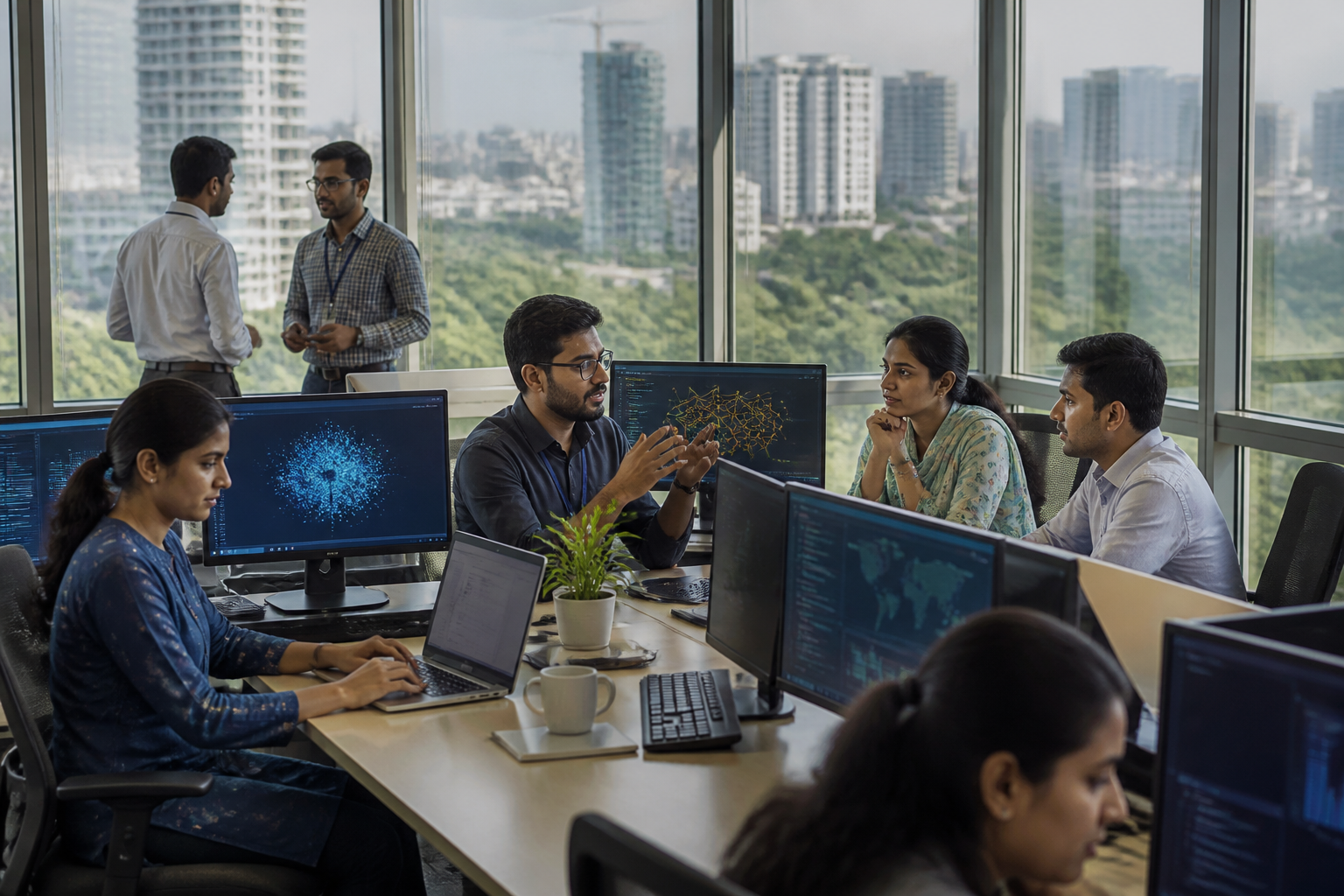
Woodside Energy’s Bengaluru hub is being built as more than a back-office technology centre. Its early design brings artificial intelligence, cybersecurity, data science, product engineering, finance, procurement and operations into one global support model, offering a window into how multinational companies are redefining the role of India-based capability centres.
The Australian energy company has grown its Bengaluru operation to about 150 to 160 people since setting up the office in February. The new facility became operational in the middle of the year, according to the company, and is now working with Woodside’s teams across its international locations.
That expansion is significant not because of the headcount alone, but because of the functions being assembled in one city. Woodside is not presenting Bengaluru only as a delivery location for technology services. Its executives describe the centre as a potential corporate hub with a wider role in digital transformation, business processes, finance and operations.
For Bengaluru, this is part of a continuing shift in how the city’s technology economy is used by global companies. The evidence in Woodside’s account points to a model in which the city’s value is tied not simply to the availability of software professionals, but to the ability to combine technical skills with business, risk and operational capabilities.
The company’s decision-making process also reflects the importance of talent concentration in the geography of global business. Sameer Singhal, Woodside’s Head of Digital Solutions Centre, said the company first assessed several countries and cities before selecting India. It then considered multiple Indian cities, with the availability of the technology skills Woodside needed emerging as a decisive factor for Bengaluru.
Singhal also cited the ability to work across time zones as part of the company’s assessment of where it should operate. That makes the location decision broader than a search for lower operating costs. In Woodside’s stated approach, the city has to support collaboration with the company’s global operations and provide access to capabilities that can be integrated into its worldwide business.
The distinction matters because a conventional global capability centre is often understood primarily as a support unit. Kristine Leo, Woodside’s Vice President and Country Manager India, said the company’s ambition was to create “just another Woodside corporate hub”. The phrase indicates a broader organisational purpose: the Bengaluru operation is intended to participate in the company’s global operating model rather than remain separate from it.
That model is still developing. Leo said Woodside was taking a gradual approach to expansion rather than rushing its growth. The company has not presented a final employment target or a detailed expansion timetable in the material supplied. What is clear is that the centre is being structured around several connected functions from the beginning, rather than adding business capabilities only after a large technology workforce has been established.
This approach also shapes how Woodside is discussing artificial intelligence. Singhal said the centre’s technology work would be guided by business outcomes rather than by the adoption of AI for its own sake. The question, in his formulation, is not whether a company can implement a technology but which business problem it is intended to solve.
That principle places AI within an operating and governance framework. It also distinguishes between individual productivity tools and AI applications designed to deliver wider business outcomes. The source material does not identify specific AI systems or projects being deployed at the Bengaluru hub. It does, however, make clear that Woodside wants technology initiatives to be capable of moving beyond successful pilots and scaling into larger operations.
Singhal described this principle as being “Designed for scale”. For a company operating in the energy sector, the issue is not only whether a digital system works in a controlled trial. It must also fit the company’s safety, security and operational requirements. Woodside operates major hazard facilities, and its executives said that AI cannot be allowed to take over areas where security and safety are involved.
The emphasis on human oversight is therefore central to the company’s stated approach. Singhal said “humans in the loop” and “humans on the loop” were critical elements of how Woodside believed AI should be managed. These phrases point to two forms of control: people may remain directly involved in a technology-enabled process, or they may supervise and intervene in its operation. The supplied material does not specify the systems, approval processes or technical controls through which that oversight will work.
The Bengaluru centre’s cybersecurity role carries a similar institutional implication. Singhal described cybersecurity as a boardroom issue rather than one restricted to information technology teams. He referred to the role of risk and audit committees in assessing an organisation’s cybersecurity posture, placing digital security within corporate governance and enterprise risk management.
This is an important feature of the hub’s proposed remit. Cybersecurity, AI and data science are being presented alongside finance, procurement and operations, not as isolated technology departments. The centre’s structure suggests that the company is trying to connect digital capability with the functions that determine how risk is managed, how decisions are made and how global operations are supported.
The workforce dimension is equally important. Abhishek Agrawal, Woodside’s Head of HR in India, said the Bengaluru centre was conceived as a technology and innovation hub focused on digital transformation and business processes. He also said a wider global footprint could provide access to additional capabilities and perspectives for addressing complex problems.
That claim is linked to the challenge of integrating teams spread across countries. Woodside has introduced cultural programmes involving its India and Australia teams so employees can understand different ways of working, Agrawal said. Such initiatives address a less visible part of global capability-centre expansion: the institutional systems required to make distributed teams function as one organisation.
The Bengaluru hub is therefore being built on three connected foundations. The first is the city’s concentration of technology skills. The second is the integration of digital functions with business and operational capabilities. The third is the governance required to use AI and manage cybersecurity in an industry where safety is a core consideration.
The available evidence does not establish whether the centre will become a large employer, how much investment it represents or which specific products and processes will be developed in Bengaluru. Nor does it establish whether the hub will eventually take on decision-making authority previously located in Perth, Houston or elsewhere. Woodside has said that the operation will create opportunities for partnerships and value creation, but has not detailed those partnerships in the supplied account.
What the company has made clear is that Bengaluru is being treated as part of its global operating architecture. The centre’s early combination of technology, finance and operations challenges the narrow description of an India office as a support arm. It also shows why the next phase of global capability-centre growth will depend on more than hiring technical workers: companies will need structures that connect talent to business outcomes, risk controls and cross-border collaboration.
For Bengaluru’s urban economy, the immediate signal is qualitative rather than numerical. Woodside’s account links the city’s attraction to specialised skills, time-zone access and the ability to support a broader corporate function. Whether that ambition becomes a durable institutional presence will depend on how the company scales the centre, integrates it with its international operations and demonstrates that its AI and cybersecurity practices can meet the demands of a major-hazard business.
