


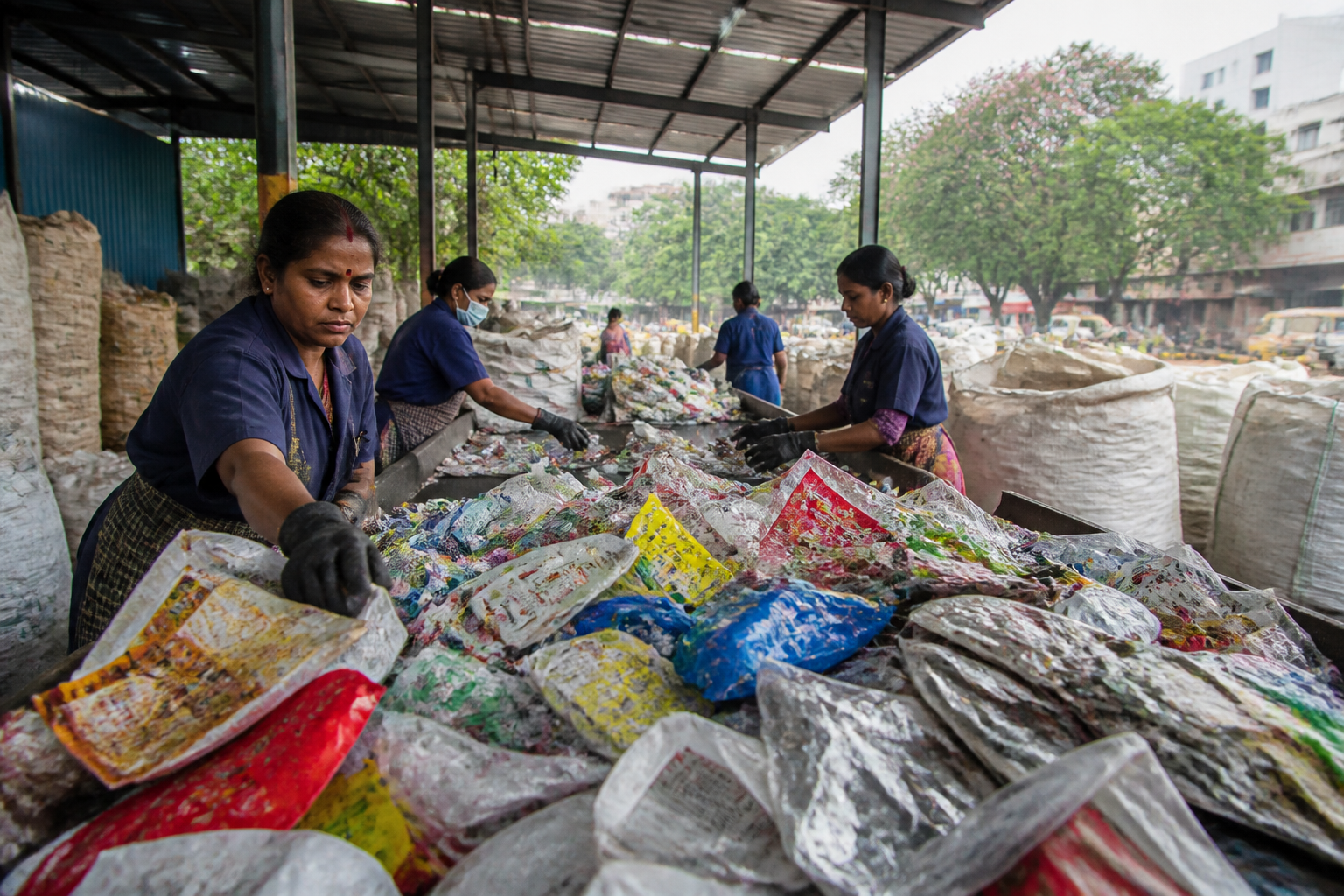
The Central Pollution Control Board’s draft guidelines for multilayered plastic packaging could change how Bengaluru handles one of its most persistent forms of urban litter. Snack wrappers, paan sachets, milk cartons, shampoo sachets, coffee pouches and chip packets may be small individually, but together they expose a much larger weakness: the city’s waste system has struggled to ensure that difficult packaging is segregated, collected, processed and kept out of the open environment.
The draft guidelines propose a uniform framework for Category III multilayered plastic packaging, or MLP. This category includes packaging with at least one plastic layer and at least one non-plastic layer, such as aluminium, paper or paperboard. Because these materials are bonded together, they are harder to recycle than single-material packaging. The proposed system covers collection, segregation, sorting, recycling, end-of-life disposal and monitoring under Extended Producer Responsibility, or EPR.
The guidelines are currently open for public consultation. They place responsibilities across urban local bodies, producers and pollution-control authorities, rather than treating MLP as an ordinary household waste stream. That distinction is important for cities such as Bengaluru, where the final outcome will depend not only on what residents discard, but also on whether the municipal collection system can keep this packaging separate and whether authorised facilities can process it.
### Why multilayered plastic is an urban systems problem
MLP is widely used in food, dairy, confectionery, personal-care and other consumer products because it is lightweight and provides protection to the contents. Its commercial advantages, however, create a waste-management problem. A packet made from multiple materials cannot be handled as easily as a conventional plastic item, and its low individual weight makes it difficult to recover economically once it is scattered across streets, drains, vacant land or mixed waste.
A city-based solid waste management expert cited in the report said the draft would make source segregation of this waste category as dry waste mandatory. Under the proposed chain, MLP would move through collection systems, Material Recovery Facilities or aggregation centres before being sent to registered recyclers or authorised end-of-life facilities.
That proposed chain reveals where the city’s responsibilities begin and end. Households and commercial establishments would need to keep the material in the dry-waste stream. Collection agencies would need to prevent it from being mixed with wet waste. Material Recovery Facilities or aggregation centres would need to sort and consolidate it. Registered recyclers or authorised end-of-life facilities would then have to receive it through a traceable system.
The system is therefore not simply a litter-control measure. It is an attempt to give a difficult material a defined administrative route after consumption. If any link fails, the packaging can return to the same informal and environmentally damaging pathways that the guidelines seek to close.
### Bengaluru’s visible litter points to an invisible processing gap
The street-level impact is especially visible in the case of small sachets and wrappers. Odette Katrak, founder of Beautiful Bharat, a city-based organisation involved in waste-management volunteer activities, described paan sachets as a major contributor to street litter. She said the sachets are difficult to sweep up and can remain in soil as non-recoverable litter, eventually breaking down into microplastics that may leach into soil and the water table.
The supplied report does not establish the volume of MLP waste generated in Bengaluru or the quantity currently reaching landfills, recycling facilities or open spaces. It does, however, document a recurring urban pattern: packaging that is used briefly remains difficult to collect and process after disposal. The mismatch is between a fast-moving consumer economy and a waste system that must deal with the material long after its commercial purpose has ended.
Experts cited in the report also said there appeared to be no reduction in MLP packaging and that consumers remained largely unaware of the environmental impact of products such as wafer and chip packets. Large quantities of the waste stream remain uncollected, according to those experts. This suggests that the challenge is not confined to consumer behaviour or municipal sweeping. It also involves product design, producer responsibility, collection infrastructure and the availability of technically suitable processing.
That distinction matters because MLP is easy to see as a cleanliness issue while overlooking the institutional choices behind it. A wrapper on a Bengaluru street is the final visible point of a chain that begins with packaging design and continues through retail, consumption, disposal, collection, sorting and end-of-life treatment.
### The proposed hierarchy changes the disposal question
The CPCB draft places material recycling at the top of the waste-management hierarchy wherever technically feasible. For MLP that cannot be recycled, the proposed hierarchy includes converting the material into products such as boards or road-construction material. The guidelines also emphasise that MLP should not be sent to landfills or openly burned.
This is a significant distinction within the proposed framework. It recognises that not all multilayered packaging can be processed through the same recycling route, while still seeking to prevent the material from disappearing into disposal practices with higher environmental risks. At the same time, the report does not specify the capacity of registered recyclers or authorised end-of-life facilities available to Bengaluru, nor does it establish how much of the city’s existing MLP stream could be handled through each proposed route.
That information will be important when the framework moves from consultation to implementation. A rule requiring segregation can improve the quality of recovered material only if the subsequent facilities, transport arrangements and monitoring systems are available. Otherwise, separately collected material may still be aggregated with other waste or sent to disposal points that the guidelines seek to avoid.
### EPR places producers inside the municipal waste equation
The draft guidelines bring MLP under Extended Producer Responsibility monitoring. This is designed to connect the companies that place packaging on the market with the waste created after use. The report says the proposed framework lays down responsibilities for producers, urban local bodies and pollution-control authorities.
The division of responsibility will be central to implementation. Urban local bodies manage or oversee public waste systems, while producers are associated with the packaging entering the market. Pollution-control authorities are expected to provide regulatory oversight. The draft’s significance lies in attempting to make these roles part of one management chain rather than leaving municipalities to address the consequences of packaging decisions on their own.
Katrak argued that greater penalties should be imposed on manufacturers that profit from these products while doing little to address their contribution to environmental degradation. Her comment identifies a wider tension within urban waste governance: municipal bodies are often the most visible institutions when litter accumulates, but the packaging format and its recovery difficulty are determined before the material reaches the street.
The report also notes that 2018 guidelines had given manufacturers two years to phase out MLP packaging that was non-recyclable, non-energy-recoverable and had no alternative use. The continued prominence of wrappers and sachets in the reported waste stream raises questions about the effectiveness of that earlier approach, although the supplied material does not provide enforcement data or explain the extent to which the phase-out was implemented.
### What Bengaluru should watch in the next phase
The consultation stage will determine how the proposed framework is refined before implementation. The immediate questions are administrative as much as technical: how source segregation will be enforced, which facilities will receive the waste, how registered recyclers and authorised end-of-life facilities will be monitored, and what penalties will apply when producers or other participants fail to meet their responsibilities.
For Bengaluru, the practical test will be whether the city can make the proposed route visible and dependable at street level. Residents may be asked to separate MLP as dry waste, but that separation will have limited value if collection, sorting and final processing are not connected. Similarly, producers may carry EPR obligations, but those obligations will need monitoring strong enough to show whether packaging is actually being recovered or merely accounted for on paper.
The CPCB draft confirms that multilayered plastic packaging is no longer being treated solely as a litter problem. It is being placed within a formal chain involving households, urban local bodies, producers, recovery facilities, recyclers and pollution-control authorities. What remains uncertain is whether that chain will have enough capacity, enforcement and accountability to prevent the material from continuing its familiar journey from a short-lived product to long-lived urban pollution.
