


The Greater Noida hit-and-run at Ek Murti Chowk has moved from a road accident report to a test of how the city protects pedestrians after a crash. A man crossing the road was struck by a Tata Punch at about 4.30 am on September 5, according to a report by Navbharat Times. The driver allegedly fled, but CCTV footage helped Bisrakh police identify and arrest him. The injured pedestrian, Himanshu Rai, remains under treatment after suffering a spinal injury, a fractured left leg and injuries to his right hand.
The immediate facts are clear enough to establish the institutional sequence. Rai had gone with his wife, Jyoti, to buy a cake near Ek Murti Chowk. While returning, he was hit as he crossed the road. The vehicle did not stop at the scene, and footage from nearby CCTV cameras recorded the incident. Police registered a first information report, examined the footage, identified the vehicle and arrested its driver. The accused was produced in court and sent to judicial custody, while the vehicle was recovered.
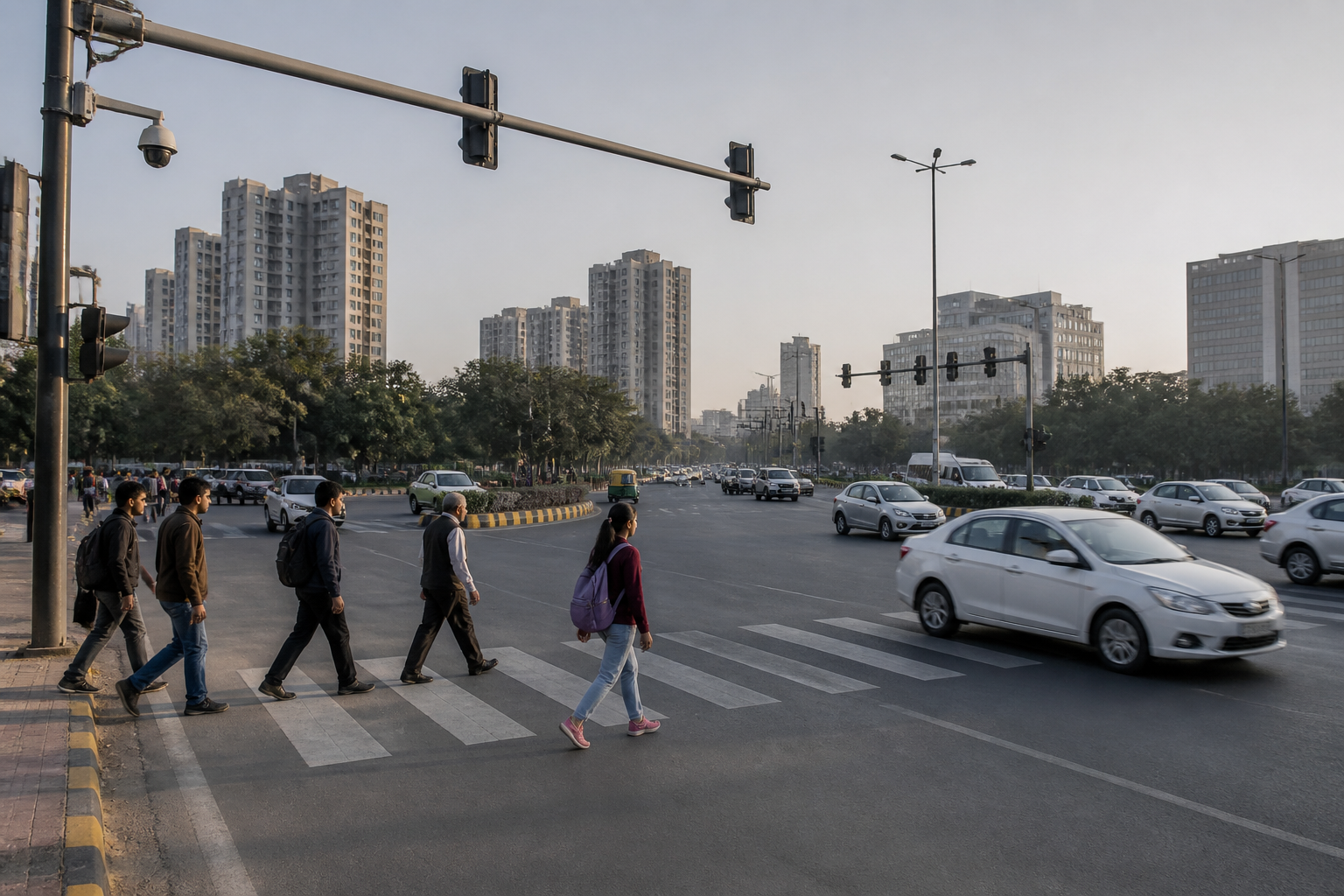
What remains less clear from the report is the road environment in which the collision occurred. The account does not establish whether Rai was using a marked pedestrian crossing, whether the junction had a signal-controlled crossing, how much lighting was available at that hour or whether the road design required pedestrians to cross multiple traffic lanes. Those details matter because a pedestrian collision is shaped not only by driver behaviour but also by the physical conditions that determine how people move across an urban road.
That distinction is important in a rapidly urbanising area such as Greater Noida West. The report places the incident at Ek Murti Chowk, a junction that connects residential communities and commercial activity. The available account does not provide traffic-volume data, speed measurements, a road safety audit or details of the junction’s pedestrian facilities. It would therefore be inaccurate to describe the location as systematically unsafe on the basis of one incident. But the circumstances described—an early-morning crossing, a vehicle allegedly travelling at high speed and a driver leaving the scene—show the types of risk that urban road management must be able to identify and address.
Rai told the publication that the car appeared to be travelling at more than 100 kilometres per hour. That is his account of the vehicle’s speed, not an officially established measurement in the supplied report. He also suspected that the driver may have been intoxicated. The report does not say that police confirmed alcohol consumption, and that possibility must therefore remain an allegation rather than a recorded fact.
The account from Rai’s wife describes the collision as severe enough to throw him several metres away. She also alleged that the car’s bumper and glass were later repaired, which led the family to believe that evidence of the crash may have been removed. The report says police were investigating these allegations. It does not provide the findings of a forensic inspection, a medical-legal report or a police statement confirming that the vehicle had been deliberately repaired to conceal damage.
For the family, however, the institutional consequences began immediately. Rai required surgery for a spinal injury and also suffered a fracture and other injuries. His wife said he was experiencing difficulty moving his body. The family also said that he had been preparing for gym and modelling work before the crash, and that his condition had seriously affected his life. These details illustrate how a road collision can extend beyond the moment of impact: treatment, loss of mobility and interruption of work can become part of the same urban safety failure.
The report also highlights the importance of time in hit-and-run investigations. Jyoti alleged that if the driver had been caught immediately, an alcohol test could have been conducted at once. The supplied material does not establish the exact time between the crash and the arrest, nor does it record whether an alcohol test was attempted. It does, however, show why the first hours after a collision are central to evidence collection. A vehicle may be moved, damaged parts may be replaced and witnesses may disperse. CCTV can preserve a record, but it does not by itself answer every question about speed, driver condition or the sequence of events.
In this case, CCTV appears to have supplied the investigative lead. Police used the footage to determine that the vehicle involved was a Tata Punch and then traced the driver. That sequence demonstrates the operational value of surveillance infrastructure in a city where road crashes may otherwise depend heavily on eyewitness accounts. It also exposes the limits of camera-led enforcement. Cameras can help identify a vehicle after a crash, but they cannot substitute for safe crossings, traffic calming, adequate lighting or immediate emergency response.
The case therefore sits at the intersection of two responsibilities. The first is enforcement after a collision: registering the FIR, securing the vehicle, identifying the driver and presenting the accused before court. The second is prevention: designing junctions so that pedestrians are not forced into dangerous conflict with fast-moving traffic. The supplied report documents the first responsibility but does not say whether any agency has reviewed the junction after the crash or whether changes to signage, crossing facilities, lighting or speed management have been ordered.
That gap is significant because responsibility for an urban road is rarely held by a single institution. Police investigate offences and enforce traffic rules. Road-owning agencies are responsible for the physical carriageway and associated facilities. Local authorities may be involved in lighting, street conditions or public-space management. CCTV operations can be distributed across police and civic systems. The report identifies Bisrakh police as the agency that investigated this case, but it does not identify the road-owning authority or record any response from it.
The distinction between criminal accountability and road safety accountability should not be lost. Arresting an alleged hit-and-run driver addresses the conduct recorded in one case. It does not establish whether the junction is safe for the next pedestrian, whether vehicles routinely exceed a safe speed there or whether the crossing arrangement is adequate. Those questions require a separate assessment based on site conditions, crash records, traffic engineering and pedestrian movement. None of that additional evidence is included in the supplied report.
The timing of the crash also raises a practical question about off-peak safety. An early-morning road can appear less congested while still allowing vehicles to travel faster. For pedestrians, lower traffic volume does not necessarily mean lower risk if vehicle speeds rise and crossing facilities are limited. The report does not provide a measured speed profile or traffic count for Ek Murti Chowk, so no broader conclusion can be drawn about night-time or early-morning danger. The incident nonetheless shows why road safety cannot be assessed only by looking at congestion during the busiest hours.
The available evidence confirms three things: a pedestrian was seriously injured; the driver allegedly left the scene; and CCTV and police investigation led to an arrest and recovery of the vehicle. It does not confirm the car’s speed, whether the driver was intoxicated, whether the vehicle was repaired to conceal evidence or whether the junction has a wider crash problem. Those questions remain subject to investigation and, where relevant, court proceedings.
The next layer of accountability lies in what happens after the arrest. Police action will determine the legal course of the case, while the relevant road authority’s response would determine whether the location is examined as a preventable safety risk. Until that assessment is made public, the Greater Noida incident remains both a criminal case involving one driver and a warning about the consequences that can follow when pedestrian movement, vehicle speed and urban junction design are not adequately aligned.
