


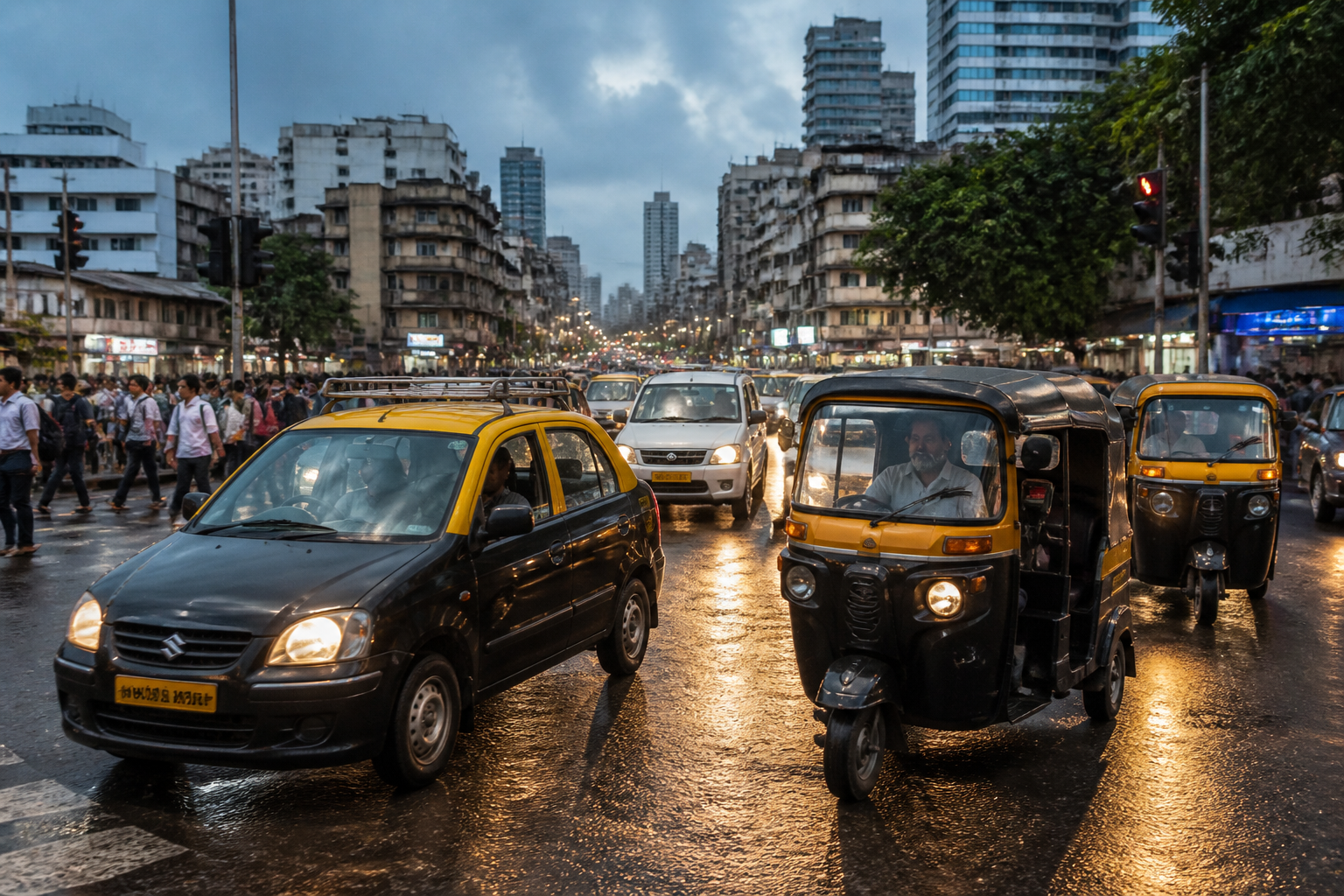
Maharashtra’s new aggregator policy brings app-based cabs, autorickshaws and bike taxis under a common regulatory framework, but its real significance will depend on whether the state can turn rules on paper into daily oversight of platforms, drivers and passenger services. The policy, reported as taking effect from 1 September, covers licensing, driver eligibility, ride cancellations, grievance redressal, fare regulation, safety and the share of revenue received by drivers.
The framework applies to companies such as Ola, Uber and Rapido operating in the state. According to the Loksatta report, each aggregator must obtain a licence from the State Transport Authority and will receive a separate licence identification number. This shifts app-based mobility from a largely platform-led service model towards one in which the government formally recognises and supervises the companies connecting passengers with vehicles.
That change matters because app-based transport sits between public regulation and private operation. The customer books through a digital platform, but the journey is delivered by an individual driver using a vehicle subject to transport rules. The platform determines or influences access to passengers, fare collection, cancellation processes and complaint handling. The policy therefore attempts to regulate not just vehicles and drivers, but the digital intermediary that organises the entire service.
The report identifies several problems that the new framework is intended to address: passenger safety, driver earnings, arbitrary fare practices, delays in complaint resolution and the loss of potential government revenue from an expanding mobility sector. These are not separate concerns. They are connected to the way platform-based transport is administered. A rule on driver income, for example, affects the economics of service delivery, while a rule on licensing determines whether the government can identify and hold an aggregator accountable.
The most significant economic provision is the guarantee that drivers receive at least 80 per cent of the total fare. The report does not specify how the amount will be calculated in cases involving discounts, incentives, cancellation charges, tolls or taxes. That detail will be important for implementation because the displayed passenger fare and the amount credited to a driver may not always represent the same components of a transaction. The policy’s stated objective, however, is clear: to provide a minimum protection for drivers’ share of platform-mediated earnings.
For drivers, the provision could create a formal benchmark in a sector where income depends on trip volumes, operating costs and platform arrangements. The same policy also requires drivers to hold a valid driving licence and badge, and prohibits them from driving continuously for more than 12 hours. Insurance protection for drivers and passengers is included in the framework, according to the report. Together, these provisions link labour conditions and passenger safety rather than treating them as unrelated regulatory subjects.
The 12-hour limit is particularly important because fatigue is a road-safety issue as well as an employment issue. Yet the effectiveness of such a rule will depend on how driving time is measured across platforms and whether the state’s proposed monitoring system can identify drivers who work through more than one application. The supplied report says the government plans to develop a special online portal for real-time monitoring of vehicles, GPS tracking, driver verification and prompt action against violations. It does not state when the portal will become operational or explain how data from different companies will be integrated.
Passenger protection is another major component of the policy. Aggregators must operate a 24-hour call centre and appoint an officer responsible for grievance redressal. This creates a formal route for complaints beyond the standard in-app process. The practical test will be whether passengers can reach a responsible authority quickly, whether complaints receive a tracking number and whether violations lead to action that is visible to the affected user. The report establishes the obligations but does not provide details of service-level deadlines, penalties or appeal mechanisms.
The policy also includes provisions aimed at women passengers. In ride-pooling services, women passengers are to be given the option of travelling only with women drivers or women co-passengers. This is a targeted response to safety concerns in shared mobility, where passengers may have less control over who joins a trip. Its usefulness will depend on the availability of women drivers and the way the option is presented inside the app. The report does not provide data on the number of women drivers or explain whether the option will be available on every platform and at all times.
Language access is included as a regulatory requirement. Aggregator applications and websites must be available in Marathi, Hindi and English. For a state with large differences in language use, this provision recognises that digital access is part of transport access. A passenger may be able to find a vehicle but still struggle to report a problem, understand fare conditions or use safety features if the interface is available only in one language. The policy therefore treats the customer-facing interface as part of the regulated service.
Fare regulation is also being brought into the framework. The report says surge pricing will be limited and that the Regional Transport Authority will determine the base fare. This is a direct intervention in one of the defining features of app-based transport: fares can change according to demand, time and availability. A regulated base fare could improve predictability for passengers, while limits on surge pricing may prevent sharp increases during periods of high demand. At the same time, the policy’s operation will depend on the formula used by authorities and on how base fares interact with platform commissions, discounts and additional charges.
The policy also has a fiscal dimension. By requiring aggregators to obtain licences, the state expects to secure lawful revenue from companies operating in Maharashtra. Licensing gives the government a clearer administrative relationship with platforms and may improve the identification of the companies active in the market. But revenue collection alone does not establish effective regulation. The state will also need reliable records of licensed operators, registered vehicles, verified drivers, complaints, insurance coverage and enforcement actions. The proposed online portal appears intended to support that administrative architecture.
This is where the policy’s central challenge lies. The rules cover a wide range of issues, but implementation will be distributed across several actors: the state transport department, the State Transport Authority, Regional Transport Authorities, aggregator companies, vehicle owners and drivers. Each actor controls only part of the service. The state can prescribe conditions, platforms control digital systems, drivers operate vehicles, and passengers generate complaints and demand. Without clear coordination, a breach may be reported to one institution while the relevant data is held by another.
The report presents the framework as a way to bring unauthorised app-based autorickshaws, taxis and bike taxis into a legal structure. That objective is especially relevant in cities where formal public transport does not cover every neighbourhood, travel time or operating hour. App-based services have filled gaps between homes, workplaces, stations and other destinations. Their expansion has also made regulation more complex because the service is neither a conventional taxi stand operation nor a purely digital business.
The policy’s provisions show the state attempting to regulate the full chain of urban mobility: who may operate, how drivers qualify, what passengers pay, how complaints are handled, how vehicles are tracked and how revenue is divided. This is broader than a licensing exercise. It is an effort to define the responsibilities of a platform in a transport system where the government remains accountable for safety and public order, even when the journey is commercially delivered.
The evidence currently available confirms the policy’s main provisions but leaves several implementation questions open. The report does not establish the number of aggregators or vehicles that will require licences, the penalties for non-compliance, the enforcement timetable, the technical design of the monitoring portal or the mechanism for auditing the 80 per cent driver share. It also does not provide data on current complaint volumes, accident patterns, fare disputes or the scale of bike-taxi operations in Maharashtra.
Those details will determine whether the policy becomes a meaningful accountability framework or remains a set of formal obligations. The next important milestones are the licensing process, the launch of the state’s online monitoring portal, publication of fare rules and evidence that grievance, safety and driver-income provisions are being enforced. Until those mechanisms are visible, Maharashtra’s aggregator policy should be understood as a significant regulatory reset whose urban impact will be measured through implementation rather than announcement.
