


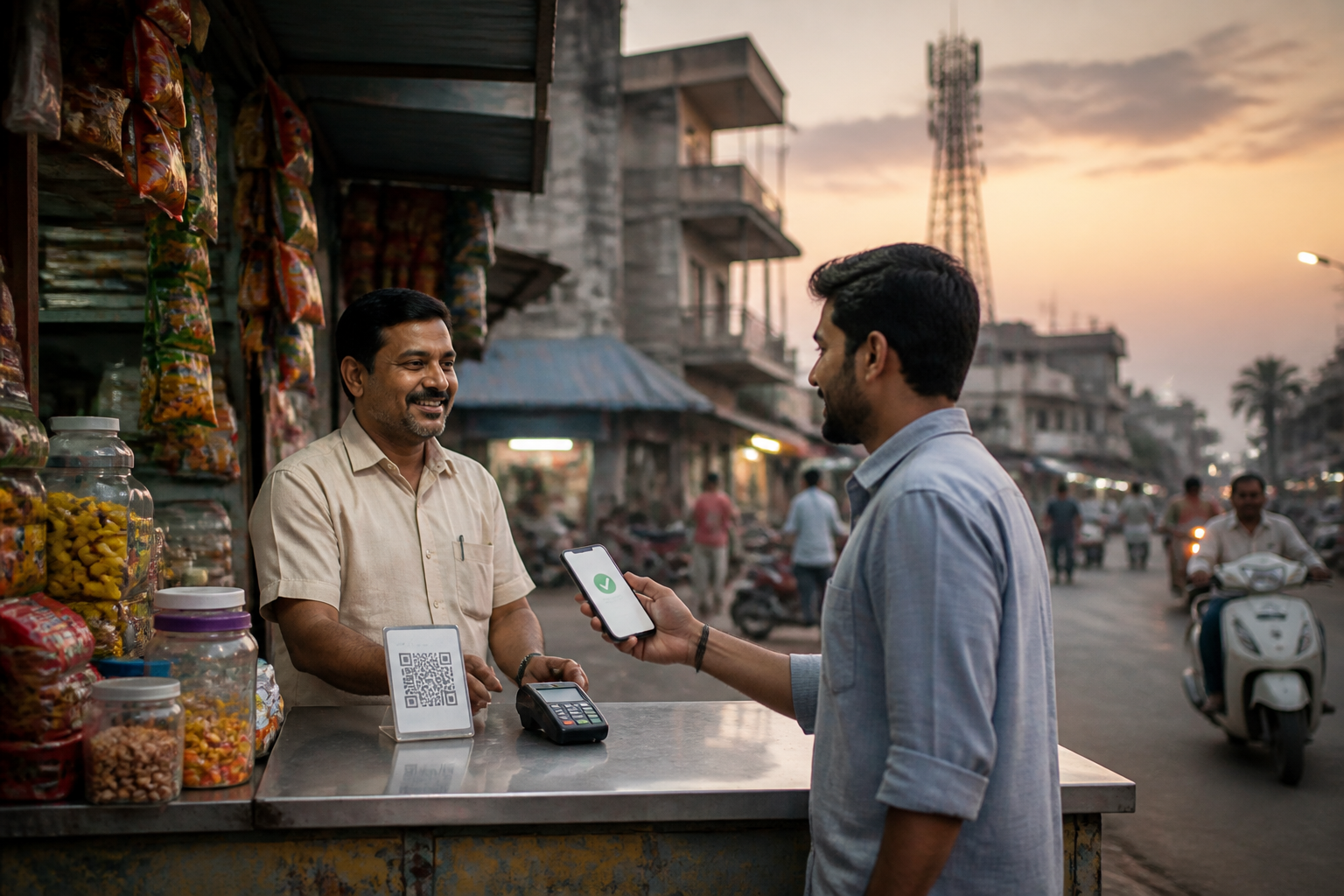
India’s new UPI MDR framework is designed to create a funding stream for the payment network at a time when transaction volumes are expanding rapidly. Under the framework announced by the Union government and detailed by the National Payments Corporation of India (NPCI), selected merchant transactions above Rs 2,000 will attract charges from 15 October 2026, while 5% of the total MDR collected from those transactions will be transferred to a dedicated development fund.
The change is significant because it links the future expansion of UPI infrastructure to activity within the payment system itself. The government’s stated objective, as reported in the NPCI circular, is to make the UPI ecosystem less dependent on government subsidies. The fund is intended to support digital payment infrastructure in Tier-3 cities and rural areas, improve acceptance among small merchants and strengthen the systems that enable payments to work reliably at scale.
The policy also shows how the economics of UPI are being divided between different types of transactions. Payments of up to Rs 2,000 will continue to carry no MDR under the framework described in the report. For selected person-to-merchant transactions above that threshold, an MDR of 0.4% has been specified. The framework does not apply one uniform rate to every UPI transaction. Instead, transactions are placed into different categories, with some covered by a flat-rate model and charges ranging from Rs 5 to Rs 300, according to the government circular and NPCI’s detailed guidance.
That distinction matters for the way digital payments are used across India. UPI is not a single type of transaction. It is used for small-value purchases at neighbourhood shops as well as larger payments to merchants. By retaining zero MDR for payments up to Rs 2,000 while applying charges to selected higher-value transactions, the framework attempts to preserve the economics of routine low-value digital payments while creating a revenue mechanism for a part of the merchant-payment market.
The source report does not provide a full transaction-category table or an estimate of the amount that the development fund could collect. It does, however, identify the proposed uses of the money. The fund is expected to support the expansion and strengthening of digital payment infrastructure in smaller cities and rural areas, encourage UPI acceptance among small traders, and finance parts of the banking and fintech system linked to payment reliability and safety.
These priorities point to a broader infrastructure challenge. A payment network is not sustained only by the visible act of scanning a QR code or transferring money. It also depends on server capacity, banking connectivity, fraud-prevention systems and the ability of institutions to process a growing number of transactions. The NPCI framework specifically identifies safety systems, server capacity and infrastructure for preventing cyber fraud as areas that could receive financial support through the MDR-linked fund.
The timing of the policy is connected to the scale of UPI usage. In August, monthly UPI transactions reached 24.51 billion, with a total value of approximately Rs 29.82 lakh crore, according to the figures cited in the report. Those numbers indicate both the reach of the network and the operational load placed on the institutions supporting it. As transaction volumes rise, the infrastructure behind the payment interface must handle more payment requests, settlement activity and security risks.
The growth figures also explain why the funding question has become more important. A system with rising transaction volumes requires continuing investment, but a zero-MDR model limits the direct revenue available to the companies and institutions involved in processing merchant payments. The new framework does not remove zero MDR across the board. Instead, it introduces a limited charge for specified transactions and assigns 5% of the collected MDR to a fund intended to strengthen the wider ecosystem.
The government has framed this as an effort to move UPI towards greater self-reliance. That objective is different from simply raising transaction charges. The policy establishes a mechanism through which a portion of revenue generated inside the payment network can be redirected towards the network’s future capacity. Its success will therefore depend on how the categories are implemented, how the fund is administered and whether the money reaches the infrastructure gaps identified in the circular.
The institutional structure is spread across multiple actors. The Union government amended the Payment and Settlement Systems Act, 2007, and issued a notification on 14 September 2026. NPCI subsequently released the detailed circular setting out the categories, exemptions and charges. Banks, fintech companies and merchants will be affected at the implementation stage because they participate in different parts of the transaction chain and will have to apply the framework to eligible payments from 15 October.
This division of responsibility is important because the policy’s stated goals extend beyond the immediate collection of MDR. Expanding UPI in Tier-3 cities and rural areas requires merchant onboarding, reliable banking access and the technical ability to process payments in locations where digital infrastructure may be less developed. The source material does not specify the fund’s governance structure, allocation formula or project-level monitoring system. Those details will determine how transparently the revenue is converted into infrastructure improvements.
The policy also creates a new relationship between the payment industry and the development of the network. PhonePe founder and chief executive Sameer Nigam said the 0.4% MDR on selected merchant transactions above Rs 2,000 could support revenue generation for the industry and allow additional investment in UPI’s expansion. His comments, as reported, reflect the industry’s view that a revenue stream could help fund growth rather than leaving expansion dependent only on public support.
At the same time, the framework’s impact will not be measured only by the amount collected. It will also be measured by whether small merchants accept UPI more widely, whether users continue to rely on it for everyday payments and whether the system becomes more resilient against outages and fraud. The stated allocation towards server capacity and cyber-fraud prevention indicates that the government is treating payment reliability as an infrastructure issue rather than only a commercial concern.
The central urban and regional question is how evenly the benefits of a nationwide digital payment network are distributed. UPI’s transaction numbers describe national scale, but they do not by themselves show whether a small trader in a rural market has the same payment reliability, merchant support or fraud protection as a business in a major city. The proposed development fund is intended to address that gap by directing resources towards smaller cities, rural areas and small merchants.
What the available evidence confirms is that the government has moved from a broad zero-MDR model towards a differentiated framework with a defined revenue-sharing component. It also confirms that 5% of the MDR collected from selected eligible transactions will go to a dedicated fund, with stated priorities including expansion, server capacity and cyber-fraud prevention. What remains unclear from the supplied material is the fund’s expected size, administrative mechanism and measurable implementation targets. Those will be the key details to watch as the new MDR framework takes effect on 15 October 2026.
