


India’s reported plan to export 650-700 tonnes of hilsa to Bangladesh in 2026 is more than a reversal in the movement of a culturally important fish. It offers a view of how regional trade is being reorganised by supply shortages, differences in consumer demand, processing economics and the logistics networks that connect distant production centres to international borders.
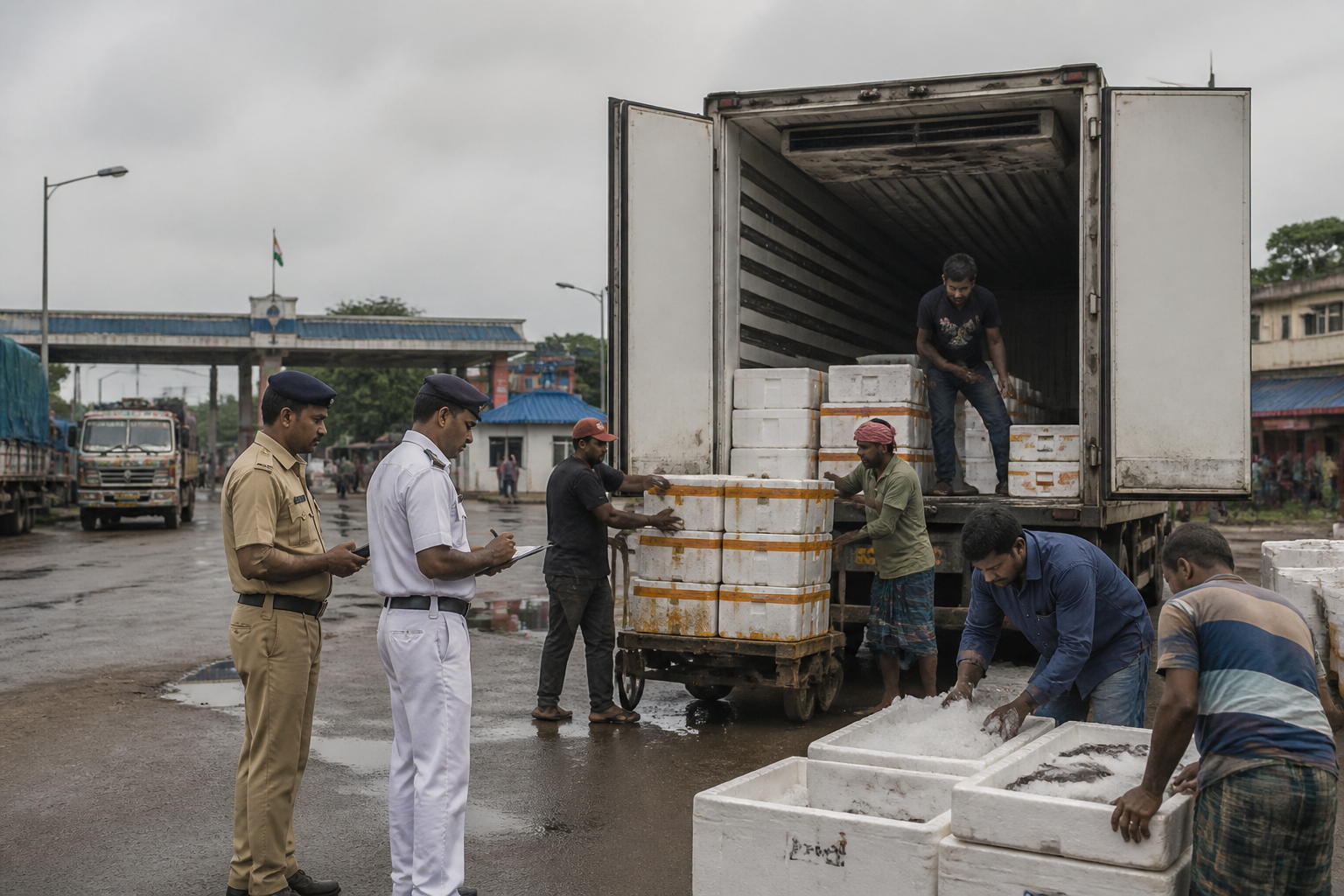
About 500 tonnes had already crossed into Bangladesh through Petrapole over the previous couple of months, according to the report, with another 150-200 tonnes expected to move by the weekend. The consignments began moving in early July, and most were sourced from Gujarat, shipped through Bharuch port and handled by Howrah-based traders. Some supplies were routed through the Howrah wholesale market before being sent across the land border.
That route matters because it links three different urban systems. Gujarat provides the fish, Howrah provides a trading and redistribution platform, and Petrapole provides the border gateway into Bangladesh. The trade therefore depends not only on the availability of hilsa, but also on the ability of markets, ports, roads, clearing agents and regulatory authorities to move a perishable commodity quickly enough to retain its commercial value.
The movement also exposes a difference between cultural preference and industrial demand. The Gujarat variety has limited demand in Kolkata because of its high roe content. In Bangladesh, however, that same characteristic makes it attractive to processing units in Chittagong, Sylhet and Cox’s Bazar. A Bangladeshi importer told the newspaper that the roe is extracted and processed for export to Europe and the United States, while the meat is dried and salted rather than consumed as fresh fish.
This is a significant distinction in understanding the trade. The fish is not moving simply because Bangladeshi households have suddenly switched their preference from domestic supply to Indian supply. It is moving because a particular physical characteristic of the product fits a processing chain. The same hilsa can therefore have low demand in one market and high value in another, depending on how it is used after arrival.
The reported shortage in Bangladesh is the immediate trigger. Howrah Wholesale Fish Market secretary Syed Maqsood Anwar said traders first attempted the export after a large consignment arrived from Gujarat and Bangladesh faced poor local catch. The initial shipment was well received, encouraging further consignments. He said another bumper catch of about 500 tonnes in Gujarat had created the possibility of sending a further 150-200 tonnes to Bangladesh.
The numbers show the scale of the reversal. India is expected to export more than four times the amount of hilsa it imported from Bangladesh last year, according to the report. The direction of movement is therefore being shaped less by a fixed national identity of the commodity and more by where supply is available, where it can be processed and where buyers are willing to pay for the relevant quality.
Prices at the border reportedly range from Rs 500 to Rs 1,000 per kg, depending on quality. Most fish entering Bangladesh weigh between 700 gm and 1.5 kg. These details point to a trade that is commercially segmented rather than uniform. Size and quality influence the price, while the intended use determines whether the roe-rich Gujarat variety is a liability or an advantage.
The Petrapole crossing is central to this system. Clearing agents said the consignments underwent food-quality checks and required no-objection certification from animal quarantine authorities before movement. Kartick Chakraborty, secretary of the Petrapole Clearing Agent Staff Welfare Association, said the formalities were maintained before the consignments were sent.
For an urban reader, this regulatory layer can be easy to overlook. Yet perishable trade depends on administrative coordination as much as on production. A fish consignment must be sourced, transported, assessed, cleared and delivered within a commercially viable period. The border is not merely a line on a map; it is an operating environment involving traders, customs and clearing personnel, quarantine authorities, transporters, wholesale markets and buyers.
Howrah’s role is equally important. The city’s wholesale fish market is functioning as an intermediary between a production centre in western India and a processing-oriented market in Bangladesh. The traders involved generally export other fish varieties, including boal, rohu, parse and tangra. Their existing commercial relationships and knowledge of cross-border procedures appear to have allowed them to test a new commodity flow when market conditions changed.
This illustrates how urban markets adapt without necessarily waiting for a new institution or a dedicated policy programme. Existing traders can redirect supply when they identify a gap between production and demand. But that flexibility also depends on infrastructure that is reliable enough for the opportunity to be commercially repeatable. The reported movement through Bharuch, Howrah and Petrapole shows the importance of connections between ports, wholesale markets and land borders.
The trade also raises a separate question about the relationship between domestic availability and export demand. Pradip Dey, director of the ICAR-Central Inland Fisheries Research Institute, said the reverse movement demonstrated that India could become a competitive supplier to neighbouring and international markets when domestic availability, quality and supply chains aligned with demand. His observation places the episode within a broader pattern of market-led redistribution rather than treating it as an isolated fish shipment.
At the same time, the available evidence does not establish whether the export flow will continue at the reported scale. The current movement was encouraged by poor catch in Bangladesh and an unusually large supply from Gujarat. The report provides no longer-term production series, policy change or formal bilateral agreement indicating that this will become a permanent trade pattern. The evidence supports a sharp change in the current flow, but not a conclusion that the traditional direction of hilsa trade has been permanently overturned.
The diplomatic and regulatory dimension remains active. Anwar travelled to Bangladesh with other members of the trade and met Commerce Secretary Ataur Rahman Khan and officials from the Indian High Commission to seek exports of hilsa from the Padma and Meghna rivers to India. The traders requested that a quantity be fixed but did not seek a time limit, arguing that only a fraction of the permitted amount reaches India before an existing deadline expires.
That request shows that the trade is not moving in only one direction at the level of market interest. Indian traders continue to seek access to Bangladeshi hilsa, even as Bangladesh receives substantial quantities from India. The commercial relationship is therefore more complex than a simple export reversal. Different varieties, origins, seasons and uses can generate demand on both sides, while permissions and deadlines determine how much of that demand becomes actual trade.
The hilsa episode presents a broader urban question: can regional food markets respond quickly enough when production and demand shift across borders? The answer depends on the capacity of cities and institutions that rarely appear in the headline. Wholesale markets must aggregate supply, ports and roads must support movement, border agencies must process consignments, and food and animal-health authorities must complete checks without undermining the value of a perishable product.
What the evidence confirms is a 2026 export movement of Indian hilsa through Petrapole, led largely by Gujarat-sourced fish and Howrah-based traders, with Bangladeshi processing demand providing the commercial incentive. What remains uncertain is whether the flow reflects a temporary response to poor catch and a bumper Indian supply or the beginning of a more durable regional seafood network. The next indicators will be the volume of further consignments, the response to requests for Bangladeshi hilsa exports to India and whether the trade continues after current supply conditions change.
