


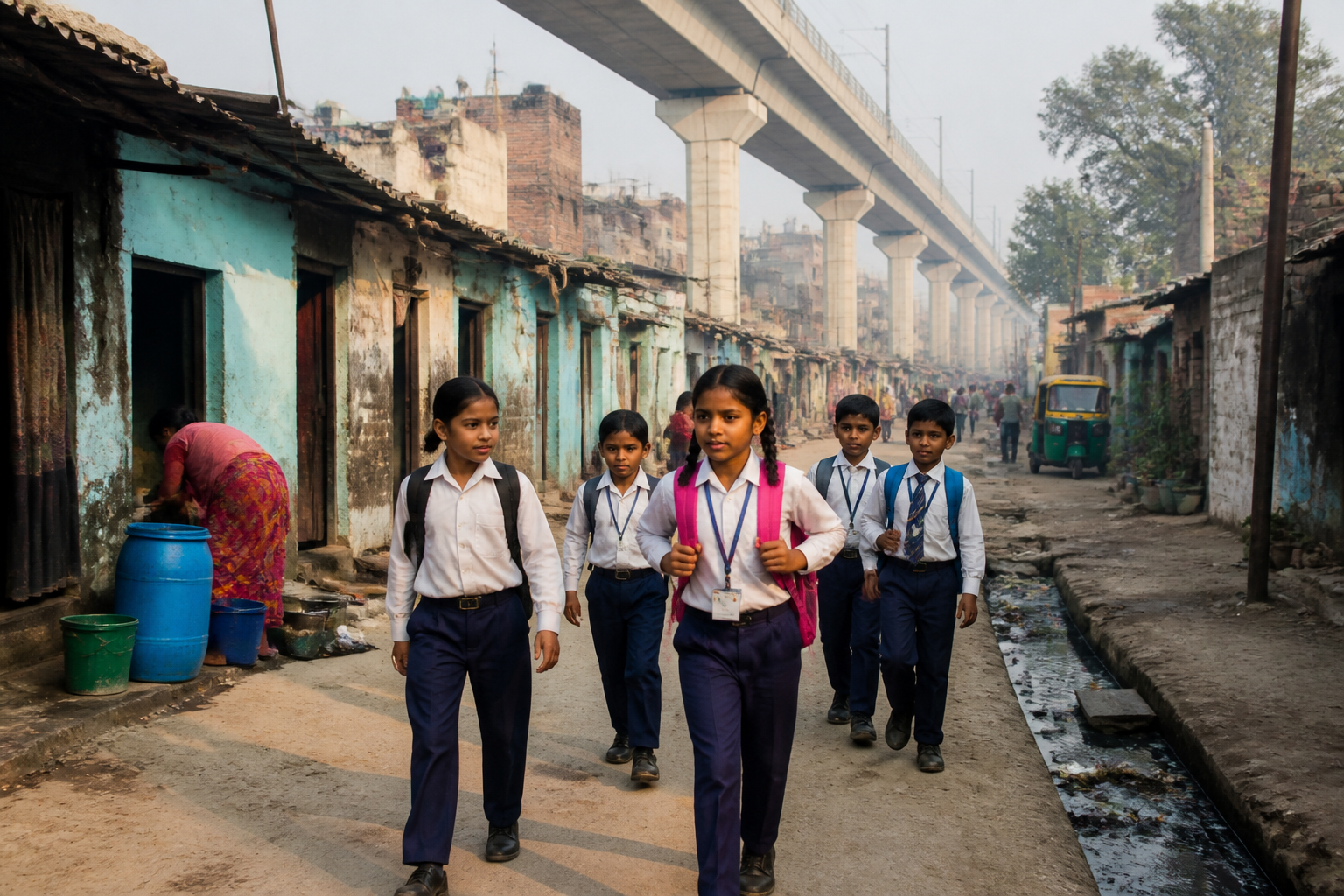
Seventeen children from scavenger families in east Delhi’s Lal Bagh settlement have started attending school after an outreach effort helped their families secure documents, complete admissions and obtain uniforms, bags and books. Another 10 children are expected to join from next Monday, according to Asha Community Health and Development Society, which is supporting the initiative.
For children living in the settlement beneath an elevated Metro corridor in Shahdara, school has traditionally been outside the family routine. Many accompanied their parents to collect discarded clothes, plastic and scrap from different parts of east Delhi, while others remained in the settlement during the day. Their families depend on the sale of reusable material collected from the city’s streets.
The transition into formal education required more than identifying vacant seats. Several parents had never attended school themselves, while children lacked Aadhaar cards, birth certificates and other documents needed during admission. Families also had to be persuaded to release children from work or household routines that contribute to their limited earnings.
Asha teams have repeatedly visited the settlement, counselled parents and assisted with documentation and admission formalities. The organisation has also provided uniforms, school bags, books and stationery. A small learning centre with a blackboard and books has been established inside Lal Bagh to prepare more children for school.
The settlement is home to around 6,000 people across nearly 400 families, many living in shanties measuring about 10 feet by 10 feet. The area has open drains, poor sanitation, unsafe water sources and limited access to healthcare. Asha estimates that approximately 250 school-age children live in the settlement, meaning the first 17 admissions represent only a small proportion of those who could require support.
The children’s school attendance is also linked to the working hours of their parents. Many adults leave around 4am to collect scrap and discarded clothing and return between 10.30am and 11am, often with their children. Anita, Asha’s team leader in Lal Bagh, said children who had previously entered school sometimes stopped attending when families returned to their villages for months.
“Admission, consequently, marks the beginning rather than the end of the effort,” Anita said, adding that the organisation would track attendance and, in some cases, ask parents to provide written assurances that their children would attend school daily.
Health is another barrier. A mobile clinic visits Lal Bagh twice a week, while about 45 residents receive meals each day based on their nutritional needs. Kusum, who oversees the clinic, said malnourishment was common among the children and could prevent them from attending school. One severely anaemic child who was previously unable to walk has recovered after intervention and may soon be able to attend classes.
For families such as Satrupa’s, the first admission marks a change after years of exclusion from formal education. She said her seven-year-old had started attending school, although her older children, aged eight and 10, remained out of school. Asha said its next step would be to bring more children into classrooms while ensuring that those already enrolled continue attending regularly.
