


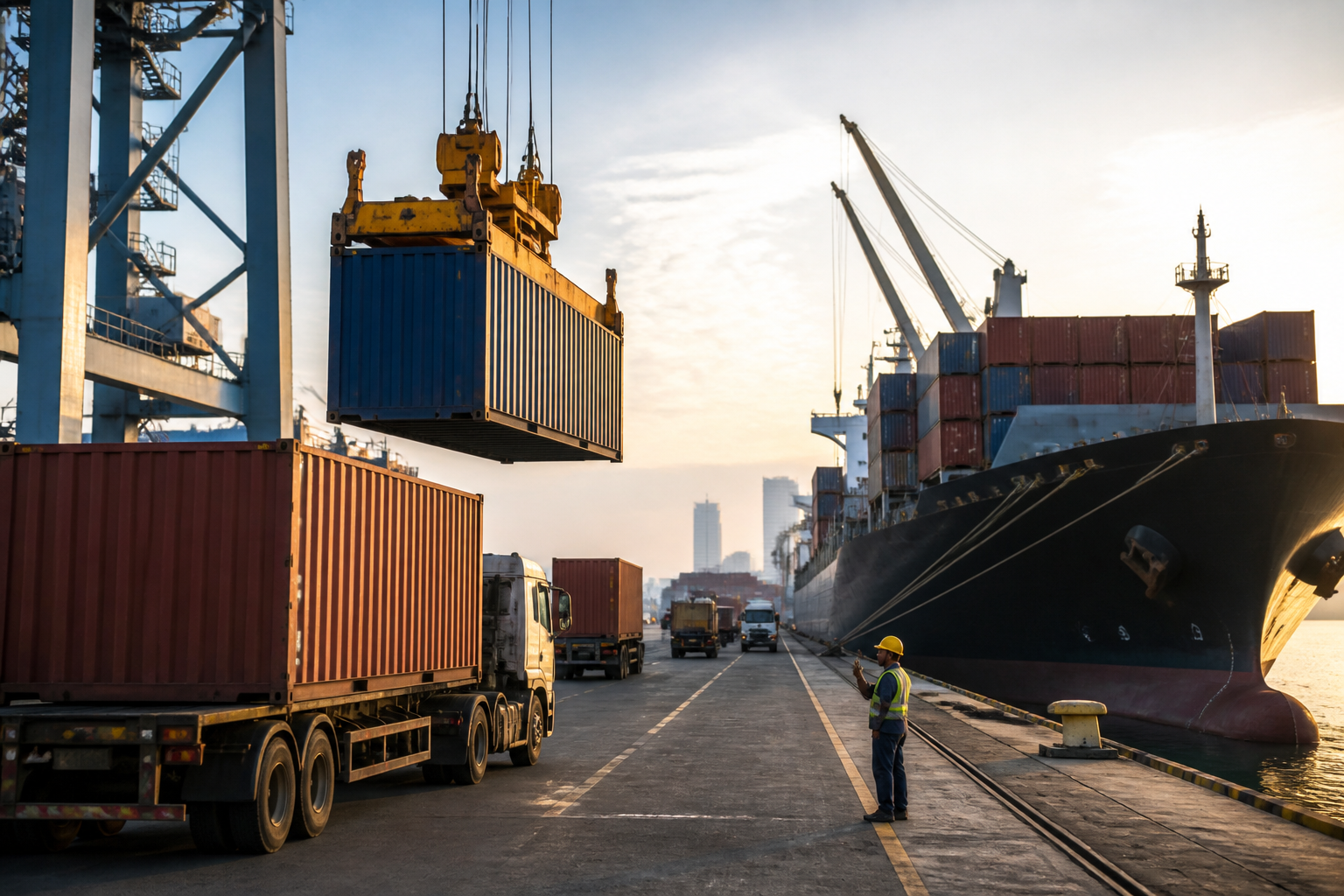
India’s export surge in August 2026 offers a more complicated picture than a single headline number suggests. Overall exports rose 25.41% year-on-year to an estimated $82.68 billion, while the total trade deficit narrowed to $9.41 billion from $11.62 billion a year earlier. Yet imports also increased sharply, and the merchandise trade deficit remained at $26.86 billion. The result is a stronger external performance, but not a clean break from India’s dependence on imported energy, electronics and other inputs.
That distinction matters to the urban economy because exports are not only a measure of overseas demand. They also reflect the performance of manufacturing clusters, ports, freight networks, industrial supply chains and service-sector centres. The data released in August indicates that more goods and services are moving through this system. It also shows that the strength of India’s export growth is distributed across commodities and markets rather than being driven by one isolated category.
The first important signal is the gap between overall exports and merchandise exports. Overall exports, which include goods and services, increased to $82.68 billion from $65.93 billion in August 2025. Merchandise exports rose 26.12% to $43.81 billion from $34.74 billion. Services exports were estimated at $38.87 billion, up 24.61% from $31.19 billion a year earlier.
This combination gives India’s trade performance two distinct engines. The merchandise side reflects factories, processing units, engineering businesses, petroleum facilities, chemical producers, textile manufacturers and the logistics infrastructure needed to move physical goods. The services side reflects a different set of economic activities, including the export of service output from India-based businesses. The supplied trade data does not disaggregate the services figure by sector or city, but its scale shows why the overall deficit is considerably narrower than the merchandise deficit.
Imports, however, rose alongside exports. Overall imports increased to $92.09 billion in August from $77.55 billion in the same month last year. Merchandise imports rose to $70.67 billion from $61.96 billion, producing a merchandise trade deficit of $26.86 billion. That deficit was lower than the $27.20 billion recorded in August 2025, but the improvement was modest compared with the pace of export growth.
The figures therefore reveal a structural tension. Export expansion can improve the trade balance even when imports grow, provided exports rise faster. But a growing import bill also indicates that production and consumption remain connected to supplies from outside the country. The commerce secretary identified energy products, including petroleum, crude oil and coal, coke and briquettes, as major contributors to the trade deficit during the first five months of the fiscal year. Electronic goods were another significant driver of import growth.
For industrial cities and manufacturing corridors, this distinction is consequential. Higher exports can mean stronger demand for factory output, warehousing, freight handling and supporting services. But when the same production system relies heavily on imported energy or electronic components, the value captured domestically depends on how much of the exported product is made or assembled within India and how much is sourced from abroad. The August figures establish that both export activity and import dependence are expanding; they do not, by themselves, establish how much domestic value is being retained.
## India exports August 2026: the volume question
The government’s interpretation of the data places emphasis on volumes, not only prices. Commerce secretary Rajesh Agrawal said the export increase was not merely value-led and also reflected higher shipment volumes. Of the 168 principal commodities tracked, 68 recorded both volume and value growth. This is one of the more significant details in the report because it suggests that the increase was accompanied by higher manufacturing and shipment volumes across a substantial group of products.
The distinction between value and volume is central to understanding the health of an export system. A rise in dollar value can occur because prices increase, even if the amount physically shipped does not. When both value and volume rise, the evidence is stronger that producers are sending more goods into external markets. The available data does not provide a complete breakdown of the remaining 100 commodities, so it cannot establish that the entire export basket expanded in physical terms. It does, however, indicate that volume growth was present across 68 tracked categories.
The strongest reported merchandise categories were engineering goods, petroleum products, chemicals and textiles. Electronic goods exports rose by around 30% in the first five months of the fiscal year, while engineering goods exports increased by more than 20%. Organic and inorganic chemical exports rose 14%, and marine products grew by more than 14%.
This mix points to a broad industrial base, but it also shows why aggregate export growth needs to be read category by category. Engineering and chemical exports are linked to manufacturing capacity and industrial supply chains. Textiles and marine products draw on different production systems, labour arrangements and logistics requirements. Petroleum products can strengthen export values while remaining closely connected to imported crude and other energy inputs. A single overall growth rate cannot distinguish these different forms of economic activity.
Market diversification is the other important part of the August picture. During the first five months of the fiscal year, exports to China rose 39%, exports to Singapore increased by more than 97%, exports to South Africa rose 58% and exports to Malaysia increased by more than 75%. Exports to BRICS countries grew 13.3% to $34.5 billion. Agrawal said Indian exports were seeing demand from the United States, the European Union, BRICS countries and other emerging economies.
These numbers suggest that export growth is not dependent on a single destination in the reported period. That can matter for industrial producers because access to more markets may allow businesses to distribute demand across regions. At the same time, the report does not provide enough information to assess whether the growth in each market is concentrated among a few large companies or spread across smaller manufacturers and service providers. Nor does it establish whether new demand is producing durable contracts or reflecting short-term changes in orders.
## Trade agreements and the infrastructure question
India’s effort to diversify markets is being supported by changes in trade access. The report states that the trade deal with Britain is now in force, while a broader agreement with the European Union is moving towards implementation. Such agreements can provide greater market access for Indian goods, but market access alone does not guarantee export growth. Producers still need the capacity to meet standards, maintain volumes, manage delivery schedules and absorb the costs of moving goods from factories to ports and overseas markets.
The supplied material does not provide data on port capacity, freight rates, customs processing, road or rail connectivity, or the regional location of the exporting firms. Those gaps matter because the urban and infrastructure consequences of trade growth cannot be measured through national export totals alone. A rise in shipments may benefit cities with industrial clusters and logistics facilities, but the distribution of that benefit depends on where production takes place and how efficiently goods move through the transport network.
The April-August figures show that the August performance was part of a wider trend. Merchandise exports during the first five months of the fiscal year rose 17.85% to $215.91 billion, while imports increased 18.21% to $363 billion. The import growth rate was therefore slightly higher than the export growth rate across that period, even though August itself recorded faster export growth than import growth.
That contrast is important. A strong month can narrow the deficit without changing the direction of the broader five-month balance. It also explains why the commerce secretary’s description of an accelerated export momentum must be read alongside the continuing rise in imports. The data supports a positive assessment of export performance, but it does not show that the trade deficit has been structurally resolved.
The monthly comparison adds another layer. Merchandise exports declined from $44.24 billion in July to $43.81 billion in August, while merchandise imports fell from $76.22 billion to $70.67 billion. The August merchandise deficit of $26.86 billion was below the $32 billion expected by economists in a Reuters poll and the $31.98 billion deficit recorded in July. The monthly fall in both exports and imports means that the narrower deficit was partly produced by a sharper decline in imports.
Gold imports also fell sharply, to $2.3 billion in August from $5.4 billion a year earlier, a decline of 57.7%. That reduction helped limit the import bill, but the report does not establish whether it represents a lasting change in demand or a month-specific movement. Energy products and electronic goods continued to be identified as important sources of import pressure.
The larger urban question is whether export growth can become a deeper industrial capability rather than only a higher national total. The available evidence is encouraging on the breadth of commodity and market performance: 68 of 168 tracked commodities recorded both volume and value growth, while engineering, chemicals, textiles, petroleum products and electronic goods all contributed to the reported expansion. But the same evidence also shows that India’s manufacturing and trade system remains exposed to imported energy and electronics.
For policymakers and city administrations, the relevant issue is not simply whether exports rise next month. It is whether industrial areas, freight systems, workers, service providers and urban utilities can support sustained production without increasing bottlenecks or import dependence. The report does not contain enough evidence to answer that question at the city level. What it does establish is that India’s external trade performance is improving through a broad mix of goods and services, while the underlying structure of the deficit remains shaped by imports.
August’s numbers therefore confirm a stronger export cycle, not the end of the trade challenge. The next developments to monitor are whether the volume gains reported across principal commodities continue, whether new market-access agreements translate into sustained shipments, and whether import growth—especially in energy and electronic goods—begins to moderate relative to exports.
