


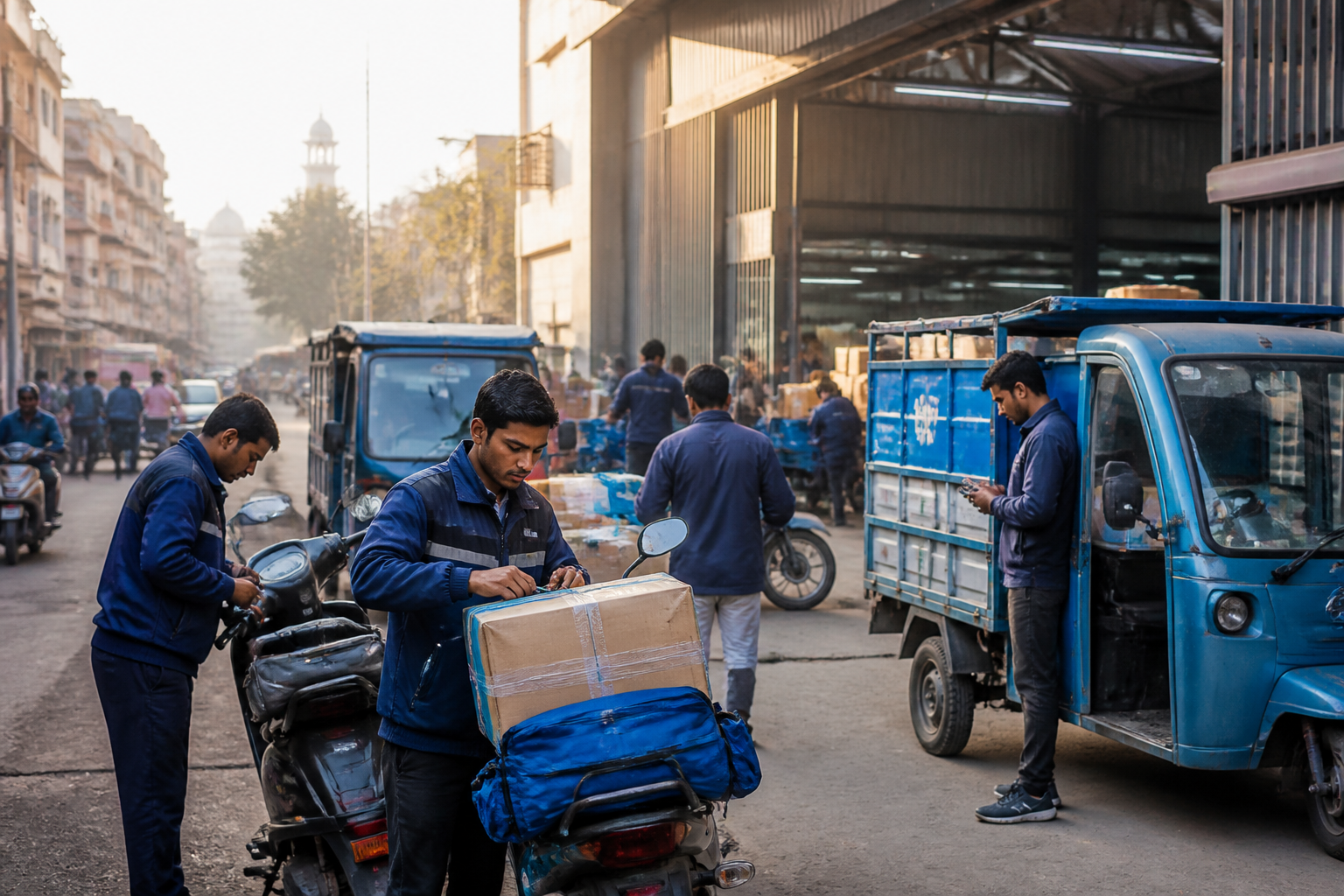
Flipkart’s plan to hire more than 250,000 direct and indirect workers for the 2026 festive season is not only a recruitment announcement. It is also a snapshot of how India’s digital commerce economy is reorganising the physical systems that move goods through cities and smaller urban centres. The company says 60% of the new positions will be in last-mile delivery and that it will add more than 900 festive delivery hubs as demand rises ahead of its Big Billion Days sale.
The scale of the plan is significant within the company’s own operating network. Flipkart said the proposed recruitment is 30,000 positions higher than its 2025 festive-season hiring. About 75,000 openings, or 30% of the total, will be for people entering the workforce for the first time. The company also said the supply-chain workforce will receive medical and accident insurance, access to a 24×7 doctor-on-call service and e-Shram registration.
The announcement places last-mile logistics at the centre of the festive commerce cycle. Unlike warehousing or long-distance freight, last-mile delivery is experienced directly at the neighbourhood level. It depends on the availability of delivery personnel, local hubs, route planning, road access and the ability to process a sharp increase in parcels without slowing down the network. Flipkart’s stated focus is greater delivery speed nationwide, with the company saying that it has achieved two-day delivery for Flipkart-fulfilled products.
That objective changes the role of the delivery hub. A hub is not simply a storage point. It is an operational link between larger fulfilment facilities, delivery routes and customers’ homes, offices and local collection points. Flipkart’s planned addition of more than 900 festive hubs indicates an effort to bring parts of the delivery network closer to demand. The announcement does not specify the location, size, ownership model or operating capacity of these hubs, so the precise urban footprint of the expansion cannot be established from the available information.
## The infrastructure behind festive demand
Festive-season hiring shows how e-commerce growth creates demand for physical capacity even when the customer transaction is digital. A purchase may take place through a mobile application, but the promised delivery depends on roads, sorting facilities, neighbourhood access and a workforce capable of completing multiple deliveries within a defined period. The more quickly customers expect orders to arrive, the more important the distribution of local hubs becomes.
Flipkart said nearly 140,000 of the new positions will be additional last-mile employment opportunities. That figure is lower than the company’s overall hiring plan because the total includes direct, indirect and contract workers across the wider supply chain. The distinction matters: the headline number represents the full employment ecosystem connected to seasonal demand, while the last-mile figure identifies the segment most directly tied to doorstep delivery.
The company’s statement also connects the expansion to Flipkart Minutes and to rising demand in Tier 2 and Tier 3 markets. These markets are not described in detail in the supplied material, and the company has not provided a city-wise breakdown of hiring or hub additions. Still, the stated direction is clear: the logistics network is being expanded beyond the largest metropolitan markets, where delivery infrastructure and customer density are generally more established.
This makes the festive season a test of network reach as well as sales capacity. A retailer can increase inventory and marketing, but orders cannot be converted into completed transactions unless the delivery system can absorb the surge. Temporary recruitment and additional hubs provide a way to add capacity for a defined period. They also reveal the extent to which e-commerce companies rely on flexible labour and distributed infrastructure during peak demand.
## Employment is becoming part of urban logistics capacity
The 75,000 first-time entrants highlighted by Flipkart show how large delivery networks can function as an entry point into the formal economy. Rajneesh Kumar, chief corporate affairs officer at Flipkart Group, said the company wanted digital-commerce growth to create pathways into employment and entrepreneurship, including for communities that have historically had fewer opportunities to participate in the formal economy.
That claim should be read alongside the structure of the hiring plan. The company says it will recruit direct, indirect and contract workers, but the supplied announcement does not provide a detailed breakdown of employment status, compensation, working hours or retention after the festive period. It therefore establishes the scale and intended composition of recruitment, but not the longer-term quality or durability of every job created.
The company said women account for 20% of its supply-chain workforce. This is a workforce composition figure rather than a specific target for the 2026 festive recruitment drive. It nevertheless indicates that gender participation is being presented as part of the supply-chain expansion. The announcement does not identify the roles held by women, the locations covered or the measures used to support participation.
Insurance, doctor-on-call access and e-Shram registration are also presented as support measures for the supply-chain workforce. E-Shram registration connects eligible unorganised workers to a national database, but the supplied material does not state how many workers will be registered or what additional benefits they will receive through the arrangement. The announcement therefore points to a formalisation mechanism without providing enough information to assess its practical reach.
## A competitive logistics race
Flipkart’s recruitment plan is part of a wider effort by large e-commerce companies to prepare for the festive sales period. Economic Times reported that Amazon India is hiring up to 160,000 temporary workers this season, 10,000 more than last year. The comparison shows that seasonal employment and delivery capacity are becoming competitive elements of online retail operations.
The two figures are not directly equivalent in every respect. Flipkart’s announcement covers more than 250,000 direct and indirect workers, including contract workers, while the Amazon figure is described as temporary workers. Even so, both plans point to the same operational problem: a short period of elevated demand requires companies to expand staffing and delivery capacity quickly.
For cities, the implications are distributed rather than concentrated in one major project. New hubs may occupy existing commercial or industrial spaces, while delivery workers add traffic and activity across residential neighbourhoods, market areas and business districts. The supplied information does not establish whether the new hubs will require new construction, changes in land use or additional municipal permissions. It does establish that the physical delivery network is expanding alongside online demand.
This distributed model makes the urban impact harder to measure than a conventional infrastructure project. A metro line or warehouse campus is visible and usually linked to a defined approval process. Hundreds of smaller delivery facilities and a large temporary workforce are more dispersed. Their combined importance lies in how they alter the daily movement of goods through the city, rather than in the visibility of any single site.
## What the announcement confirms—and what remains unclear
The available evidence confirms five developments. Flipkart plans to recruit more than 250,000 direct and indirect workers for the 2026 festive season; the plan is 30,000 positions larger than the company’s 2025 festive hiring; 75,000 openings are intended for first-time entrants; 60% of the new jobs are expected to be in last-mile delivery; and more than 900 festive delivery hubs are being added. Flipkart also says the expansion includes nearly 140,000 additional last-mile employment opportunities.
The evidence does not establish how many roles will continue after the festive season, how workers will be distributed across cities, or how the additional hubs will be funded and operated. It also does not provide data on delivery volumes, hub utilisation, worker earnings, accident rates or the effect of the expansion on local traffic and public infrastructure. Those are important questions, but answering them would require company disclosures, labour data, municipal information or independent research not included in the announcement.
The immediate significance of the plan is therefore operational. Flipkart is responding to expected festive demand by adding people and decentralised delivery capacity. Its emphasis on two-day delivery, Tier 2 and Tier 3 markets and Flipkart Minutes suggests that speed and geographic reach are central to the company’s current logistics strategy, although the supplied material does not provide performance data to measure the results.
For urban India, the broader issue is how digital consumption translates into physical employment and infrastructure. The festive hiring plan shows that online retail growth still depends on neighbourhood-level networks and workers who can connect those networks to customers. The next developments to monitor are the locations and operating arrangements of the 900-plus hubs, the duration of the new jobs, the distribution of the 75,000 first-time opportunities and whether the promised worker-support measures extend across the full direct, indirect and contract workforce.
