


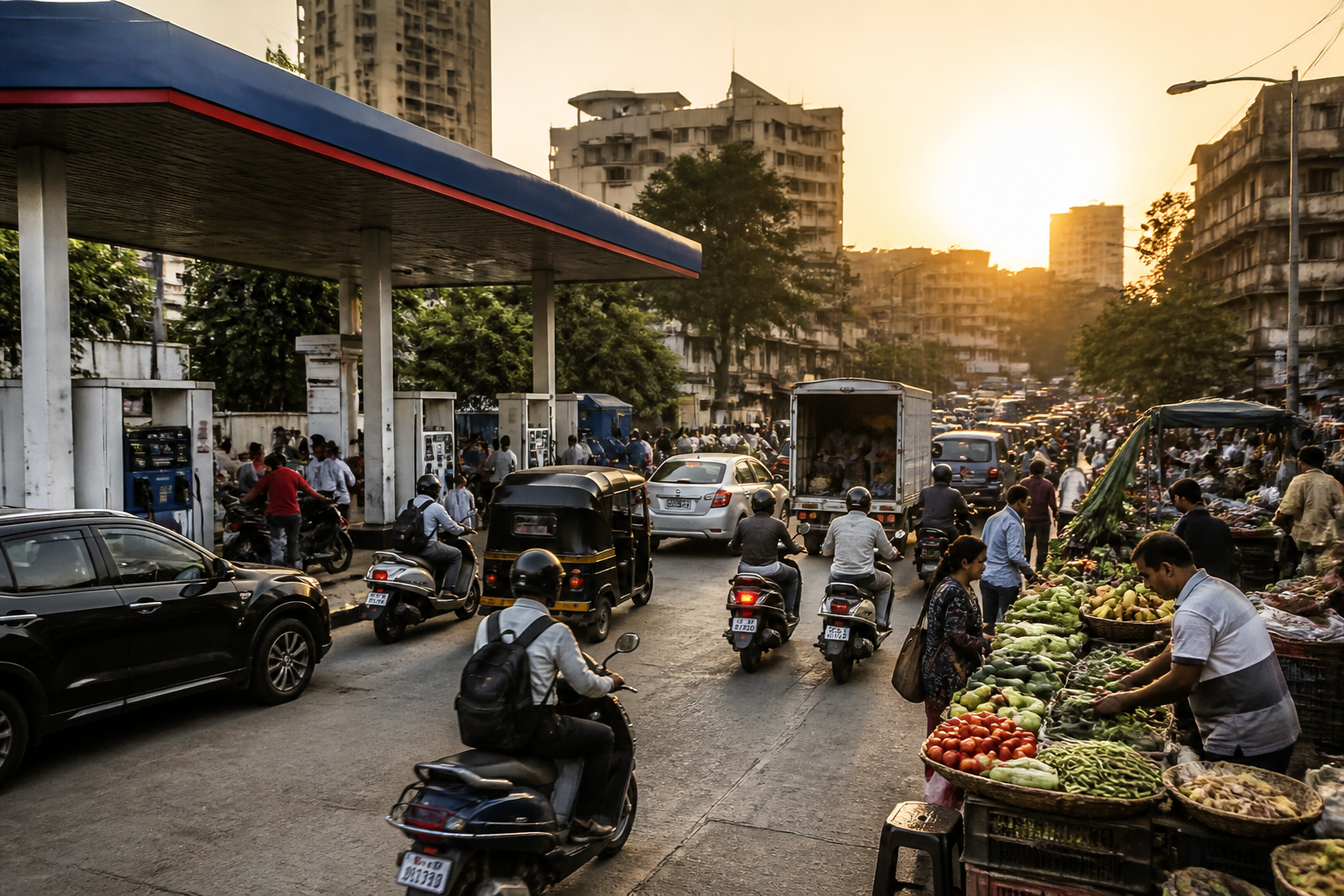
India’s latest inflation data shows a contained consumer-price problem alongside a sharper wholesale-price shock, creating a difficult policy signal for the Reserve Bank of India. Retail inflation rose to 4.82% in August from 4.45% in July, remaining within the RBI’s 2-6% tolerance band, while wholesale inflation increased to 9.9% from 9.8%. The divergence matters because households, producers and urban businesses do not experience price pressure through the same channels.
The immediate concern is not that retail inflation has breached the RBI’s tolerance range. It has not. The concern is that the structure of price increases is changing. Food and beverages, which carry a weight of around 37% in the Consumer Price Index, recorded inflation of 5.7% in August, up from 5.3% in July. At the same time, the fuel and power component of the Wholesale Price Index rose sharply, with inflation increasing to 22.9% from 20.1%.
That combination creates a potential transmission problem for cities. Households encounter inflation through food, transport and daily consumption. Businesses encounter it through energy, manufactured inputs, logistics and operating costs. A wholesale shock may therefore appear before its full effect is visible in the retail index. The latest data does not establish the scale or timing of that pass-through, but it shows that the pressure is already more intense at the production and distribution end of the economy.
The two indices are designed to measure different parts of the economy. CPI tracks the prices paid by consumers, while WPI captures movements in wholesale markets. Their composition and underlying dynamics differ, so they can move in different directions. This distinction is important for urban policy because cities combine both sides of the price system: they are large consumer markets and also centres of manufacturing, logistics, construction and services.
The August CPI figure was broadly in line with expectations and almost identical to a Bloomberg forecast cited in the source report. The article also notes that unless there is a significant increase in the September CPI print, inflation for the quarter ending September is unlikely to differ substantially from the Monetary Policy Committee’s August forecast of 4.7%. That provides some near-term stability, but it does not remove the risk associated with energy prices.
Food and fuel remain central to that risk. Retail inflation’s non-core component increased from 1.9% in January 2026 to 5.6% in August, while core inflation rose more gradually from 3.3% to 4.3% over the same period. The pattern suggests that the recent acceleration has been driven more strongly by food and fuel than by a broad-based increase across all consumer categories. For urban residents, this distinction is significant because essential spending can absorb a larger share of household budgets even when core inflation remains comparatively moderate.
The wholesale data adds another layer. Inflation in manufactured products rose from 8.3% to 8.4%, while food inflation under WPI increased from 6.7% to 7.1%. Output PPI, which measures prices received by producers after excluding net taxes and trade and transport margins, recorded year-on-year inflation of 9.8% in August, up from 9.6% in July. Together, these figures point to continuing pressure in the supply chain, although they do not by themselves show how much of that pressure will reach final consumers.
Energy is the main variable that could alter that balance. The source report says international benchmark crude crossed $100 per barrel earlier in September and was trading at $108.76 as of 18:56 IST on Monday. It also reported India’s crude oil basket at $119 per barrel on September 11. The report attributes the movement to disruption risks around the Bab Al-Mandab Strait and the wider West Asia conflict, while noting that analysts expect energy prices to rise significantly unless traffic through Hormuz and Bab Al-Mandab returns to normal.
For India’s cities, the relevance of crude prices extends beyond petrol and diesel. Energy costs are embedded in freight, public and private transport, food distribution, manufacturing and many services. The supplied evidence does not quantify the effect on municipal operations, construction costs or household transport bills, so those impacts cannot be stated as measured outcomes. But the institutional pathway is clear: higher energy costs first affect wholesale and producer prices, and may later influence the prices faced by consumers if fuel retailers, transport operators and businesses adjust their charges.
The policy complication is that fuel prices have remained unchanged at government-run retailers for 123 days, despite fuel markets moving higher. The report says fuel prices in India are deregulated on paper, while also noting that public-sector retailers have not raised prices since May 15. This creates a gap between international energy costs and the prices immediately visible to consumers. If that gap remains, some pressure may be absorbed elsewhere in the economy or reflected later through a sharper adjustment.
That possibility is shaping expectations for monetary policy. State Bank of India Chief Economist Soumya Kanti Ghosh called for a 25-basis-point rate increase in October followed by another in December, arguing that if oil prices remain elevated, inflation could move towards 6.5% or higher in October and November. Care Ratings Chief Economist Rajni Sinha said the Monetary Policy Committee would remain data-dependent and that a sustained increase in inflation could strengthen the case for a rate hike. HSBC’s Pranjul Bhandari also forecast two 25-basis-point increases, taking the repo rate to 5.75%.
These are economist views, not policy decisions. The source material does not report an RBI announcement changing the policy rate. The October policy meeting is therefore important because it will test whether the central bank treats the current energy shock as temporary or as a risk capable of becoming embedded in inflation expectations. The decision will also involve a trade-off: higher rates can help restrain demand and inflation, but they can also raise borrowing costs for households and businesses.
That trade-off is particularly relevant in urban economies, where growth depends on credit-sensitive activity such as housing, real estate, construction, vehicles and small businesses. The supplied data does not provide evidence of a slowdown in these sectors, so no such conclusion can be drawn yet. It does, however, establish the conditions under which the cost of money and the cost of energy could begin moving in the same direction, putting pressure on investment and household affordability.
The data therefore presents three separate signals. Consumer inflation remains within the RBI’s tolerance band, which limits the case for treating the current situation as an immediate retail-price crisis. Food inflation is rising and has a large weight in household consumption, making the pressure visible in essential spending. Wholesale fuel, power and manufactured-product inflation is considerably higher, indicating that producers and supply chains are facing a more severe cost environment than the headline CPI alone suggests.
The central urban question is whether that wholesale pressure remains contained or moves through the systems on which cities depend. The answer will depend on crude prices, shipping conditions, domestic fuel pricing, food supply and the extent to which businesses can absorb higher costs. The August data cannot resolve that question. It does show why headline retail inflation is not sufficient to understand the full exposure of India’s urban economy to external energy shocks.
For now, the evidence confirms a mixed picture: retail inflation is moderate but rising, wholesale inflation is high, food prices are strengthening and fuel-and-power inflation has accelerated sharply. The next CPI reading, movements in crude prices, domestic fuel-price decisions and the RBI’s October policy response will determine whether August represents a manageable increase or the early stage of a broader inflation challenge.
