


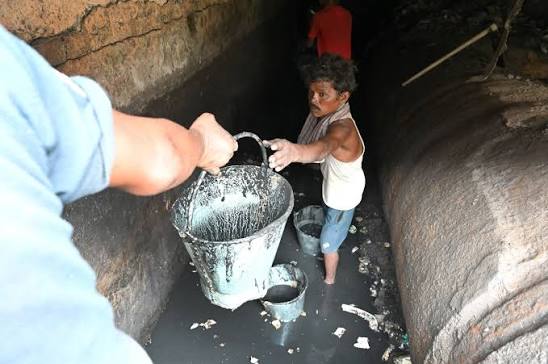
The continuing deaths of sanitation workers in and around Mumbai show that India’s ban on manual scavenging has not ended the practice on the ground. Workers still enter septic tanks, sewers and sewage plants without safety equipment, while families of those who die can wait years for compensation that courts have treated as a statutory responsibility of the state.
The issue is not only the presence of hazardous work. It is the gap between the legal framework governing sanitation and the fragmented way the work is actually commissioned. Buildings, housing societies, contractors and suction-truck operators remain part of the chain through which workers are hired. When an accident occurs, families can be left navigating police complaints, compensation claims and disputes over who is responsible for payment.
That gap is visible in the cases of Chandan Jaiswar and Vikas Kisan Tak, who died in December 2024 after entering a septic tank at a chawl in Uran while attempting to rescue another worker who had collapsed inside. According to the report, an FIR was registered against the contractor, the suction-truck owner and one of the homeowners who had engaged them to clean the tank without safety equipment. Yet the families of the two men were still awaiting the statutory compensation when the report was published.
Chandan’s father, Ratanlal Jaiswar, has been painting vehicles for a living and said he wanted to use the compensation to return to Uttar Pradesh and support his family. Tak’s widow, Archana, has been doing domestic work along with his mother and sister to pay the rent for their room in Asudgaon, Panvel. Tak had worked as a driver-cleaner on a suction truck and also cleaned septic tanks, earning about Rs 17,000 a month, mostly in cash. He was the family’s sole breadwinner.
These cases underline how urban sanitation is often organised outside the regular workforce visible to municipal systems. Arjun Chauhan, a contract worker from Panvel, told the Times of India that he had been entering septic tanks and sewers for 15 to 20 years. He said contractors, buildings and housing societies paid him between Rs 700 and Rs 2,000 a day, depending on the work. He also said that protective equipment was not provided despite the legal requirement.
Chauhan’s account is important because it explains why prohibition alone has not eliminated the work. The legal ban does not itself provide a worker with a stable alternative livelihood when the next job is arranged through informal contractors and payment is made by the day. His statement that he continues because he has to feed his family points to an enforcement problem rooted in the organisation of urban services, rather than simply individual non-compliance.
The available data suggests that the problem is broader than isolated accidents. National Commission for Safai Karamcharis data cited in the report recorded 332 sanitation-worker deaths in 18 states and Union Territories during hazardous cleaning of sewers and septic tanks between January 1, 2021 and June 30, 2026. Maharashtra recorded the highest number, with 58 deaths.
At the same time, official data and reported experiences do not align. A figure tabled by the Maharashtra government in July 2025 recorded zero deaths in Mumbai between 2021 and 2024. Activists disputed that figure. The Centre has also maintained that a survey found no manual scavengers in India. The contradiction is central to the policy problem: a practice that is officially absent becomes difficult to identify, regulate and prevent, even when families and workers report continuing hazardous cleaning.
The classification of deaths also matters. The legal ban covers manual cleaning of manholes, septic tanks and sewers, but the work may be described through terms such as hazardous cleaning, sewer work or septic-tank cleaning. The report’s cases involve workers entering confined spaces to clean or rescue others, often through private arrangements. If official systems record only formally identified manual scavengers, they may fail to capture workers engaged through contractors, housing societies or informal service networks.
That administrative gap has consequences beyond statistics. Without identification, there is no complete list of workers at risk, no reliable record of the employers and agencies commissioning the work, and no automatic mechanism to trigger compensation after a death. Families must instead establish the circumstances of the accident and pursue authorities for payment, often while losing their primary source of income.
The compensation framework has also changed. The Supreme Court raised the compensation for sewer and septic-tank deaths to Rs 30 lakh in 2023 and directed governments to provide rehabilitation, including employment for the next of kin and education for children. The payment was intended to be more than an ex gratia gesture: it was part of a broader obligation to support families after a preventable workplace death.
However, the cases reported from Mumbai show that the revised amount has not translated into timely relief. Nearly seven years after three workers died while cleaning a tank in Govandi in 2019, each widow had received Rs 10 lakh, while the balance remained pending. In another case, the family of Akshay Mandal, who died with Fulchand Kumar Saw while cleaning a sewage plant in Powai in November 2025, received Rs 10 lakh from the contractor on humanitarian grounds but was still awaiting the statutory compensation.
The distinction between humanitarian payment and statutory compensation is significant. A contractor’s payment can provide immediate assistance, but it does not replace the state’s obligation under the compensation framework. Treating the two as interchangeable can shift responsibility away from the public authority and leave families dependent on the willingness or capacity of a private employer.
That question of responsibility was directly addressed by the Bombay High Court in August, according to the report. The state had argued in the Jaiswar and Tak case that, because the workers had been engaged by a private contractor, compensation should be recovered from the employer. The court held that the state must pay the families even when workers are privately engaged and can recover the amount from the employers later. It also struck down Item 11 of the 2019 and 2025 government resolutions, which required private societies or contractors to make the payment instead of the state.
The ruling places the immediate burden of relief on the state while preserving its ability to pursue employers for recovery. In practical terms, that changes the sequence families must navigate. They should not have to wait for a dispute between the government, a contractor, a suction-truck owner, a housing society or a homeowner to be resolved before receiving compensation.
Yet a court ruling can address liability after a death; it cannot by itself eliminate the conditions that produce the death. The report indicates that workers continue to be called to enter tanks and sewers without safety cover. This suggests that enforcement must operate before an accident, through controls over who is authorised to undertake sanitation work, what equipment is required, how workers are trained and how private premises are monitored.
The urban setting makes that challenge particularly complex. Sanitation work takes place across municipal infrastructure, private buildings, chawls, housing societies, sewage plants and individual premises. Responsibility is distributed across public authorities and private actors, while the worker may be hired informally through a contractor or truck operator. A system with many commissioning points but no clear, enforced chain of accountability can allow every participant to treat the worker as someone else’s responsibility.
The financial terms described by Chauhan also show why enforcement cannot be separated from livelihoods. Daily payments of Rs 700 to Rs 2,000 may be the only income available to workers with limited employment alternatives. If the state recognises the hazard but does not provide a credible transition to safer work, the prohibition remains disconnected from the economic reality that sustains the practice.
The Supreme Court’s direction on rehabilitation included employment for the next of kin and education for children. The experiences of the families in Uran, Panvel, Powai and Govandi show why those provisions matter. Tak’s widow and relatives have taken up domestic work to pay rent. Mandal’s father described the loss of income that affected food and festival expenses. Jaiswar said work becomes harder to find during the monsoon. Compensation, employment and education therefore address different parts of the same urban vulnerability: immediate survival, replacement income and the future prospects of children.
The continuing dispute over the number of deaths also raises a governance question. If official surveys find no manual scavengers while the national sanitation-worker death data records hundreds of deaths during hazardous cleaning, the terminology and data collection process require scrutiny. The report does not establish how each agency defines or counts manual scavenging, but the discrepancy itself makes the quality of identification a central issue.
Activists cited in the report argue that the failure to acknowledge the extent of continuing manual scavenging is linked to caste-based discrimination. That claim is part of a wider concern about who performs the most dangerous and least visible urban work. The report records the view of Maharashtra Municipal Kamgar Union representative Milind Ranade that the deaths reflect an attitude that sanitation workers are expected to accept such risks. Safai Karmachari Andolan national convenor Bezwada Wilson said delayed compensation showed that the government had yet to acknowledge the extent of the practice.
The evidence presented does not suggest that Mumbai’s problem is a lack of legal prohibition. India has banned manual cleaning of manholes, septic tanks and sewers, and the Supreme Court has specified compensation and rehabilitation obligations. The more persistent failure lies in converting those rules into routine administrative action: identifying hazardous work, preventing unauthorised entry, recording deaths consistently, ensuring immediate payment and securing rehabilitation for affected families.
The Bombay High Court ruling may clarify who must pay first, but the cases described show that families still face long waits. The next test is whether the ruling produces faster disbursement, whether the revised Rs 30 lakh compensation is paid in full, and whether employment and education support reaches dependants. Equally important is whether authorities can identify workers who remain in the system before another call sends them into a septic tank or sewer.
