


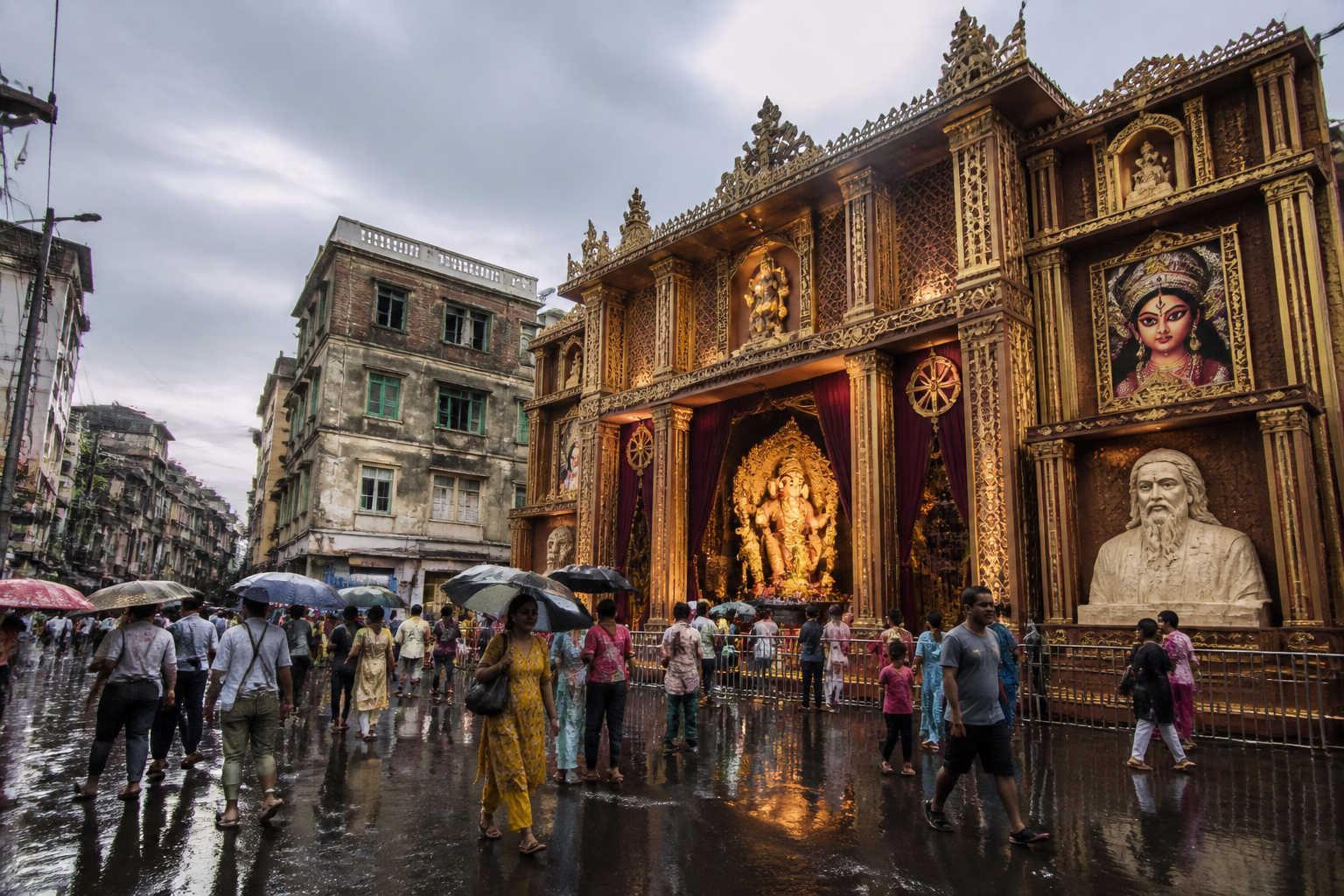
Kolkata Ganesh Puja is becoming more than a prelude to Durga Puja. Across the city, pandals are increasingly being used to express political loyalties, construct cultural identities, remember contested histories and organise charitable activity. This year’s installations show how a festival once associated with relatively low-key community celebration is adapting to Bengal’s changing political mood.
The clearest example is at Janbazar, where a Ganesh pandal carries an image of Durga and a nearby half-bust honours Gopal Mukherjee, a meat seller who organised armed resistance during the 1946 Great Calcutta Killings. The puja was inaugurated on Sunday evening by state BJP chief Samik Bhattacharya. Organisers have presented the installation as a statement about a changed Bengal and as an invitation to Durga into that altered political and cultural landscape.
Ashish Sharma, vice-president of the Janbazar Sri Sri Ganesh Puja Utsav Committee, said Ganapati is worshipped before a new journey and described the state’s political change as a reason for the theme. Sharma, who is identified as a BJP supporter and grassroots organiser, also said the committee had wanted to honour Mukherjee earlier but had been unable to do so because of political pressure. The puja budget is over ₹7 lakh this year, twice the previous year’s allocation.
The Janbazar installation demonstrates how a city festival can become a venue for political symbolism without being formally converted into a political meeting. The choice of figures, visual references and inauguration guests gives the pandal a public language through which organisers can communicate ideas about history, religious identity and political change. Because pandals are located within neighbourhoods and remain accessible to passers-by, these messages reach audiences beyond party offices or campaign platforms.
The political use of Kolkata’s festival spaces is not confined to one ideological position. Around the same time last year, a Ganesh Puja pandal on Anwar Shah Road displayed lines from Pratul Mukhopadhyay’s song “Ami Banglay gaan gai / Ami Banglar gaan gai”, a well-known expression of Bengali identity. The theme was presented as a protest against the alleged harassment of Bengali-speaking people, many of them Muslim working-class residents, by police in BJP-ruled states. That issue had become a major electoral theme for the Trinamool Congress. The organisers were perceived to be close to the then ruling party and said their budget was lower than in earlier years.
The contrast between the Janbazar and Anwar Shah Road themes is significant because it shows that the same festival format can carry competing definitions of belonging. One pandal invokes a nationalist and Hindu cultural vocabulary; another foregrounds the Bengali language and alleged discrimination against Bengali-speaking workers. In both cases, the pandal functions as a neighbourhood-scale public platform. Its design is not merely decorative: it places political arguments within a familiar ritual and urban setting.
This transformation reflects the wider influence of Durga Puja on Kolkata’s festival culture. Durga Puja has long been associated with elaborate themes, artistic installations and public commentary. Ganesh Puja, by comparison, was described as a relatively low-key prelude to the festive season. Increasingly, however, Ganesh Puja organisers are adopting the theme-based approach associated with Durga Puja, turning temporary structures into spaces for social commentary and cultural assertion.
The shift also shows how urban festivals operate as flexible civic institutions. Pandal committees raise money, select themes, invite political figures, manage public gatherings and organise welfare activities. They are neither conventional government bodies nor ordinary private associations, but they can influence how neighbourhoods present themselves and how residents encounter public questions. Their decisions over design and programming provide a visible record of the issues that organisers believe will resonate locally.
Not every theme is explicitly political. In Kasba, the P. Majumdar Bridge Indu Park Garden Committee’s 16th Ganesh Puja is modelled on a lotus. Its secretary, Shankar Das, said there was no politics in the installation and that the committee tried to incorporate a theme each year. The statement is a reminder that the spread of themed pandals does not mean every design is intended as political communication. Some committees use visual concepts primarily to create an attraction or maintain a recurring community tradition.
Yet even non-political themes exist within a festival environment where public attention is increasingly organised through visual storytelling. A lotus-shaped pandal, a historical bust, a language-based message or an installation responding to a public tragedy all compete for attention in the same urban landscape. The common feature is the conversion of a temporary religious structure into a public-facing narrative space.
Earlier themes cited in the report show how quickly this format can respond to collective concerns. Ganesh Puja pandals have previously reflected the campaign for justice in the RG Kar rape and murder case. In 2022, some incorporated Covid safeguards such as masks and social distancing into their designs. These examples place political messaging within a broader pattern: pandals can absorb urgent events, public anxieties and social campaigns, then translate them into visual forms that are encountered during everyday movement through the city.
The physical geography of the festival matters. Pandals have come up across Kolkata, from Janbazar and Anwar Shah Road to Kasba, Bhowanipore and Behala. The report also records a 19-foot idol at the Sri Sri Ganesh Puja on Brajamani Debya Road and more than 1,000 fresh laddus being distributed by the Ganapati Bhakt Mandal Ganesh Puja on Rakhal Mukherjee Road. These details show that the festival’s urban presence is built through multiple layers: visual spectacle, food distribution, religious observance, political messaging and community service.
Charity is an important part of this network. Blood donation camps, meals and clothing distribution for marginalised people are included in several pujas. Organisers at the Behala puja said clothes would be distributed among around 500 underprivileged people on Tuesday. Such activities give committees a role that extends beyond the duration of rituals. They also connect festival spending to visible forms of neighbourhood welfare, even though the report does not establish the total scale or institutional structure of this assistance.
The budgets and public programmes indicate that Ganesh Puja is also becoming more organisationally ambitious. At Janbazar, spending has doubled to more than ₹7 lakh in a year. The report does not provide comparable budgets for all the other pujas, so the Janbazar figure cannot be treated as a citywide trend. It does, however, show how a committee can allocate substantially more resources when its festival is designed to carry a larger public message.
Political inaugurations add another institutional layer. The Janbazar puja was inaugurated by the state BJP chief, while the Anwar Shah Road puja was inaugurated by BJP MLA Papiya Adhikari. The report notes that former Trinamool heavyweight Aroop Biswas, the defeated candidate from Tollygunge, had inaugurated the same puja in earlier years. These changes in who opens a neighbourhood festival demonstrate how pandals can become points of contact between political representatives and local associations.
That contact does not necessarily mean that every committee is controlled by a political party. The available evidence instead shows a spectrum: some organisers openly articulate political positions, some deny political intent, and some use the pandal to address social issues without a declared party affiliation. What changes is the visibility of these associations. An inauguration, a theme and a public installation can together create political meaning even when the event remains formally a religious celebration.
The weather remains a practical constraint on this public culture. Persistent rain and overcast conditions have worried organisers, with light to moderate rain expected on the main day of the festival. Weather affects footfall, electrical arrangements, idol protection, food sales and the safety of temporary structures. That operational reality sits alongside the symbolic role of the pandals: the festival’s political and cultural messages still depend on the ability of residents to gather, visit and move through the city.
Kolkata’s Ganesh Puja therefore offers a useful view of how urban public space is negotiated outside formal planning processes. Temporary structures can reshape streets and neighbourhood visibility for several days, while committees decide which histories, identities and grievances receive public display. The city’s festival landscape becomes a parallel civic arena, one where cultural assertions are made through images, budgets, invitations and acts of charity rather than through official policy documents.
The evidence confirms that Kolkata’s Ganesh Puja is acquiring a more pronounced theme-based and public-facing character. It does not establish that all pandals are politically aligned or that one cultural narrative has displaced another. Instead, it shows competing claims being placed within the same festival network: nationalist symbolism at Janbazar, Bengali identity at Anwar Shah Road, non-political design at Kasba, public-health and justice themes from earlier years, and charity across neighbourhood committees. The developments to monitor are whether this political and cultural use of pandals expands further, how committees balance public messaging with religious observance, and whether festival spaces continue to serve as platforms for civic welfare as well as identity claims.
