


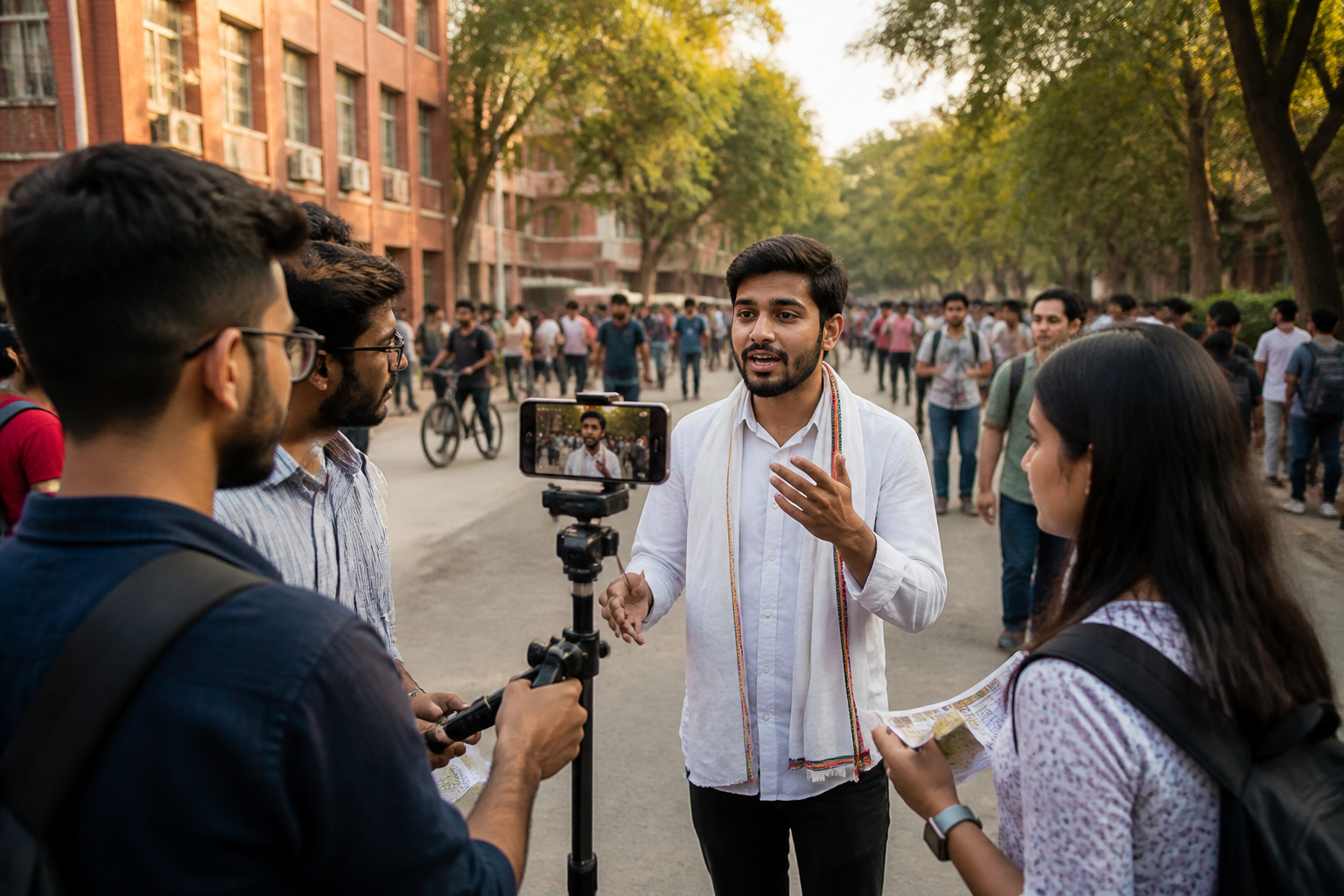
Delhi University’s DUSU campaign is moving from college gates and physical marches to reels, influencers and short-form videos, showing how restrictions on posters and printed material are changing not only the way candidates reach voters but also the use of campus space. The shift ahead of the September 18 election places digital visibility at the centre of student politics, while raising a less visible question: whether moving campaigns online reduces their physical footprint or simply transfers the contest to a faster, more crowded public sphere.
The immediate change is visible in the campaign format. Candidates are using short videos for introductions, campus humour, issue-based messaging and image-building. Content creators are helping produce these campaigns, bringing editing, trend awareness and platform-specific storytelling into an election that was once built primarily around face-to-face interaction, meetings, marches and personal networks.
This is not only a technological adjustment. It is a change in the relationship between candidates, voters and the spaces in which political communication takes place. The physical campaign traditionally occupied college entrances, roads, common areas and student networks. The digital campaign occupies timelines and feeds, where a message can travel quickly but can also disappear from attention just as rapidly.
The difference matters because university elections are forms of institutional governance. Candidates are not merely promoting personal brands; they are competing to represent students and influence the public conversation around campus concerns. When that conversation moves to platforms designed for rapid consumption, the campaign’s most visible qualities can become its editing, humour, appearance, speaking style and ability to participate in online trends.
A student involved in creating election-related content told the Times of India that long speeches may struggle to hold students’ attention, while a short video can succeed when it is entertaining, relatable or connected to a campus issue. The observation helps explain why reels have become useful political tools: they reduce a long pitch to a few seconds and allow candidates to package a recognisable identity for an audience already accustomed to consuming information through short-form video.
The same creator said social media had become a natural substitute as restrictions on printed material increased. Digital formats also allow campaigns to use cars, props and other visual elements in videos even when comparable displays cannot be part of physical campaigning on campus. In this sense, online campaigning does not eliminate the visual competition of elections. It relocates it into edited and repeatable content.
For students, the move can make political exposure feel more voluntary. Kavya, a first-year student quoted in the report, said she preferred being able to choose when to engage with campaign content rather than encountering candidates outside classrooms or sitting through a long speech. If a reel interests her, she watches it; otherwise, she can scroll past.
That preference reflects an important change in the idea of access. Physical campaigning creates encounters that students may not have chosen but cannot easily avoid. Digital campaigning gives users more immediate control over whether to watch, skip or revisit a message. Yet this control exists within platforms where visibility is also shaped by repetition, shareability and the ability of content to capture attention quickly.
The report does not establish how students decide whether a reel is credible, how campaign spending is divided between physical and digital activity, or whether online reach translates into votes. Those questions remain important because visibility and representation are not identical. A candidate may become recognisable through a polished digital identity without giving voters a fuller account of their programme or institutional priorities.
The campaign’s online turn is also linked to the physical condition of university elections. A senior university official said encouraging social media campaigning could help limit defacement of public spaces and reduce pollution associated with conventional campaign materials. The statement places digital campaigning within an administrative objective: reducing the material impact of elections on the campus environment.
Posters, printed leaflets and other campaign materials can leave behind waste and marks on walls and public surfaces. Restrictions on such material therefore affect more than campaign aesthetics. They shape how campuses are maintained, how election activity is regulated and how public space is treated during a high-energy political contest.
However, moving campaign material online does not make the election impact-free. The supplied report does not provide figures on the amount of printed material avoided, the volume of digital content produced or the environmental cost of online activity. It therefore supports the conclusion that digital campaigning can reduce visible defacement and some conventional campaign pollution, but not a broader claim that it is automatically sustainable.
The institutional shift is particularly significant because the university administration is not simply tolerating a new communication channel. By indicating that social media campaigning would be encouraged, it is placing digital outreach within the management of the election itself. Regulation is thus moving from controlling where candidates can put posters or conduct physical activity to managing how election communication operates across online and campus environments.
That creates a more complex administrative landscape. Physical campaign restrictions are visible and easier to observe: posters can be removed, printed material can be limited and public spaces can be inspected. Digital campaigning is distributed across platforms and can be produced by candidates, student groups, content creators and influencers. The report identifies the growing role of creators but does not establish the rules governing sponsorship, disclosure, content moderation or campaign expenditure in this environment.
The 2026 DUSU contest has pushed digital campaigning closer to the centre of campaign strategy, although student outfits had experimented with online platforms in earlier elections. This suggests an evolution rather than a sudden invention. The difference now is the degree to which digital content appears to be integrated into candidate presentation and voter outreach.
The change also alters the role of campaign workers. In a conventional campaign, personal networks, face-to-face canvassing, meetings and marches helped candidates build recognition. In the emerging model, content creators can operate at the intersection of student politics and social media culture. Their expertise lies in translating campus concerns and candidate personalities into formats suited to specific platforms.
That translation has consequences for what becomes politically legible. A manifesto or speech may explain a position in detail, but a reel must communicate through a combination of image, sound, pace and recognisable cues. The report says candidates’ appearance, manner of speaking, use of humour, participation in online trends and ability to present campus concerns can all contribute to their digital identity. Political communication is therefore becoming more closely tied to performance and format.
This does not prove that substantive issues have disappeared. The report notes that candidates are producing issue-based videos as well as introductions and humorous content. But it does show that issues now compete for attention inside a communication system where entertainment and relatability can determine whether a message is watched at all.
The generational divide is visible in the contrast between current voters and alumni. Deepali Raina, who graduated from Delhi University in 2010, recalled an election environment based heavily on direct contact and personal networks. For her cohort, candidates had to physically reach students, and the connection was more personal. Today’s campaign does not remove personal connection; it redefines it through a screen, a recognisable online persona and repeated digital exposure.
The resulting election space is both broader and thinner. A reel can potentially reach thousands of students within hours, according to student observations cited in the report. That scale can help candidates move beyond the limits of a particular college gate or physical meeting. But the same content can quickly lose attention, making sustained engagement more difficult.
The evidence available here does not show whether this new reach is more representative, more informative or more equal than traditional campaigning. It does show that the administration’s restrictions, students’ media habits and the professionalisation of campaign content are pushing in the same direction. Together, they are making online communication central to a major student election.
The larger urban question is how institutions manage public communication when the physical and digital versions of a shared space overlap. Delhi University’s campus is a physical environment that must be protected from defacement and pollution, but it is also a networked community where political visibility increasingly depends on platforms outside university walls. The DUSU campaign illustrates that regulating one space can intensify activity in another.
What is established is that candidates are using reels and creators more extensively, students can choose how they engage with much of the content, and the university sees digital campaigning as a way to reduce the physical footprint of elections. What remains unclear is how these campaigns are regulated, financed and assessed, and whether digital visibility produces deeper student participation. Those questions will become more important as the September 18 election approaches and online campaigning takes a larger role in determining who is seen, heard and remembered.
