


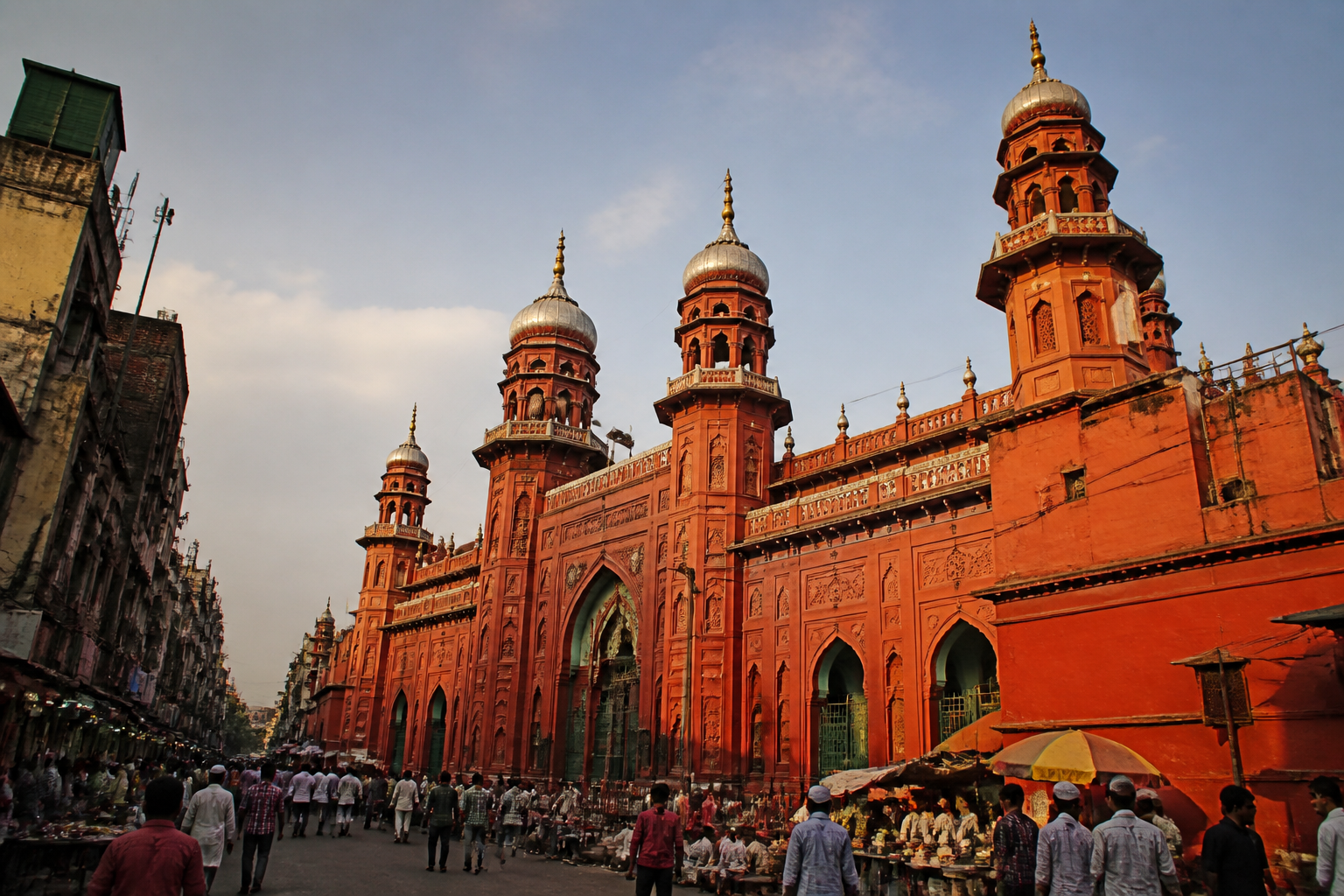
Nakhoda Masjid’s centenary is not only a milestone for one of Kolkata’s most recognisable religious buildings. It is also a reminder that the city’s urban heritage survives through continued use, community stewardship and everyday public interaction, rather than through architecture alone. Standing on Chitpore Road, the mosque remains a place of worship, a reference point for Ramadan and Eid, and a landmark embedded in the food, trade and cultural life of central Kolkata.
The mosque, regarded as Kolkata’s largest, was built with the contribution of the city’s Kutchi Memon community and under the initiative of Hazi Zakaria, a business tycoon associated with the shipping trade. According to trustee Nasser Ebrahim, the present structure was established after two smaller mosques on the site were demolished. Their trustees agreed to the proposal to create a larger mosque, allowing the site to become a more substantial religious institution.
That origin story places Nakhoda Masjid within a wider pattern in Kolkata’s urban development. Commercial cities attract communities that build institutions around work, trade, worship and mutual support. The Kutchi Memons came to Kolkata from the Kutch region of Gujarat, drawn by the city’s importance as a commercial centre. The mosque was therefore not an isolated architectural project. It was connected to the movement of people, the growth of business networks and the creation of community infrastructure in a dense urban neighbourhood.
The exact date of completion remains a matter of internal debate. Ebrahim said one school of thought places the completion of the mosque in 1926, while another believes construction ended in 1930. The majority view among those associated with the mosque is that it was ready in 1926. That uncertainty does not diminish the building’s historical value. Instead, it shows how the history of urban landmarks is often carried through institutional memory, community accounts and inherited traditions rather than a single universally accepted record.
Nakhoda Masjid’s importance also comes from the fact that its traditions continue to operate in the city’s daily rhythm. During Ramadan, a light is switched on at the top of the mosque to signal the beginning of aftaari, or the breaking of the fast, each evening. The light is also switched on in the morning to mark the beginning of sehri, when the fast starts. The mosque continues to take the call on moon-sightings and Eid in Kolkata, giving it a role that extends beyond its immediate congregation.
These practices turn the mosque into an urban timekeeper. Its significance is not limited to the visual drama of its red terracotta-coloured walls, or to the silver and gold elements on its minarets. The building communicates with the surrounding city through ritual, sound, movement and collective attention. It anchors religious time in a neighbourhood that also functions as a major commercial and food district.
That combination of built form and living practice is central to understanding why historic religious buildings remain relevant in changing cities. A protected facade or restored minaret can preserve a structure, but it cannot by itself preserve the institution’s role. Nakhoda Masjid’s continuity comes from the interaction between the building, its trustees, worshippers, visitors, traders and the streets around it. Its heritage is therefore both architectural and operational.
The mosque’s doors are open to people of different faiths who want to experience its architecture and history, trustee Nasser Ebrahim said. Non-worshippers are restricted from entering for some time around prayers, but can visit during the rest of the day. This arrangement illustrates how religious sites can function as both sacred spaces and points of public cultural engagement, while retaining rules necessary for worship.
The distinction matters in a crowded historic district. Public access to heritage buildings is often discussed as a question of tourism, but access also depends on the institution’s own needs. A mosque is not a museum. Its primary function is worship, and visitor access has to operate around that purpose. At Nakhoda Masjid, the balance is being managed through time-based restrictions rather than by separating the building entirely from public experience.
The streets around the mosque become especially prominent after Ramadan, when Eid brings a concentration of Mughlai food activity. Kebabs, biryani and other dishes draw residents and visitors into the surrounding lanes. In recent years, food vlogging and Instagram culture have expanded that audience, introducing younger visitors, including members of Gen Z, to the area’s history and architectural character.
This has created a new layer in the relationship between heritage and urban economy. The mosque’s visual identity attracts attention, while the food streets provide a reason for people to spend time in the neighbourhood. The result is a form of cultural visibility in which religious heritage, local commerce and digital media reinforce one another. The source does not establish the scale of this economic effect, but it clearly records a shift in how younger visitors encounter the site: not only through worship or formal history, but through food, photography and social media discovery.
Such visibility can support the continued recognition of older city districts, but it also makes stewardship more important. A landmark that becomes a destination must continue to function as a place of worship. The mosque’s trustees have chosen not to organise formal centenary celebrations, saying that it is not appropriate to celebrate the anniversary in a way that compromises the dignity of a place of worship. Their position reflects an institutional understanding of heritage that prioritises continuity and religious purpose over spectacle.
That decision is significant because anniversaries often encourage cities to package historic buildings as events or attractions. Nakhoda Masjid’s trustees have instead treated the centenary as a moment for remembrance and prayer. Their approach keeps the institution’s own priorities at the centre of the milestone, even as the surrounding streets continue to attract visitors and food-related activity.
The mosque’s history is also inseparable from the demographic changes affecting the Kutchi Memon community. The community helped build the mosque and continues to provide its trustees. Yet the number of Kutchi Memon families in Kolkata has declined to about 70, according to a community member quoted in the source. Many have moved to Mumbai, Bengaluru or other countries.
This creates a structural question for community-managed urban heritage: how does an institution remain connected to its founding community when that community becomes smaller or more geographically dispersed? In Nakhoda Masjid’s case, the building’s public importance may now extend beyond the size of the community that built it. Its preservation depends on trusteeship, institutional memory and the mosque’s continuing relevance to the wider city.
The comparison with other Kutchi Memon institutions adds to that context. The community runs a mosque and a Jamaat Khana, or resting place, on Mumbai’s Mohammed Ali Road, and also runs a mosque in Bengaluru. These institutions reflect how migrant commercial communities established a network of religious and social infrastructure across cities where they developed business connections.
Nakhoda Masjid therefore represents more than a single structure on Chitpore Road. It records Kolkata’s role as a destination for trade, the movement of communities from western India, and the way religious institutions helped create a sense of belonging in a commercial metropolis. Its present condition also reflects the changing geography of those communities, with migration reducing the number of families in the city while leaving the institutions they established in place.
The available account does not provide details of a formal conservation plan, structural assessment, restoration budget or municipal heritage designation. Those omissions are important. The centenary confirms the mosque’s historical and urban significance, but it does not by itself establish how the building will be maintained over the next century. The source records the trustees’ hope that Nakhoda Masjid will stand for several more centuries, while also showing that the institution’s continuity has so far depended heavily on community stewardship and daily use.
The larger urban lesson is that Kolkata’s heritage cannot be understood only through isolated monuments. It is carried through working neighbourhoods where buildings, rituals, markets, food lanes and migrant histories overlap. Nakhoda Masjid remains visible because it is still active. Its signals shape Ramadan routines, its architecture draws visitors, and its surrounding streets continue to support commerce and public gathering.
The centenary consequently offers two confirmed facts about living heritage. First, historic buildings retain urban value when their original institutional purpose remains active. Second, that value is sustained by communities whose composition and location can change over time. What remains to be monitored is how the mosque and the surrounding Chitpore Road district manage visitor interest, religious use and long-term stewardship without separating the building from the living city that gives it meaning.
