


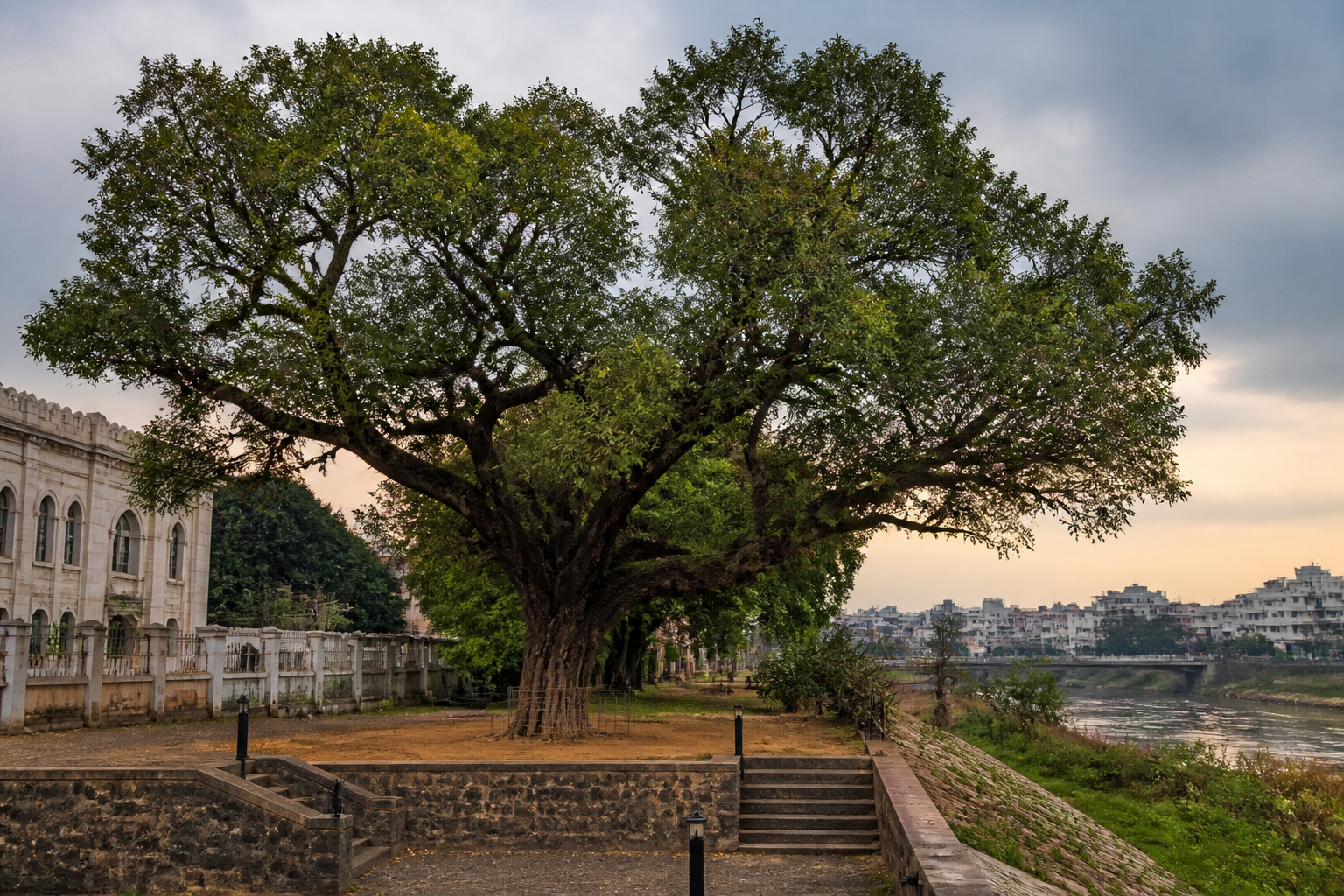
Hyderabad’s Musi flood tree is more than a surviving piece of natural heritage. It is a physical record of how a river disaster reshaped the city, damaged its buildings and infrastructure, and left behind a question that remains relevant to urban planning: what does a city choose to preserve when development pressures rise around places of public memory?
On September 28, 1908, the Musi River flooded Hyderabad after the city received around 17 inches of rain. The river rose to nearly 15 feet above its banks, inundating several parts of the city and killing thousands of people. More than 80,000 houses were damaged, while areas including Afzal Gunj, Ghansi Bazar and Kolsawadi were badly affected. Several bridges across the river were also washed away.
The scale of the disaster placed the Musi at the centre of Hyderabad’s urban history. This was not only a natural event. The flood exposed the vulnerability of a city built around a river that could rapidly exceed its banks, overwhelm neighbourhoods and sever connections between parts of the urban area. The surviving tamarind tree near the river offers a human-scale entry point into that history, but the wider record concerns housing, bridges, hospitals, roads and the relationship between the city and its floodplain.
The tree stood within the compound of what was then Afzalgunj Hospital, now Osmania General Hospital. As the floodwaters rose, around 150 people climbed into its branches to avoid being swept away. Accounts cited in reports about the flood state that the survivors remained there for two days, without food, waiting for the water to recede before coming down. The hospital itself was severely damaged.
That detail makes the tree significant in two distinct ways. It is a survivor of the flood, and it is also linked to the survival of people who were trapped by the collapse of ordinary urban protection. When bridges were washed away, houses were damaged and the hospital was affected, the tree became an improvised refuge. Its importance therefore does not come only from its age or size. It comes from the role it played during a civic emergency.
A wooden board placed on the trunk records that the tree saved around 150 people during the 1908 Musi flood. In 2002, the then Hyderabad collector Rajeshwar Tiwari named it ‘Prana Dhatri’, meaning giver of life. The name formalised a local memory that had endured for decades and connected the tree to the history of the disaster.
Hyderabad’s centenary commemoration of the flood in 2008 showed how the tree had become part of the city’s public record. Civil society groups and historians gathered under it to remember those who died. An exhibition featuring photographs of Hyderabad before, during and after the flood was also organised. The gathering turned the tree into a place where the city could connect archival evidence with a physical site.
That connection is important for understanding urban heritage. Historic buildings and monuments are often protected because their architectural value is visible. A tree associated with a disaster represents a different category of heritage: one based on collective memory, public safety and the lived experience of residents. It carries evidence of an event that transformed the city without being a conventional monument.
The tree’s survival, however, has not been guaranteed by its historical importance. Road-widening plans along the Musi in 2008 raised concerns that it could be cut down. Officials said the tree could not be relocated, while heritage activists pressed for its protection. Activists also sought heritage status, arguing that its role in saving human lives made it historically important.
This conflict reveals the institutional gap that can emerge between infrastructure planning and heritage conservation. Road widening is generally assessed through requirements such as traffic movement, right-of-way and construction feasibility. Heritage protection introduces another set of questions: whether a site has historical value, whether it can be preserved in place, and which authority is responsible for ensuring that development does not remove it.
The reported inability to relocate the tree also underlines a practical limitation. Unlike a structure that can sometimes be dismantled and reconstructed, a mature living tree cannot necessarily be shifted without risking its survival. Its location is part of its meaning as well. Moving it away from the Musi, the hospital compound and the setting of the 1908 flood could preserve the organism while weakening the historical relationship that gives it value.
In 2019, concerns were raised about the tree’s condition after fungal growth was found around its trunk. Its deteriorating condition prompted calls for greater protection. This shifted the question from whether the tree should be saved from road construction to whether it was receiving the maintenance and conservation required to survive in place.
The two pressures are connected. Development can damage heritage through direct removal, altered surroundings or construction activity. Neglect can produce the same result more slowly, through decay and the absence of specialist care. In the case of the Musi flood tree, the reported threats included both infrastructure pressure and biological deterioration.
Residents gathered at the ‘Saviour Tamarind Tree’ in 2023 to remember those who died in the 1908 floods. Such commemorations show that the site remains part of Hyderabad’s civic memory more than a century after the river rose over its banks. The continuing gatherings also indicate that the tree has a public function: it provides a place for residents to connect the city’s present with a disaster that shaped its past.
The 1908 flood record contains several different measures of urban vulnerability. Around 17 inches of rain fell before the river rose to nearly 15 feet above its banks. More than 80,000 houses were damaged, thousands of people died, and several bridges were washed away. These figures describe not only the force of the flood but also the extent of the city’s exposure across housing, transport links and public institutions.
The story of the tree does not replace that larger evidence. Instead, it makes the consequences legible. One tree, one hospital compound and 150 survivors provide a concentrated account of how residents experienced the flood: with movement restricted, food unavailable and conventional shelter compromised. The tree’s branches became temporary infrastructure when formal systems could not protect everyone.
That interpretation must remain grounded in what is established in the available account. The source records the historical flood, the tree’s association with survivors, commemorations, road-widening concerns and reports of fungal growth. It does not establish the tree’s current structural condition, its present legal protection, the authority responsible for its upkeep or whether a formal heritage designation was granted. Those questions remain important for any future assessment of the site.
The institutional issue is therefore not simply whether Hyderabad values the tree. It is whether the city has a clear framework for protecting places that combine environmental, historical and public-memory value. The reported calls for heritage status suggest that existing protection was considered insufficient by activists. The road-widening controversy shows that heritage concerns entered the planning process only when a direct threat emerged.
The Musi flood tree also demonstrates why urban heritage cannot be separated entirely from infrastructure planning. The tree stands near a river, a hospital and roads whose use has changed over time. Each of those elements belongs to a different administrative and functional system, but the historical meaning of the site comes from their connection during the flood. Treating them separately risks preserving an object while losing the story around it.
For Hyderabad, the tree’s significance lies in this combined record. It recalls the destructive capacity of the Musi, the scale of damage to homes and bridges, the vulnerability of public facilities and the resourcefulness of residents who sought refuge in its branches. It also records the continuing tension between road expansion, maintenance needs and the preservation of urban memory.
More than a century after the flood, the tree remains standing near the Musi. The available account confirms its historical association with the 1908 disaster and the repeated public efforts to protect it. What remains unclear is the current condition of the tree and the extent of its formal protection. Those are the next facts the city’s heritage and civic authorities would need to establish if the ‘Prana Dhatri’ is to remain a living record rather than only a remembered one.
