


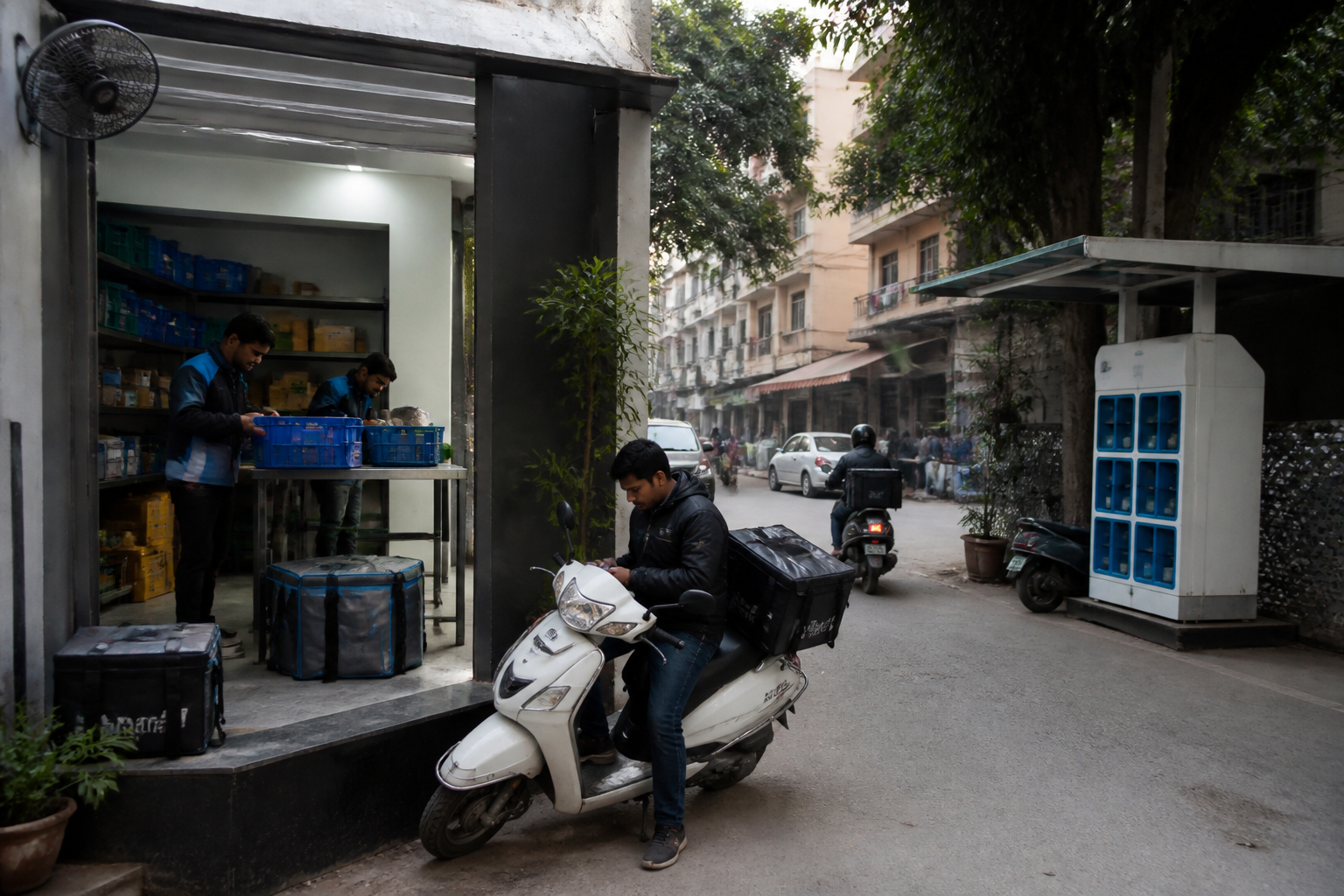
Flipkart Minutes has quadrupled its business in a year and expanded to nearly 1,200 micro-fulfilment centres across more than 150 cities. The growth is a measure of one company’s ambitions, but it also reveals how quickly quick commerce is becoming embedded in India’s urban systems. What began primarily as a way to deliver groceries and household essentials is moving into premium food, personal care, electronics, pet supplies and other categories, while extending deeper into Tier 2 and smaller markets.
The expansion comes two years after Flipkart launched Minutes in August 2024. The platform says it expects to reach about 1,500 micro-fulfilment centres by the end of 2026. Its growth is taking place alongside an intensifying contest with Blinkit, Zepto, Swiggy Instamart, BigBasket and Amazon Now. The competition is not only for online shoppers. It is also for the physical infrastructure, delivery workers, brand partnerships and local demand data needed to make rapid delivery viable across a wide geography.
That makes quick commerce an urban infrastructure story as much as a retail story. Micro-fulfilment centres, often described as dark stores, act as neighbourhood distribution points. Their location determines which customers can be served quickly, what products can be stocked locally and how delivery networks interact with roads, housing clusters, commercial streets and employment markets. As these facilities spread beyond the largest metros, they are helping create a more distributed model of retail logistics.
The available figures show the scale of that shift. Flipkart Minutes says it has created more than 400,000 direct and indirect jobs since its launch, although the supplied report does not break that figure down by employment type, city or duration. The platform also says about 60 per cent of its customers return to use the service. Together, those figures point to a business model that depends on repeated local demand rather than one-time promotional transactions.
The company’s customer growth is particularly pronounced in Tier 2-plus markets. Its customer base in cities including Ambala, Barabanki, Bhagalpur, Durgapur, Kanpur, Roorkee, Siliguri, Salem and Tiruppur grew nearly 25 times year-on-year, according to the report. That expansion challenges the assumption that instant delivery is principally a metropolitan service. The report does not establish whether demand in these cities is evenly distributed or concentrated in particular neighbourhoods, but it does show that smaller urban markets are becoming important areas of competition.
The product mix is changing with that geographic expansion. Demand in these markets includes Korean noodles, sauces and ready-to-eat meals, as well as premium skincare and personal care products. On the platform, gourmet and specialty grocery has grown eight times since its launch within the past year. Men’s grooming has grown nearly sixfold year-on-year and pet food five times. These categories are less about emergency replenishment than convenience, discovery and the availability of products that may not be stocked consistently by nearby physical retailers.
This expansion also complicates the usual definition of quick commerce. The model is commonly associated with daily essentials, fruits and vegetables and short delivery windows. However, Flipkart Minutes reported that its largest single order was worth ₹6 lakh and included five smartphones. That order is not evidence that high-value electronics have become a typical quick-commerce purchase, but it does demonstrate the breadth of categories companies are testing through the format.
Gen Z is another important part of the platform’s reported growth. Flipkart says this customer base grew nearly five times year-on-year over the past 12 months and that Gen Z accounts for more than 45 per cent of orders in categories including beauty, electronics, gaming, wearables, fragrance, health and nutrition, and grooming. The cohort also represents one in three gourmet orders on the platform. The figures suggest that younger consumers are using quick commerce for planned and aspirational purchases as well as routine household needs.
That shift has consequences for the urban geography of retail. When a wider range of goods is held close to consumers, the boundary between convenience retail and digital commerce becomes less clear. A neighbourhood may continue to have supermarkets, specialist shops and street-level vendors, while also being served by one or more invisible distribution facilities. The supplied material does not quantify the effect on traditional retailers, local traffic or rents, so those impacts remain unestablished. It does show, however, that quick-commerce companies are attempting to capture more shopping occasions within the same urban catchments.
The physical network is central to that strategy. According to CLSA tracking cited in the report, India’s quick-commerce footprint has expanded to 477 cities. Across the five players monitored by the brokerage, the top 10 cities account for 3,536 dark stores. Blinkit has close to 30 per cent of dark stores in those cities and more than 34 per cent nationally, while leading the store count in six of the 10 cities. Zepto leads in three of the remaining four.
The same data places Flipkart Minutes ahead of Swiggy Instamart in the top 10 cities on both dark-store count and PIN-code coverage. Flipkart Minutes had 627 dark stores in those cities, compared with 615 for Swiggy Instamart, while BigBasket had 497. These numbers do not by themselves establish which platform has the highest order volumes, delivery efficiency or profitability. They do reveal that the battle is increasingly being fought through network density and geographic coverage, not merely through app-based discounts or brand recognition.
Network density creates a difficult operating equation. More facilities can reduce the distance between inventory and customers, but they also require property, labour, inventory management and last-mile capacity. The report does not provide the capital cost of the expansion, the utilisation rate of individual centres or the profitability of the service. Without those measures, the scale of the footprint should be read as evidence of competitive investment rather than proof of a settled business model.
The geographic ambition is visible in Flipkart’s stated goal of reaching the whole of Bharat. Kunal Gupta, senior vice president and head of Flipkart Minutes, said the company expects about 1,500 micro-fulfilment centres by year-end and wants to expand access to more consumers. That language places the service within a broader nationalisation of digital commerce, in which platforms seek to make urban consumption patterns available across different classes of cities.
The model is also creating new links between platforms, producers and local demand. Flipkart Minutes says it has built an ecosystem of nearly 500 direct-to-consumer brands since August 2024. Through partnerships with Farmer Producer Organisations, it says it has connected thousands of farmers directly to consumers. The report attributes these claims to the platform and does not independently measure changes in farmer incomes or price realisation. Even so, the partnerships indicate that quick commerce is being positioned not only as a delivery layer but also as a route to market for brands and producers.
The sustainability claims reflect another pressure on the delivery network. Flipkart says a growing share of last-mile deliveries uses electric vehicles and that it is installing battery-swapping infrastructure across micro-fulfilment centres. It has also introduced lighter compostable and biodegradable packaging for key fruits and vegetables categories to reduce virgin plastic use. The supplied material does not state the share of electric deliveries, the number of battery-swapping locations, or the measured reduction in packaging waste. Those details will be necessary to assess the environmental effect of the changes.
What is clear is that quick commerce is developing through several overlapping systems: physical stores, digital demand, local delivery labour, road networks, warehouse operations and increasingly specialised supply chains. Its spread to smaller cities means that the relevant question is no longer only whether consumers want faster delivery. It is also where distribution facilities are located, how workers and goods move through neighbourhoods, whether local demand can sustain the infrastructure and how companies manage the cost of maintaining proximity.
The policy landscape remains only partly visible in the supplied material. The report identifies company expansion, brand and farmer partnerships, electric vehicles, battery swapping and packaging changes, but it does not set out a specific government scheme, municipal framework or regulatory regime governing the micro-fulfilment network. That absence matters because the physical growth of quick commerce intersects with land use, commercial licensing, road access, labour conditions, waste management and electricity demand. The article provides no evidence to determine how those issues are currently administered across the 477 cities in the CLSA tracking.
The next phase of competition will therefore be judged on more than the number of dark stores. Coverage, repeat use and category expansion will remain important, but so will the efficiency and resilience of the networks behind them. Flipkart Minutes’ reported rise to nearly 1,200 centres and its planned expansion to 1,500 establish the scale of its current push. The broader evidence confirms that quick commerce is moving from a metro convenience service towards a national urban distribution model. What remains uncertain is whether the economics, employment model and environmental systems supporting that growth can match its geographic ambition.
