


Quick Commerce in Small Towns Is Recasting India’s Retail Map
Flipkart’s expansion of its Minutes quick-commerce service into smaller Indian cities offers a revealing snapshot of how digital retail is moving beyond the country’s largest urban markets. The company says its customer base across locations such as Siliguri, Ambala, Barabanki, Bhagalpur and Durgapur has grown nearly 25 times year-on-year. That claim, combined with the expansion of the service to nearly 1,200 dark stores across more than 150 cities, points to a change in the geography of instant delivery.
The immediate announcement is commercial: Flipkart says demand for Minutes is rising, repeat use is high and the platform is adding categories beyond everyday essentials. The larger question is what this growth says about the changing relationship between small-town consumers, local retail and urban logistics. Quick commerce was initially associated with dense metropolitan neighbourhoods where short delivery distances, concentrated demand and high smartphone usage could support rapid fulfilment. The supplied evidence suggests that this model is now being tested across a wider range of Indian urban settlements.
Flipkart said about 60% of Minutes customers return to shop on the platform. The broader business has expanded four times year-on-year since its launch two years ago, according to the company. These figures are company-reported and do not, on their own, establish the profitability or long-term viability of the model. They do, however, show the scale at which the service is being positioned and the extent to which the company sees smaller cities as a growth market.
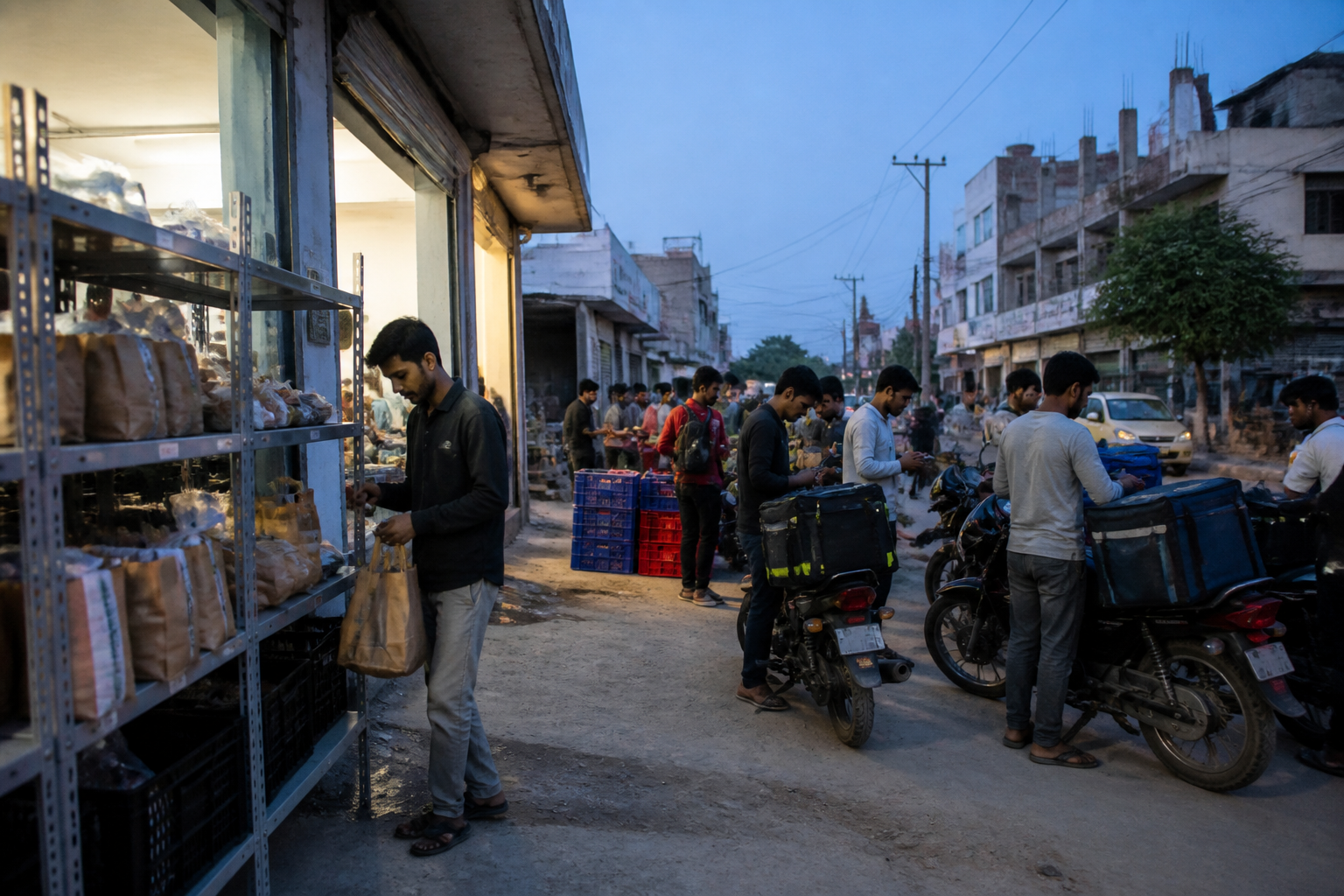
The expansion is being supported by a dark-store network. Nearly 1,200 such facilities now serve more than 150 cities, according to Flipkart. Dark stores are retail fulfilment points designed primarily for online orders rather than conventional walk-in shopping. Their expansion changes the physical organisation of delivery: inventory is placed closer to consumers, orders are assembled locally and the final delivery journey is shortened.
The source material does not provide information on the size, location or operating economics of individual stores. It also does not establish how many jobs the network supports, how it affects existing retailers or whether the stores are profitable in smaller markets. Those questions are important because quick commerce depends not only on consumer demand but also on the cost of maintaining inventory, delivery capacity and fulfilment infrastructure across different urban densities.
What the reported figures do show is a broadening of the consumption categories being served. Flipkart said gourmet and specialty grocery, launched within the past year, has grown eight times. Products cited by the company include cold-pressed oils, imported cheeses, international avocado varieties and Korean ready-to-eat meals. Consumers in smaller cities are also reportedly buying Korean noodles, sauces and ready-to-eat meals, along with premium skincare and personal-care products.
This matters because it shifts the quick-commerce proposition away from a narrow emergency-delivery model. The service is being presented not only as a way to obtain milk, snacks or household supplies quickly, but also as a channel for discretionary and premium purchases. In that sense, the platform is attempting to turn delivery speed into a general shopping habit rather than a service used only when a customer needs an item immediately.
The company’s comments about Gen Z reinforce that strategy. Flipkart said this group is its fastest-growing customer cohort on Minutes, with the customer base increasing nearly five times year-on-year over the past 12 months. Gen Z accounts for more than 45% of orders across categories including beauty, electronics, gaming, wearables, fragrance, health and nutrition, and grooming, the company said.
These figures suggest that younger consumers are helping expand the range of occasions for which quick commerce is used. The reported demand is not limited to routine grocery replenishment. It includes products associated with personal care, entertainment, consumer electronics and lifestyle consumption. However, the available material does not provide a demographic breakdown by city, income group or household type, so the extent to which this pattern is representative of smaller-city consumers as a whole remains unestablished.
The development also raises questions about the relationship between platform retail and existing local markets. In smaller cities, neighbourhood shops and traditional retailers remain part of the everyday distribution network, but the supplied report does not quantify their share of sales or describe how they are responding to quick-commerce expansion. Nor does it establish whether platforms are sourcing products from local businesses, competing with them, or doing both in different categories.
Flipkart said its growing network could create new opportunities for brands, farmers and local businesses to reach customers. That is a stated company objective rather than evidence of an outcome already achieved. Whether such opportunities materialise will depend on procurement arrangements, listing practices, margins, delivery economics and the ability of smaller suppliers to meet platform requirements. None of those details is provided in the source material.
The possible launch of a standalone Minutes app adds another layer to the company’s strategy. Flipkart is understood to be piloting a separate app, with a wider rollout expected ahead of its annual festive sales in October. Analysts at JM Financial said a standalone app could give Minutes a sharper identity as a quick-commerce platform rather than leaving it embedded within Flipkart’s broader e-commerce proposition. They also said the timing could help the service benefit from higher traffic and engagement during the Big Billion Days period.
A separate app would represent more than a branding change if it changes how customers discover and use the service. Embedded access keeps quick commerce within a larger online shopping ecosystem. A standalone application positions it as a distinct destination built around frequent, rapid transactions. The supplied information does not confirm the final rollout schedule or the features of the proposed app, so its operational impact cannot yet be assessed.
The competitive setting is already crowded. Minutes operates alongside Amazon’s Now, Eternal’s Blinkit, Swiggy’s Instamart and Zepto. The presence of several major platforms indicates that quick commerce is being treated as a significant retail category, but competition also makes expansion more demanding. Companies must balance delivery promises with the cost of local inventory, fulfilment sites and customer acquisition. The source material provides no comparative data on market share, delivery times or financial performance among these services.
For city economies, the most important development may be the spread of platform infrastructure into places that have historically received new retail formats later than the largest metros. Siliguri, Ambala, Barabanki, Bhagalpur and Durgapur are not presented as a single type of city, yet their inclusion in the same expansion story suggests that quick-commerce companies are looking beyond a limited set of high-density markets. The model is being adapted to a more varied urban landscape, although the report does not explain how store density or delivery operations differ between these locations.
That distinction is central. A service that works in a dense metropolitan cluster cannot automatically be assumed to work in a smaller or more dispersed city. The economic logic depends on order frequency, basket size, travel distance, product availability and the cost of maintaining fulfilment capacity. The reported 60% repeat-customer figure and rapid growth in selected categories indicate strong engagement among some users, but they do not answer whether demand is sufficiently consistent across all operating locations.
The available evidence therefore confirms a clear direction but not a settled outcome. Flipkart is expanding Minutes across more than 150 cities, adding dark stores, targeting younger consumers and moving into premium categories. It is also considering a standalone app that could give the business greater visibility before the festive shopping season. These steps show how quick commerce is being repositioned as a broad retail channel for both metropolitan and smaller-city consumers.
What remains uncertain is the effect on local retailers, employment, supplier networks, traffic and the financial sustainability of the dark-store model outside the largest markets. Further information on store-level economics, city-wise demand, sourcing and competition would be needed to assess those questions. For now, the evidence points to a retail system in which small towns are no longer treated solely as future markets: they are becoming an active testing ground for the next phase of India’s platform-led urban commerce.

