


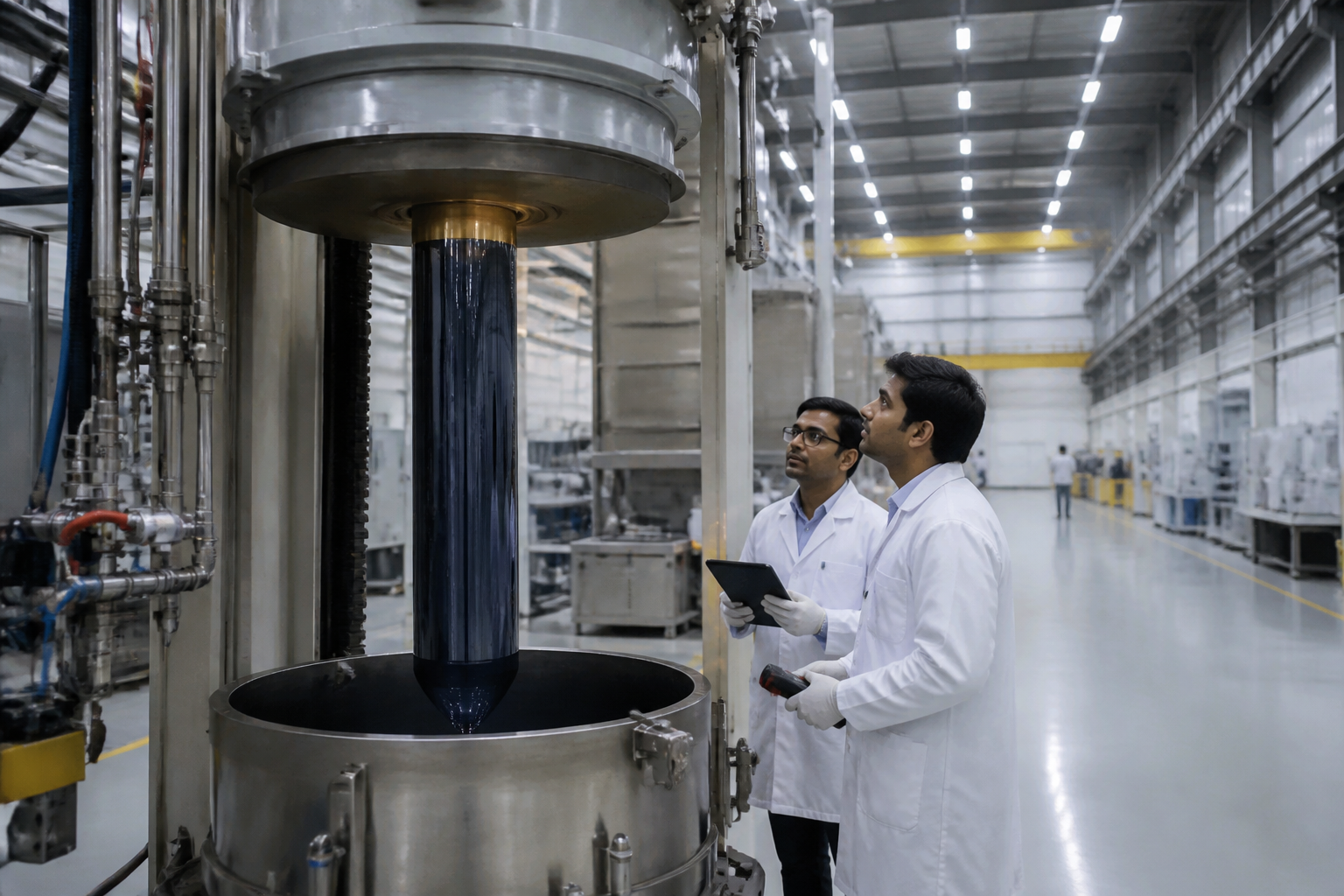
Raana Semiconductors’ plan to launch a commercial 12-inch Czochralski, or CZ, machine for solar manufacturers places a relatively specialised piece of industrial equipment at the centre of India’s effort to build a more vertically integrated solar supply chain. The Chennai-based deep-tech company says it expects to launch the machine within the next 10 to 12 months and is seeking to support around 10 GW of cell production capacity over the following three years.
The announcement is significant because the equipment used to make silicon ingots sits upstream of wafer and cell production. Pure silicon is converted into single-crystal ingots through the CZ process, after which the ingots can be sliced into wafers. Those wafers are used in solar cells as well as in chips, sensors and other applications. According to Raana’s founder and chief executive, Rajasekar Elavarasan, more than 90 per cent of the world’s semiconductor electronics use wafers produced through the CZ method.
For India’s solar industry, the immediate question is not simply whether a domestic company can produce a larger machine. It is whether equipment localisation can keep pace with the expansion of domestic ingot, wafer and module manufacturing. Several Indian solar module manufacturers, including Grew Solar, Vikram Solar and Swelect Energy, are described as being in the process of building ingot and wafer manufacturing capacities. That creates a potential customer base for Indian equipment makers, while also exposing the scale of the technological and commercial challenge.
The present market remains heavily dependent on imported equipment. Elavarasan said that countries including Germany, South Korea, the United States and China dominate CZ machine manufacturing, while more than 90 per cent of the ingot machines used in solar manufacturing are produced in China. Raana’s proposed machine therefore represents an attempt to address a specific dependency within the broader solar manufacturing chain rather than a complete solution to domestic supply-chain exposure.
The company says its machines are currently about 70 per cent localised and that it expects to raise the level incrementally. It is also working on a 40,000-square-foot manufacturing facility in Hosur, Tamil Nadu. The proposed facility would give the company additional production capacity, although the supplied information does not establish its investment size, commissioning date, expected workforce or final manufacturing output.
Raana already has more than 40 CZ machines deployed, producing two-, four- and six-inch ingots. Most of those machines are used for research purposes in defence, atomic and other national laboratories. The company has also deployed equipment for materials such as lithium niobate and germanium, which are used in quantum applications and infrared cameras. That installed base provides evidence of prior equipment deployment, but it does not by itself establish whether the company can produce and service commercial-scale 12-inch machines at the volume required by solar manufacturers.
The distinction between Raana’s solar and semiconductor strategies is central to its business model. For solar manufacturing, the company plans to sell machines to producers. For semiconductors, Elavarasan said Raana intends to supply wafers rather than machines and retain the intellectual property associated with ingot and wafer manufacturing. The company plans to have a commercial 12-inch CZ machine for chips in about three years, indicating that the solar product is being treated as the nearer-term commercial opportunity.
This difference also reflects the distinct demands of the two markets as described by the company. Solar manufacturers require equipment that can support large production capacities, while semiconductor production involves a more controlled approach to intellectual property and wafer manufacturing. The supplied material does not provide performance specifications, production yields, machine pricing, customer contracts or comparative operating costs, so the commercial competitiveness of the proposed equipment cannot yet be assessed.
Raana is reportedly in the process of securing an order for approximately 2 GW of machine capacity from a major Indian solar manufacturer. The order has not been presented as final. Elavarasan said that, if secured, it could help push the company’s revenue to around ₹300 crore by the 2027-28 financial year. The conditional nature of the projection matters: the order, its value, delivery schedule and revenue recognition remain unconfirmed in the supplied report.
The policy environment could strengthen the market for locally integrated equipment and components. The Ministry of New and Renewable Energy has proposed including solar ingots and wafers in the Approved List of Models and Manufacturers from June 1, 2028. If implemented as proposed, the measure would enforce local sourcing of these components for module manufacturers. The policy would therefore create a future requirement for domestic supply, but its practical effect will depend on the final rules, eligibility conditions, enforcement mechanism and the capacity of Indian producers to meet them.
The proposed 2028 sourcing requirement also creates a timing issue. Equipment manufacturers must develop and commercialise machines before solar producers can depend on the resulting ingot and wafer capacity. Raana’s planned 12-inch solar machine is expected within the next 10 to 12 months, while the company says it aims to support roughly 10 GW of cell production capacity over three years. These timelines suggest that machine development, customer qualification and factory commissioning will need to progress together. The available information does not establish whether the proposed Hosur facility will be operational before the first machines are delivered.
India’s solar manufacturing expansion has often been discussed in terms of module and cell capacity, but the Raana announcement highlights the less visible equipment layer beneath those factories. Ingot growth machines, wafer-processing systems and related manufacturing tools determine how much of the production chain can be controlled domestically. If these systems remain imported, a module industry may expand while retaining exposure to external suppliers for critical production assets.
At the same time, localisation is not equivalent to complete self-sufficiency. Raana describes its machines as about 70 per cent localised, implying that some components or technologies continue to come from outside the company’s domestic production base. The supplied information does not identify those components or indicate how localisation will be measured. It also does not establish whether other Indian companies are developing competing CZ equipment, or how domestic machines compare with imported systems on reliability, throughput, maintenance and cost.
The company’s existing deployments in national laboratories show that it has experience supplying specialised CZ equipment for smaller ingot sizes and research applications. Moving to a commercial-grade 12-inch platform for solar manufacturers would be a different test, involving scale, repeatability, production uptime, after-sales support and the ability to deliver multiple machines. None of those performance indicators is available in the source material, making the planned launch an important milestone but not yet proof of commercial success.
The broader policy question is whether domestic solar manufacturing can be built as an interconnected industrial ecosystem rather than as a collection of downstream factories. The proposed ALMM change gives ingot and wafer production a stronger place in that ecosystem. Companies such as Raana are attempting to supply the machinery needed to make that policy objective operational. Solar manufacturers, in turn, would need to decide whether locally produced equipment can meet their production and financial requirements.
What the announcement confirms is that Indian companies are targeting an upstream gap in solar manufacturing and that policy is moving towards greater domestic sourcing of ingots and wafers. What remains uncertain is whether Raana will secure the reported 2 GW order, complete its Hosur facility, deliver the 12-inch machine within the stated period and raise localisation beyond its current level. The next milestones are the commercial launch, confirmation of customer orders, commissioning of the Hosur plant and the final form of the proposed sourcing rules due to take effect in 2028.

