


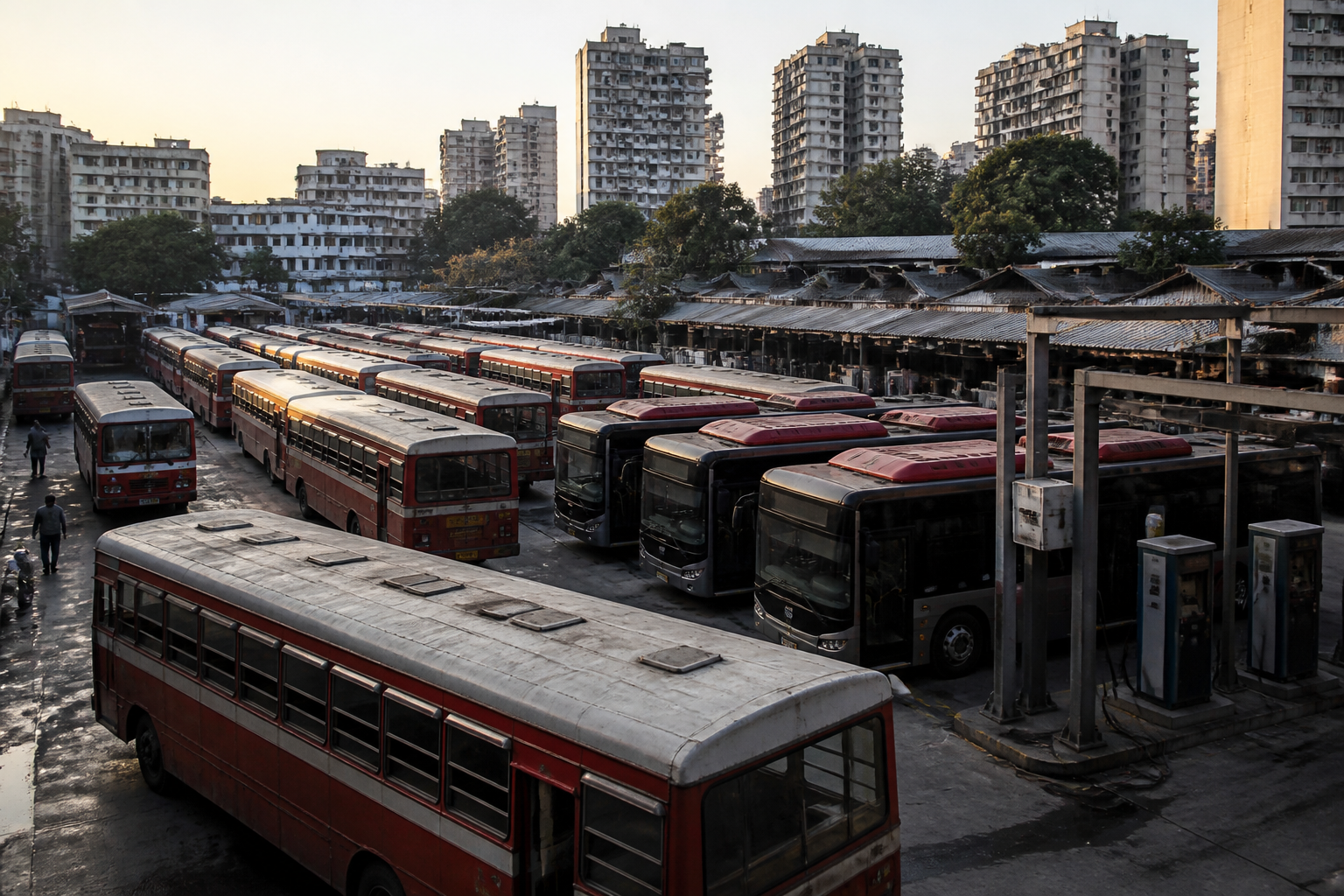
Mumbai’s BEST is facing a revival debate that goes beyond its immediate finances. A citizens’ action group has urged the Union government, Maharashtra government and Brihanmumbai Municipal Corporation to treat the undertaking as essential civic infrastructure, while warning that privatisation, workforce reductions and the shrinking share of self-owned buses could weaken its public-service role.
The intervention by Aapli BEST Aplyach Sathi places several linked questions at the centre of the discussion: who should own and operate the buses serving the city, how should a financially distressed public transport undertaking be supported, and how can the system expand without shifting the burden to commuters? The group’s demands also connect daily bus operations with the proposed commercial redevelopment of 22 bus depots, making land and asset management part of the revival debate.
The immediate issue is not whether Mumbai needs cleaner buses. The group has endorsed electric mobility, but argues that the transition should not be separated from questions of ownership, staffing and revenue control. Its position is that outsourced electric buses, contractual staff and outsourced fare ticketing could change the way BEST functions, even if the vehicles themselves reduce emissions.
That distinction matters because a transport system is not defined only by its technology. It also depends on who controls the fleet, who employs the workforce, who collects fares and how decisions are made when commercial and public-service objectives conflict. In the account published by the Times of India, Aapli BEST Aplyach Sathi said that a move towards 100% contractual operations could affect fleet ownership, staff stability and farebox revenue control. These concerns were presented as part of a wider warning about BEST’s deteriorating condition.
The source material does not establish the current size of BEST’s self-owned fleet, the number of contractual buses or employees, the undertaking’s financial deficit, or the precise timetable for any transition to fully contractual operations. Those omissions are important. They mean the debate can identify the direction of concern, but not yet measure the scale of the operational change or its financial consequences.
Even so, the issues raised are structurally connected. A smaller self-owned fleet can alter an undertaking’s direct control over availability and deployment. A larger contractual operation can change the relationship between the public authority and the service provider. Workforce reductions can affect institutional capacity, while outsourced ticketing can influence the undertaking’s control over passenger and fare information. The citizens’ group has not argued against electric buses as such; it has argued that the institutional model surrounding them deserves equal scrutiny.
This makes BEST’s revival question different from a simple procurement exercise. Replacing older vehicles with electric buses may address one part of the transport challenge, but it does not by itself resolve questions about operating responsibility, employee security, fare collection or long-term financial sustainability. The group’s position is that the clean-transport transition should be designed around a stable public-service system rather than treated as a stand-alone technology upgrade.
The proposed redevelopment of 22 bus depots adds a second layer to the dispute. Depots are described in the report as potential commercial assets, but they are also operational spaces connected to the functioning of a bus network. A decision about their redevelopment therefore has implications beyond property monetisation. It can affect how the transport undertaking organises its fleet, maintains vehicles and preserves space for future service needs. The group has called for complete transparency regarding the planned commercial redevelopment, but the supplied report does not provide project designs, development agreements, valuation details, timelines or confirmed uses for the sites.
That absence of detail limits what can be concluded about the redevelopment plan. It does, however, clarify what information should be available for public scrutiny: the intended use of each depot, the effect on bus operations, the ownership and revenue arrangements, and the safeguards for maintaining transport capacity. Without those details, the commercial value of the land cannot be assessed against the operational value of the depots.
The group’s proposed financial response is also notable. Rather than relying primarily on fare increases, it has called for non-fare revenue from bus stops, depots and advertising assets. This approach frames BEST’s physical network as a broader civic and commercial resource. It suggests that the undertaking’s financial recovery should involve better use of existing assets, while protecting commuters from bearing the full cost through higher fares.
The report does not establish how much revenue these assets could generate or whether the proposed monetisation would be sufficient to close BEST’s financial gap. Nor does it explain the legal, administrative or contractual arrangements governing the assets. The proposal is therefore a policy demand, not a documented financial plan. Its significance lies in the choice it presents: whether revenue improvement should come from fares, property and advertising, public support, operating efficiencies, or a combination of these measures.
The appeal to the Union government, Maharashtra government and BMC highlights another defining feature of the issue: responsibility is distributed across levels of government. The citizens’ group has argued that BEST should not be treated simply as a loss-making entity, but as essential civic infrastructure. That framing shifts the question from whether the undertaking is commercially self-sustaining to how public authorities value the wider service it provides.
The supplied material does not detail existing subsidies, grants, budgetary commitments or the formal division of responsibilities among the three governments. It therefore cannot establish which institution should fund particular revival measures. It does show, however, that the group sees BEST’s distress as a public-policy problem rather than an internal corporate matter. The proposed solution depends on coordination between governments, the civic administration and the undertaking itself.
The available numbers are limited but significant. The reported demand for complete transparency covers 22 bus depots. The proposed operational direction described by the group is 100% contractual operations. These figures indicate the scale of the institutional questions being raised, even though the report provides no baseline against which to measure change. There is no fleet inventory, staffing table, ridership figure, farebox calculation or timeline in the supplied material.
That evidence gap should shape the next stage of the debate. Public discussion about BEST’s revival will require more than broad positions for or against privatisation. It will require clear information about the share of owned and contracted buses, the status of permanent and contractual staff, the operation of fare ticketing, the financial role of depots and the consequences of any redevelopment for bus services. It will also require authorities to explain how electric mobility fits into the undertaking’s wider operating model.
The central urban question is therefore one of public capacity. BEST’s future is being contested through the language of fleet ownership, contracts, staffing, fares and land, but these are not separate disputes. Together they determine how much control a public transport undertaking retains over the network it is expected to operate. The citizens’ group’s intervention argues that financial repair should not reduce that capacity without a transparent assessment of the consequences.
What the available evidence confirms is that the revival debate has moved beyond the condition of buses alone. It now includes the ownership of vehicles, the stability of the workforce, control over fare collection, the treatment of depots and the role of government support. What remains uncertain is the scale, timing and design of the proposed changes. The next developments to monitor are official responses from the Union government, Maharashtra government and BMC, details of the 22-depot redevelopment plan, and a publicly documented revival framework for BEST.
