


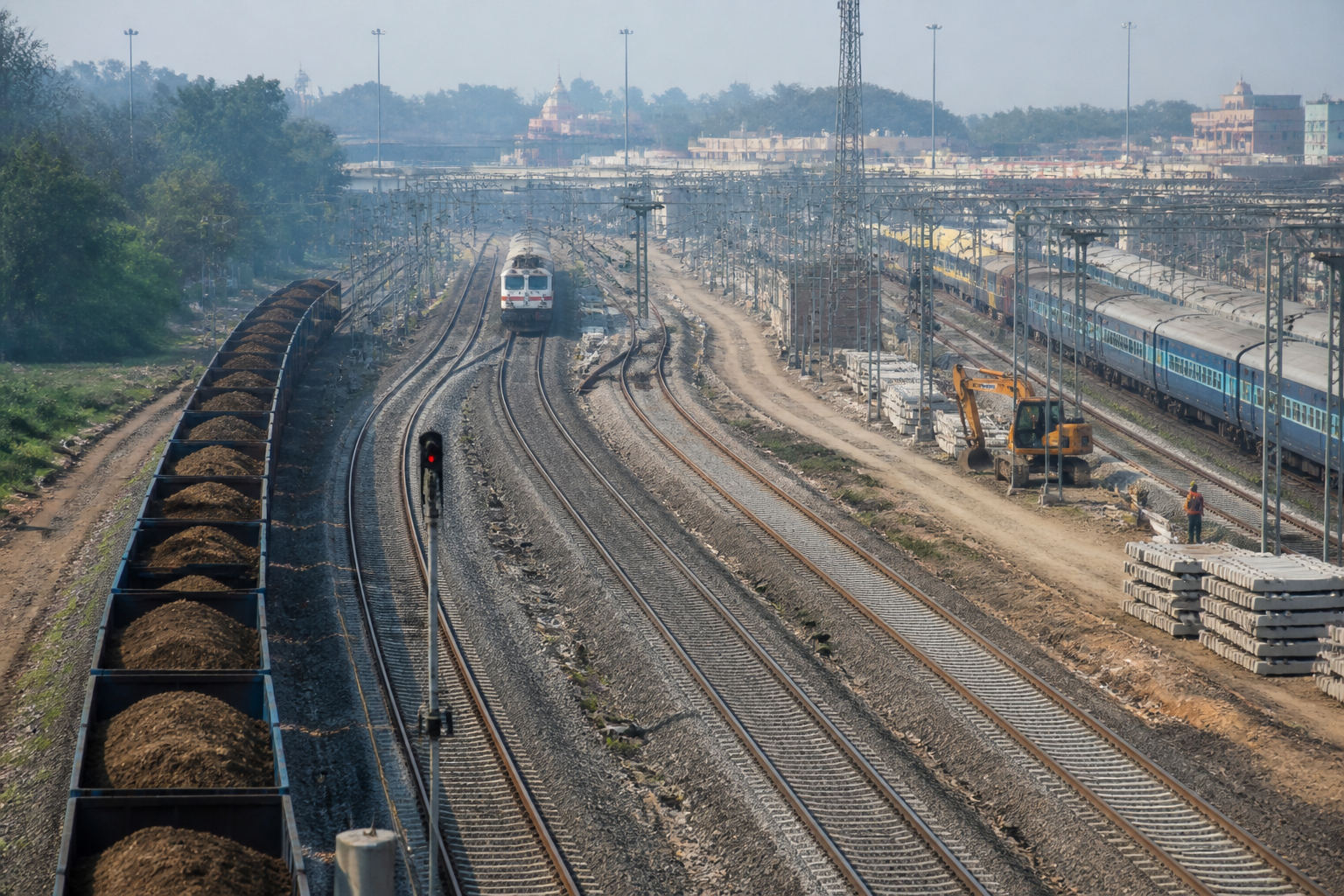
The approval of eight railway multitracking projects worth a combined Rs 20,804 crore has put capacity expansion at the centre of India’s rail infrastructure agenda. The projects cover routes across southern, eastern and central India, add about 1,196 km to the railway network and are planned for completion by 2029-30. Their stated purpose is straightforward: ease congestion, improve operational efficiency and reliability, and create additional capacity for passenger and freight movement.
The approvals are significant not because they represent a single new railway line, but because they address the constraints that emerge when existing routes have to accommodate multiple forms of traffic. The five projects approved across Tamil Nadu, Andhra Pradesh, Karnataka and Telangana will add about 540 km through third and fourth lines, doubling and multitracking works. Three additional projects across West Bengal, Jharkhand, Odisha, Madhya Pradesh and Chhattisgarh will add around 656 km.
Taken together, the approvals show an infrastructure strategy based on expanding capacity along existing routes rather than treating connectivity only as a question of building entirely new corridors. The source material identifies these routes as important for coal, cement, iron and steel, containers, automobiles, food grains, petroleum products and fertilisers. The projects therefore connect railway investment to the movement of goods that support construction, manufacturing, energy and urban consumption.
The southern package includes five works with distinct capacity implications. The 77-km Arakkonam-Renigunta section will receive third and fourth lines. The 47-km Whitefield-Bangarapet section will also receive third and fourth lines. The 147-km Hosur-Omalur route and the 159-km Salem-Karur-Dindigul route are listed for doubling, while 110 km between Secunderabad, including Ghatkesar, and Kazipet will receive multitracking works.
The projects span 17 districts in the four southern states. According to the government information cited in the report, the investment is expected to improve connectivity to around 2,121 villages with a combined population of about 52 lakh. That figure gives the approvals a wider significance than their immediate engineering description. A multitracking project changes the capacity and reliability of a route, but it can also influence how settlements along that route connect to markets, employment centres and regional services.
The operational problem these projects seek to address is the competition for limited railway capacity. Passenger services, freight trains and other railway operations share routes whose ability to handle additional traffic is constrained by the number of available lines and the efficiency of movement. Adding lines can allow trains to be scheduled with greater flexibility and can reduce the pressure created when faster or priority services interact with slower freight movement. The source material, however, does not provide current congestion levels, route utilisation rates or estimated reductions in delays, so the precise operational gains remain to be established during implementation.
The government expects the southern projects to support additional freight traffic of 47 million tonnes per annum. The three projects approved in the eastern and central parts of the country are expected to enable incremental freight movement of around 27 million tonnes per annum. Together, the stated potential amounts to approximately 74 million tonnes of additional annual freight capacity. These figures are projections associated with the approved works, not evidence that the additional volumes have already materialised.
That distinction matters for assessing the infrastructure’s eventual effect. Railway capacity is a necessary condition for carrying more freight, but the supplied material does not establish how quickly traffic will shift to the upgraded routes, whether commodity demand will rise as anticipated, or what operational changes will be required to use the additional capacity. The approvals establish the investment decision and the intended capacity outcome. They do not yet demonstrate completed construction or realised freight growth.
The choice of commodities named in the project description points to the relationship between rail infrastructure and the broader logistics system. Coal, iron and steel, cement, petroleum products, fertilisers, food grains, automobiles and containers all move through supply chains that depend on predictable transport. For cities, the implications can extend beyond railway stations. Construction materials, fuel, food and manufactured goods must reach urban markets, while industrial regions need dependable links to suppliers and customers. A route constrained by congestion can increase uncertainty across that system, although the supplied information does not quantify any existing cost or delay effects.
The projects have been planned under the PM Gati Shakti National Master Plan. The reference places the approvals within a framework intended to coordinate infrastructure planning and improve connectivity between networks. In this case, the stated planning logic links railway capacity with villages, districts, freight commodities and regional routes rather than treating each line as an isolated asset.
The institutional structure is also clear at the approval stage. The Cabinet Committee on Economic Affairs approved the five southern projects and the three projects covering West Bengal, Jharkhand, Odisha, Madhya Pradesh and Chhattisgarh. The source does not provide details on individual tender packages, land requirements, construction contracts, annual expenditure schedules or agency-level implementation responsibilities. Those details will be important in determining whether the 2029-30 completion target can be met.
The timeline itself is a reminder that the infrastructure effect will be gradual. Although the approvals were announced together, the projects cover different routes, engineering requirements and geographies. Third and fourth lines, doubling and multitracking may involve different construction conditions and operational arrangements. The supplied material does not specify whether work has begun on any of the sections, nor does it identify interim commissioning milestones.
The geography of the approvals creates two broad infrastructure stories. In the south, the projects concentrate on routes linking parts of Tamil Nadu, Karnataka, Andhra Pradesh and Telangana, including connections around Bengaluru, Chennai-region rail movements, Salem, Dindigul, Secunderabad and Kazipet. In the east and centre, the projects cover states with major coal, mineral, industrial and manufacturing linkages. The common thread is not a single regional development model but the expansion of capacity on routes described as important for both connectivity and freight.
The scale of the investment also illustrates the difference between network expansion and service improvement. A railway line can be physically extended while the quality of service remains dependent on signalling, maintenance, rolling stock, scheduling, terminals and last-mile connections. None of those elements is detailed in the supplied report. As a result, the approvals should be understood as a major infrastructure input whose eventual public value will depend on how effectively the wider railway system uses the new capacity.
The immediate market reaction, with railway stocks including IRCTC, Ircon, Titagarh Rail Systems, RVNL and IRFC rising by varying amounts during the reported session, reflects investor attention to the project pipeline. That response is separate from the infrastructure outcome. Share-price movements indicate market expectations around companies associated with railway activity; they do not establish that construction has been completed, that freight volumes have increased or that passengers are already experiencing better service.
For urban and regional economies, the larger question is whether multitracking can convert constrained rail routes into more reliable infrastructure corridors. The approvals identify a potential connection between public investment, freight capacity and access for thousands of villages. They also show that railway planning is being framed around both network resilience and economic movement. Yet the decisive evidence will come later: progress against the 2029-30 schedule, commissioning of the additional lines, measured changes in route capacity and the actual freight volumes carried.
What the current evidence confirms is the government’s commitment to add capacity across routes serving major passenger and freight geographies. It also confirms an intended increase of about 74 million tonnes per annum in freight movement across the two project groups. What remains uncertain is the pace of construction, the operational performance after commissioning and the extent to which improved rail capacity changes regional connectivity and urban supply chains. Those are the milestones that will determine whether the approvals become a functioning network improvement rather than only a large capital allocation.
