


Karnataka SIR Notices Reveal the Limits of Legacy Voter Data
Subheadline: Notices issued during the electoral-roll revision show how automated checks, old records and local verification are colliding in Bengaluru.
Standfirst: Notices generated for entrepreneur Nandan Nilekani and his family during Karnataka’s Special Intensive Revision of electoral rolls have drawn attention to a process affecting about 43.8 lakh voters. The notices were linked to the absence of names in the 2002 electoral data, spelling mismatches and other system-identified discrepancies. At the same time, election officials clarified that Bharat Ratna scientist Prof CNR Rao had not received a notice after a mismatch in his records was identified and resolved through local verification. Taken together, the cases show that the central issue is not the prominence of the individuals involved, but the way a large administrative exercise is using old electoral records, software flags and booth-level checks to establish present-day voter details.
The Election Commission’s Special Intensive Revision has created a new layer of administrative work across Karnataka. In Bengaluru, officials said notices were generated for Nandan Nilekani and family members under the “no-mapping” category because details of their names had not been provided in the 2002 voter list. Bengaluru South City Corporation officials said the notices were part of the process used to identify records that require verification.
The report does not establish that the notices represent a finding of wrongdoing or an automatic deletion from the electoral roll. Instead, the notices indicate that the records were flagged for further examination. Bengaluru South City Corporation commissioner Ramesh KN said officials would check the records for discrepancies, if available, and resolve them without issuing notices in cases where the matter could be settled through verification. He also said he would check the status of the notices.
That distinction is important because the SIR process appears to combine historical electoral data with current voter information. Where a voter’s details cannot be mapped to the 2002 rolls, the system places the record in a category requiring attention. Other voters have reportedly been flagged for spelling mismatches and what officials described as logical discrepancies, including system-identified errors involving age gaps between family members.
According to the report, around 43.8 lakh voters across Karnataka have been flagged under these categories. The figure illustrates the scale of the exercise. A system that produces millions of flags is not simply checking isolated individual records; it is creating a state-wide administrative workload for election officials, booth-level officers and voters who may be asked to clarify their details.
The use of 2002 data also exposes a basic challenge in maintaining public databases: a historical record may be necessary for comparison, but it may not correspond neatly with the way a person’s name, address or identity is recorded today. Names can be spelled differently across documents, households can change, and records may use initials, shortened names or alternate forms. The report’s account of Prof CNR Rao’s case demonstrates how a mismatch can arise even when the person remains present in the electoral system.
The Election Commission clarified that no notice was issued to Prof Rao in connection with the SIR exercise in Malleswaram assembly constituency. District election officer and Greater Bengaluru Authority chief commissioner Maheshwar Rao said enumeration forms were personally delivered to Rao and his family by senior election officials, after which the required information was filled in.
Officials had identified a spelling mismatch while comparing the electoral records. In the 2002 electoral rolls, the name was recorded as “Rama”, while the current registration used “Prof CN Rao M”, according to the official cited in the report. Rao’s name was also included in the draft electoral rolls. His office confirmed that he had not received a notice.
The case was resolved through a recommendation by the booth-level officer, without requiring Rao to appear at a hearing. Maheshwar Rao said the necessary process had been initiated for inclusion in the final electoral roll. The account provides an example of local verification operating as a corrective to an automated or database-led flag.
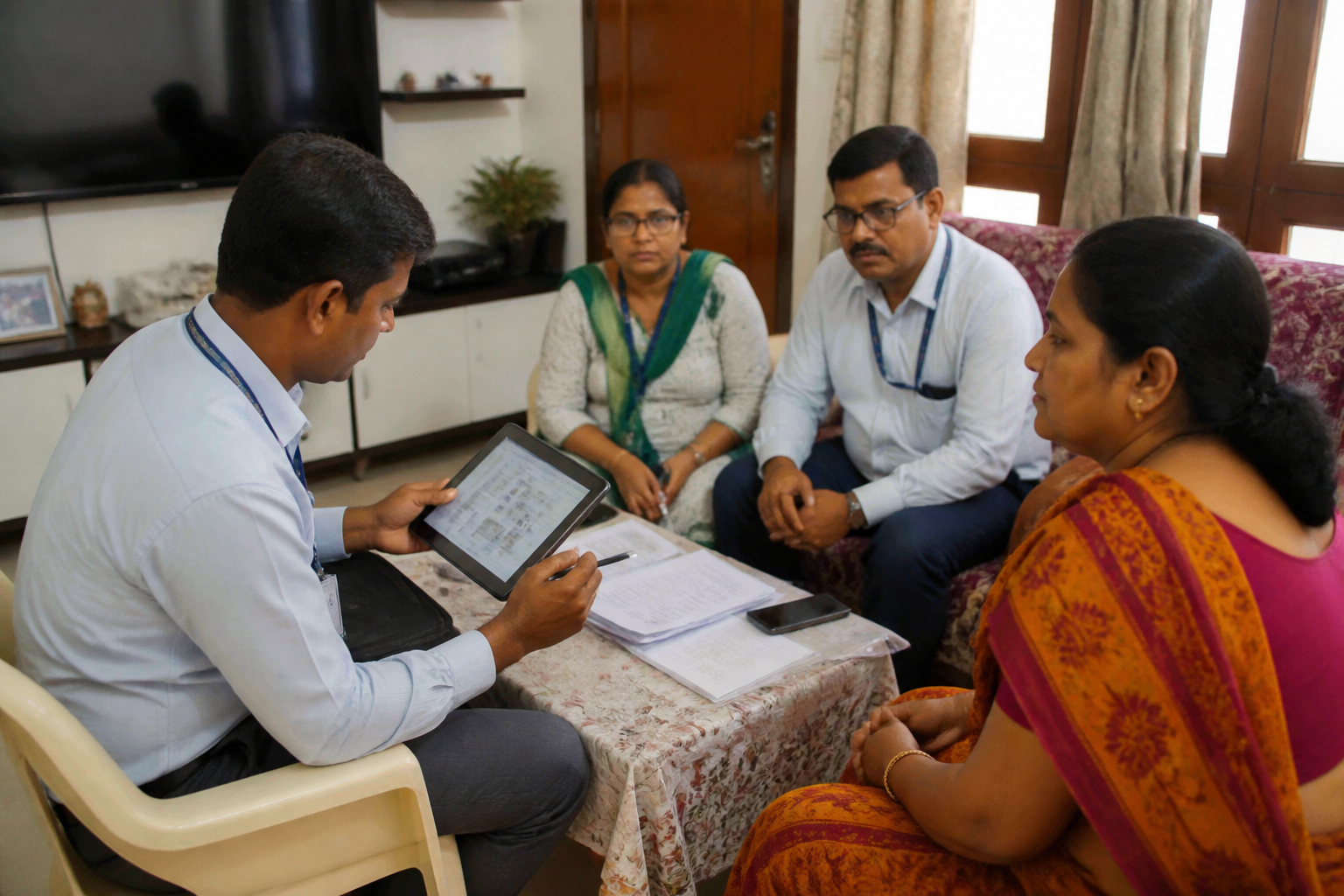
Officials also said the software used by the Election Commission does not distinguish between prominent individuals and other voters when generating notices. A notice is produced on the basis of the data available to the system. However, once a booth-level officer identifies that a notice has been generated in the name of a prominent person, it may not be served. Instead, the officer may visit the person’s residence and complete the verification process there.
This arrangement places considerable responsibility on booth-level officers. They are not merely delivering forms or notices; they are also interpreting discrepancies, comparing records and deciding whether a matter can be resolved through local verification. In a process involving 43.8 lakh flagged voters, the consistency of those decisions becomes a central administrative question. The supplied report does not provide data on how many cases have been resolved at this stage, how many notices have been served, or how many names have been excluded from draft or final rolls.
The cases also show why the language used in electoral administration matters. “No mapping” may describe a technical relationship between a current record and a historical database, but to a voter it can appear to question whether the person belongs on the roll. Similarly, a spelling mismatch may be a routine data-quality issue, yet it can create uncertainty if the process requires a voter to produce documents, attend a hearing or make repeated visits to an election office.
The report indicates that authorities are using different responses depending on the nature of the discrepancy. In some cases, a notice may be generated. In others, officials may visit the voter’s residence or resolve the mismatch without issuing a notice. For the administrative system, this flexibility may help reduce unnecessary hearings. For voters, however, the process can be difficult to understand unless the reason for a flag and the available remedy are communicated clearly.
The institutional responsibilities are divided across several levels. The Election Commission’s software and electoral databases generate or identify discrepancies. District election officials oversee the revision within constituencies. Civic authorities and senior officials are involved in local administration, while booth-level officers carry out direct verification. The process therefore depends on coordination between data systems and field-level personnel.
That coordination is particularly significant in Bengaluru, where electoral records are being checked against older data while the city’s administrative structure includes multiple civic and election authorities. The report refers to Bengaluru South City Corporation officials and the Greater Bengaluru Authority chief commissioner in separate cases. It does not establish whether the two cases followed identical procedures, but it does show that local administrative channels are central to resolving voter-record discrepancies.
The available evidence confirms three facts. First, the SIR exercise is generating a large number of flags across Karnataka. Second, the flags include missing links to 2002 data, spelling differences and logical discrepancies. Third, officials say not every flag will result in a conventional notice or require the voter to appear at a hearing. Beyond that, important questions remain unanswered in the supplied material, including the number of notices actually served, the deadline for responses, the proportion of flags caused by each category and the safeguards against erroneous exclusion.
Those unanswered questions are central to understanding the urban governance dimension of the exercise. Electoral-roll revision is a constitutional and administrative function, but in a city it is also a citizen-interface problem. The quality of the process depends not only on the database but on whether residents can understand a notice, access the required records and obtain a correction when an old or inconsistent entry is identified.
The Nilekani and Rao cases should therefore be read as examples of a wider transition in public administration. Large datasets and automated checks can identify patterns that manual review might miss, but they can also convert ordinary variations in names and family information into formal flags. Field verification remains necessary because the meaning of a discrepancy cannot always be determined from the database alone.
The immediate next steps are procedural. Officials are expected to check the status of the notices involving Nilekani and his family, while the process to resolve the spelling discrepancy in Prof Rao’s record and include his name in the final electoral roll has been initiated. For the wider SIR exercise, the key developments to monitor are how flagged voters are contacted, how discrepancies are resolved and whether the final rolls reflect corrections made during verification.
