


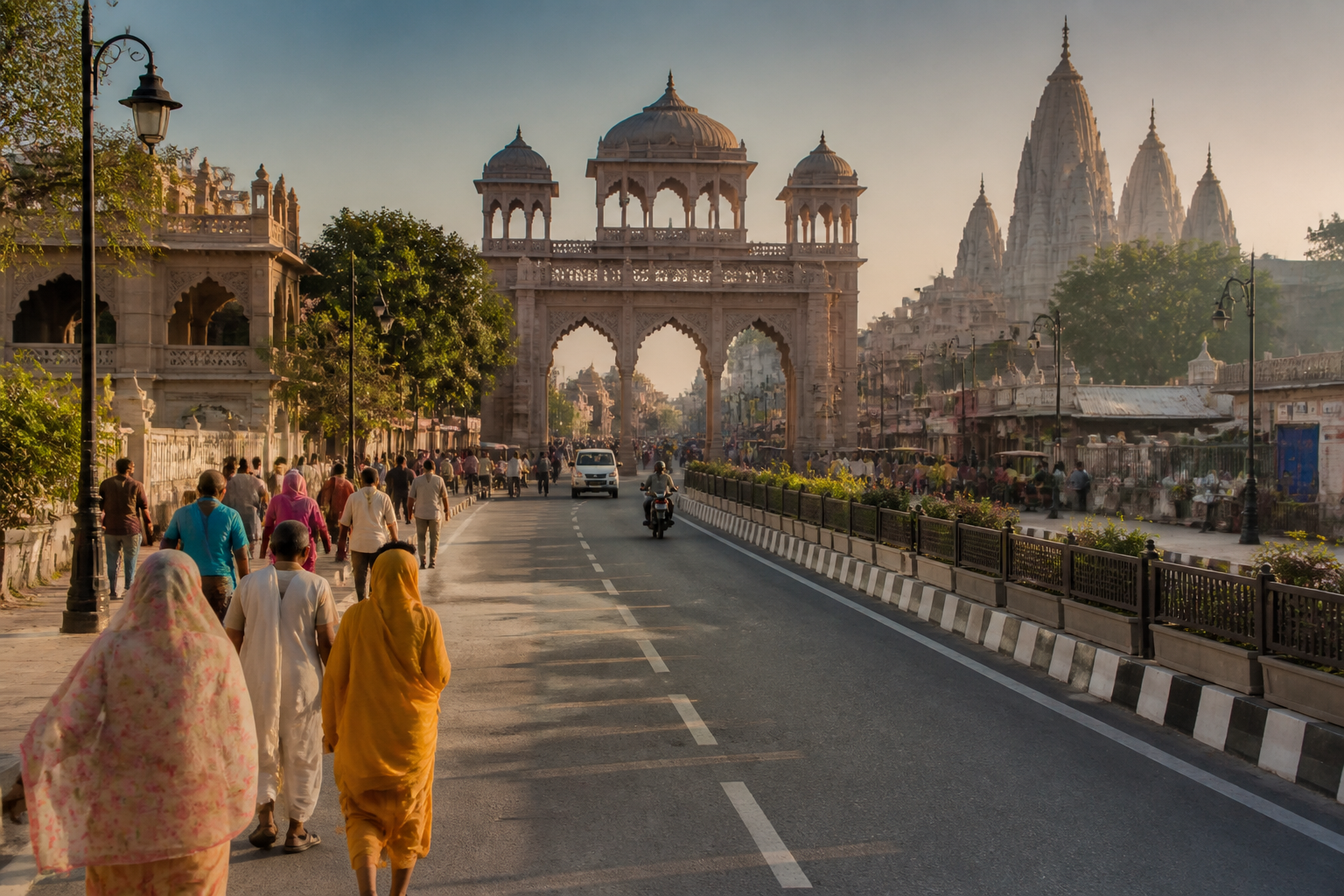
Uttar Pradesh’s Rs 1,051-crore Mathura-Vrindavan development push is being presented as the next major transformation of a pilgrimage region after Ayodhya. The programme combines roads, bridges, visitor accommodation, municipal training, beautification and proposed cultural infrastructure. Its significance, however, extends beyond the number of projects. It raises a central urban question: can a pilgrimage town absorb larger visitor volumes and new real-estate demand without losing the historic character that drives its appeal?
The programme was announced earlier this month by Chief Minister Yogi Adityanath during Krishna Janmashtami celebrations, after he offered prayers at the Shri Krishna Janmabhoomi temple. According to the report, 229 projects have been either inaugurated or initiated across Mathura and Vrindavan. Sixty-two projects valued at Rs 540 crore have been inaugurated, while the foundation stones for another 167 projects worth more than Rs 437 crore have been laid. A further Rs 72 crore was transferred directly to beneficiaries under housing schemes.
That mix matters because the programme is not limited to temple precincts or ceremonial improvements. It includes transport links, crossings, civic capacity and visitor infrastructure. The stated direction is a broader urban transformation of the Braj region, with the chief minister also announcing plans for grand temple complexes on a scale comparable to those in Ayodhya and Kashi.
The largest identified mobility project is a Rs 251-crore four-lane highway connecting the Yamuna Expressway to Vrindavan. The route is intended to address congestion on narrow access roads used by pilgrims leaving the expressway. The project includes dedicated lanes and LED lighting along the stretch. A two-lane bridge over the Yamuna is also planned or under development to reduce pressure on older bridges and pontoons while improving links between rural areas, hospitals and markets in Mathura.
Other projects target specific pressure points created by pilgrimage and festival traffic. A 12-storey tourist hostel is being built at the Nayara Police Lines campus at a cost of Rs 47 crore. The facility is intended to accommodate demand during Janmashtami, Holi and Radhashtami, when visitor numbers rise sharply. A Rs 31-crore civic training centre in Vrindavan is designed to train municipal staff in cleanliness, smart services and pilgrim management.
The programme also links mobility improvements to land-use change. A Rs 86-crore, 30-metre master-plan road in Chhata is intended to move freight traffic away from village lanes and create conditions for commercial development. At the junction of the expressway link road and the Mathura-Vrindavan highway, a Rs 44-crore flyover is expected to address congestion. The Rs 35-crore Chhatikara road project includes landscaping, footpaths, cycle tracks and underground wiring on a principal gateway to Vrindavan from NH-19.
These projects illustrate how infrastructure can alter the geography of a pilgrimage economy. A new road does not only shorten travel time. It changes which parcels become accessible, where visitors can stay, how goods move and which locations become viable for commercial activity. In Mathura-Vrindavan, the same transport investment that improves pilgrim access can increase demand for hotels, guest houses, service apartments, retail space and second homes.
The report places this possibility in the context of Delhi-NCR. With improved road links, Mathura and Vrindavan are described as being roughly two hours from Delhi, Noida and Greater Noida. The resulting market opportunity identified by the report is straightforward: easier weekend travel can support second-home demand, while higher visitor volumes can expand accommodation and hospitality requirements. The Chhata road could also support warehousing and retail by improving freight movement and opening land for commercial use.
Vrindavan’s emerging role as a retirement and long-stay destination adds another layer to the urban transition. A town that serves pilgrims for a few hours or days requires a different infrastructure system from one that accommodates permanent residents, seasonal visitors, retirees and service workers. Water supply, sanitation, waste management, local mobility, healthcare access and housing affordability become more important as the duration of stay increases. The supplied material identifies these pressures but does not provide capacity data or performance figures for the existing systems.
The government’s proposed next phase includes a ropeway in Vrindavan, large parking projects, the Raya Urban Node, the Surdas Brajbhasha Academy and Saurabhi Van, described in the report as a planned 400-acre city forest. These proposals indicate an attempt to manage the region through a combination of transport infrastructure, visitor facilities, cultural institutions and new urban nodes. Their final form, funding arrangements, implementation schedules and land requirements are not established in the supplied material.
The stated ambition to develop temple complexes on the scale of Ayodhya and Kashi places the infrastructure programme within a wider model of religious tourism-led urban development. Ayodhya is presented in the report as an example where temple-related investment has coincided with increased hotel demand, rising land prices near the Ram Mandir and greater investor interest. The report draws a parallel with Mathura-Vrindavan, where religious significance, existing visitor flows and new connectivity could produce similar real-estate pressure.
That comparison is useful, but it does not mean the two places have identical urban conditions. Vrindavan is described as a living pilgrimage town with narrow lanes, ancient temples, ghats and a distinctive spatial rhythm. Its value is not only the number of visitors it can accommodate. The physical and cultural character of the town is itself part of the visitor experience. Large roads, flyovers and new construction may solve some access problems while creating new pressures around heritage areas, traffic distribution, land values and the relationship between old neighbourhoods and new development.
Ankit Aggarwal, director of Devika Group, described the investment as a significant phase in the evolution of the Braj region. In comments cited by the report, he said the programme strengthened connectivity, civic amenities, tourism and cultural infrastructure, and could make Vrindavan more accessible and conducive to organised development. He also said the region’s spiritual and cultural character should guide the next phase of urbanisation.
Aggarwal specifically identified internal connectivity, parking, sanitation, water management, green spaces and heritage conservation as areas requiring attention. These priorities follow directly from the region’s dual role as both a pilgrimage destination and a settlement. A highway can improve regional access, but it does not automatically resolve movement within the town. A tourist hostel can add beds, but it does not by itself address waste, water or pedestrian safety. A beautified gateway can improve the arrival experience, but it does not determine how development will proceed behind it.
The programme therefore brings together two different scales of urban planning. At the regional scale, expressway connections, bridges, freight roads and new urban nodes can redistribute movement and investment across Mathura, Vrindavan and surrounding settlements. At the local scale, the quality of streets, drainage, sanitation, parking, public spaces and heritage management will determine whether the transformation improves everyday conditions for residents as well as visitors.
The housing component also deserves attention. The report notes that Rs 72 crore was transferred to beneficiaries under various housing schemes, but it does not specify the number of beneficiaries, the schemes involved, the locations of homes or how the housing support connects to the broader development plan. Without those details, the relationship between large-scale visitor infrastructure and resident housing remains unclear. A tourism-led property cycle can increase land and rental values, while the benefits of improved connectivity may be distributed unevenly.
The same uncertainty applies to real-estate expectations. The report and the quoted industry view identify second homes, long-stay living, hotels, service apartments, retail and warehousing as likely areas of interest. Those are plausible development categories connected to the announced infrastructure, but the supplied material does not provide transaction data, price trends, construction approvals or occupancy figures. The immediate evidence confirms a substantial public investment programme; it does not yet establish the scale or timing of any resulting property-market expansion.
What is clearer is the direction of policy. The state is treating Mathura-Vrindavan as a combined religious, cultural and urban development geography rather than as a set of isolated temple sites. Roads, civic training, visitor accommodation, cultural institutions, landscaping, parking and proposed ecological infrastructure are being assembled into one regional transformation narrative. That approach can improve coordination if institutional responsibilities, funding and implementation are clearly defined. The source material does not provide those administrative details.
The evidence also shows that project announcements and completed infrastructure are at different stages. Of the 229 projects cited, 62 have been inaugurated and 167 have had foundation stones laid. This distinction is important for assessing the programme. An inaugurated project represents a different level of delivery from a project that has only reached the foundation-stone stage. Timelines, tender information, construction progress and operational performance will be necessary to judge how much of the proposed transformation has become usable infrastructure.
Mathura-Vrindavan’s next phase will consequently be measured not only by the value of sanctioned works or the number of projects announced. It will be measured by whether new regional access is matched by internal mobility, whether visitor capacity is matched by civic services, whether housing support reaches residents, and whether commercial growth is compatible with heritage and ecological assets. The source confirms the scale and direction of the investment, but not yet its full urban outcomes.
The central issue is therefore not whether Mathura-Vrindavan will change. The announced projects make change likely. The unresolved question is how that change will be managed across a pilgrimage town, a living residential settlement and an emerging real-estate market. The next developments to monitor are the implementation of the inaugurated and newly initiated works, details of the proposed ropeway and parking projects, the Raya Urban Node and city forest, and the safeguards attached to temple, road and commercial expansion.
