


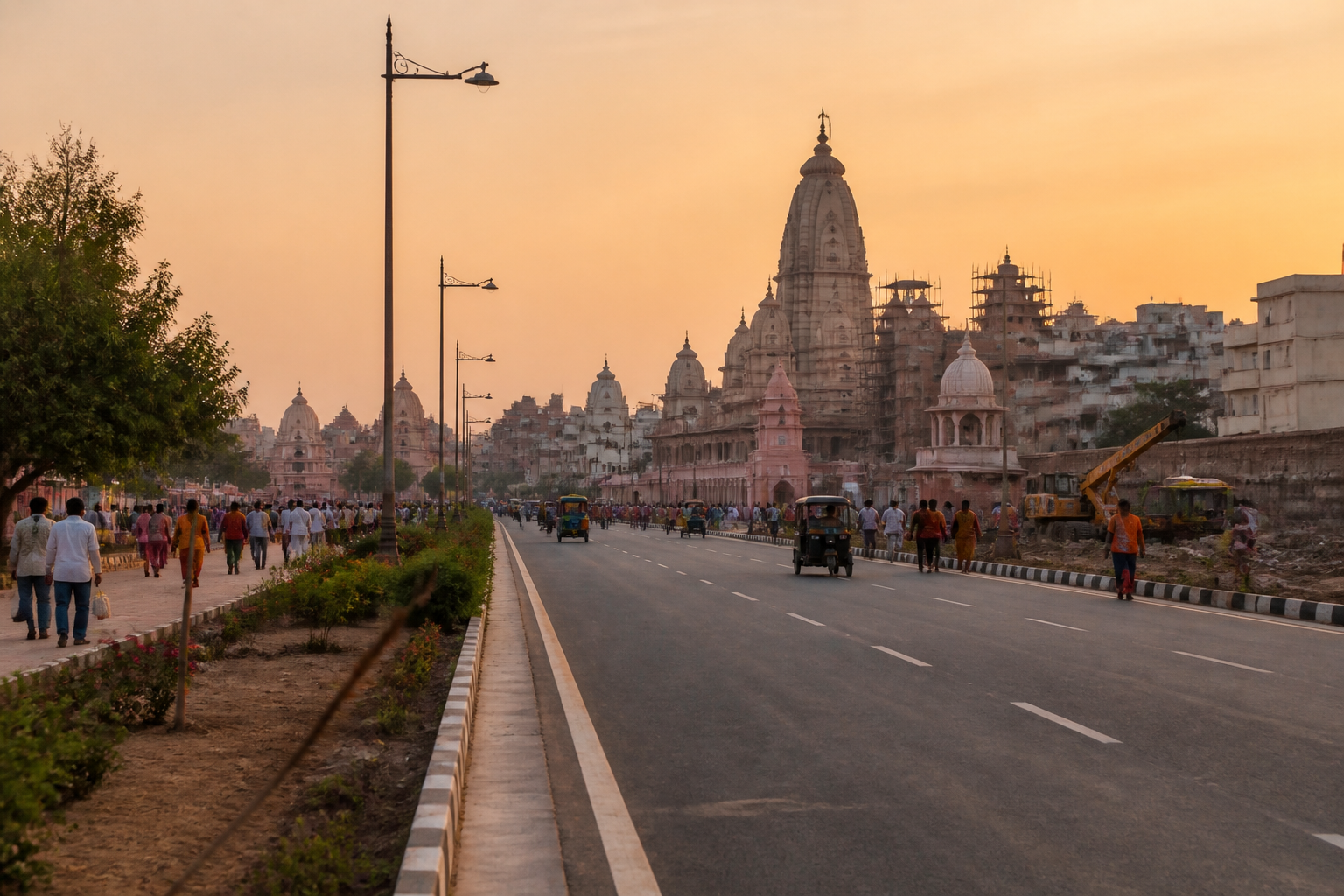
The Uttar Pradesh government’s Rs 1,051-crore development push across Mathura and Vrindavan is more than a collection of road, bridge and beautification projects. It is an attempt to reshape one of India’s most important pilgrimage regions around higher visitor volumes, stronger regional connectivity and a larger religious-tourism economy. The scale of the intervention also raises a difficult urban question: can a historic pilgrimage town modernise without weakening the cultural character that makes it valuable in the first place?
Announced during Krishna Janmashtami, the programme covers 229 projects across Mathura and Vrindavan. According to the supplied report, 62 projects worth Rs 540 crore have been inaugurated, while foundation stones have been laid for another 167 projects worth more than Rs 437 crore. The state has also transferred Rs 72 crore directly to beneficiaries under various housing schemes.
The project list shows that the plan is aimed at several layers of the urban system at once. It includes regional road connectivity, crossings over the Yamuna, visitor accommodation, municipal training, traffic management, streetscape improvements and future tourism infrastructure. This combination is significant because pilgrimage congestion is rarely caused by one missing road alone. It emerges from the interaction between access routes, internal streets, parking, sanitation, accommodation and the ability of local institutions to manage periodic surges in population.
### From access roads to a regional network
The largest identified project is a Rs 251-crore four-lane highway connecting the Yamuna Expressway to Vrindavan. The report describes the road as a response to congestion on narrow access routes used by pilgrims leaving the expressway. Dedicated lanes and LED lighting are planned along the stretch. The project therefore addresses the first stage of the visitor journey: moving people from a high-capacity regional corridor into a pilgrimage destination whose internal network is more constrained.
A new two-lane bridge over the Yamuna is intended to reduce pressure on older bridges and pontoons while connecting rural areas to hospitals and markets in Mathura. This gives the bridge a function beyond pilgrimage access. It is also described as a link between settlements and essential urban services, making its impact dependent on how effectively it integrates with the wider road network.
The plan includes an Rs 86-crore, 30-metre master-plan road in Chhata. The stated purpose is to shift freight traffic away from village lanes and create space for commercial activity. This indicates that the infrastructure programme is not limited to temple approaches. It also seeks to reorganise the movement of goods and open new development corridors. Once a road is designed to support freight and commercial use, questions of land conversion, access management and municipal capacity become as important as the road itself. The supplied material does not establish how those issues will be governed.
An Rs 44-crore flyover is planned at the meeting point of the expressway link road and the Mathura-Vrindavan highway. Another Rs 35 crore is being spent on the Chhatikara road, described as the main gateway into Vrindavan from NH-19. The work includes landscaping, footpaths, cycle tracks and underground wiring. Together, these projects show an effort to improve both traffic flow and the visual quality of arrival routes.
### Pilgrimage demand is also a municipal capacity problem
The development plan recognises that visitors require more than roads. A 12-storey tourist hostel costing Rs 47 crore is being built inside the Nayara Police Lines campus for periods of high demand, including Janmashtami, Holi and Radhashtami. Temporary or seasonal overcrowding is one of the defining pressures on pilgrimage towns, where the resident population and the visitor population can be very different in scale. The hostel is a direct attempt to add organised accommodation capacity within the public infrastructure system.
The state has also allocated Rs 31 crore for a civic training centre in Vrindavan. The facility is intended to train municipal staff in cleanliness, smart services and pilgrim handling. This may be one of the most consequential components of the programme because it focuses on the institutions that must operate the city after construction is completed. New roads and visitor facilities can improve access, but their public value depends on daily maintenance, waste management, traffic control and the ability to respond during major festivals.
The training centre also suggests that the state views Vrindavan’s challenge as one of administration, not only construction. However, the report does not specify the centre’s staffing model, training capacity, performance indicators or relationship with the local municipal administration. Those details will determine whether the facility becomes an operational asset or remains an isolated capital project.
Other projects and proposals point to an expanding tourism infrastructure system. Officials have flagged a ropeway in Vrindavan, large parking projects, the Raya Urban Node, a Surdas Brajbhasha Academy and Saurabhi Van, described as a 400-acre city forest and billed as Asia’s largest. The supplied material does not provide timelines, land details or implementation status for these proposals. They should therefore be treated as announced components of a future pipeline rather than completed infrastructure.
### The real estate effect will follow the infrastructure
The development push is already being interpreted through the lens of property and investment. An industry representative quoted in the report argues that better connectivity and civic services could make Vrindavan more accessible, liveable and suitable for organised development. The same assessment identifies spiritual tourism, second homes and long-stay living as areas likely to gain importance.
This connection between infrastructure and real estate is not incidental. A faster route from the Yamuna Expressway can expand the practical catchment of weekend visitors. More reliable access can support guest houses, service apartments and small hotels. A road intended to divert freight can encourage warehousing, retail and other commercial uses along its corridor. The state’s intervention is therefore likely to influence land demand as much as it changes travel times.
The report also describes Vrindavan as an emerging retirement and long-stay destination for people seeking a spiritual environment while retaining access to nearby cities. That claim is presented as an industry view rather than as a measured demographic trend. Even so, it points to a wider shift in how pilgrimage towns are being positioned: not only as places for short visits, but also as locations for extended stays, second homes and potentially permanent settlement.
This creates a planning challenge. A city designed mainly for periodic pilgrimage flows may not provide the same services required by long-stay residents. Water supply, sewage treatment, solid-waste management, healthcare, internal mobility and public spaces become more important when visitors stay longer or new residents move in. The supplied report identifies water management, sanitation, parking, green spaces and heritage conservation as priorities for the next phase, but it does not establish whether detailed capacity plans have been released.
### The Ayodhya comparison has limits
The government’s messaging places Mathura-Vrindavan alongside Ayodhya and Kashi, including a commitment to develop grand temple complexes on a similar scale. The comparison reflects the political and cultural importance assigned to the three religious centres. It also creates an expectation that temple infrastructure can become a central driver of urban transformation.
But Mathura and Vrindavan are not blank sites awaiting a new urban identity. Vrindavan contains narrow lanes, historic temples, ghats and established patterns of pilgrimage and daily life. The supplied report’s quoted industry assessment makes the same point in institutional terms: development should complement rather than dilute the region’s spiritual and cultural character.
That distinction matters because infrastructure can produce both access and pressure. Wider roads may reduce congestion on selected corridors while increasing land values and development intensity around them. New accommodation can absorb visitors but also change the scale and type of construction. Beautification can improve gateways while leaving unresolved the less visible systems of drainage, waste collection and internal movement. A city forest or cycle track may add public value, but only if it is connected to a broader network of usable public spaces.
The current programme provides clear evidence of public investment and project diversification. It does not yet provide enough information to evaluate land-use controls, heritage safeguards, water availability, sewage capacity or the funding required for long-term operations. Those gaps are important because the success of the plan will be measured not only by inaugurated projects, but by whether the city can function during peak festivals and ordinary weeks alike.
### A development test for pilgrimage towns
Mathura-Vrindavan’s transformation is being built around a familiar sequence: improve regional access, expand visitor infrastructure, strengthen civic administration and allow the resulting economic activity to spread into real estate and services. The Rs 1,051-crore programme clearly follows that sequence, with projects ranging from a four-lane highway and bridge to a tourist hostel and municipal training centre.
What remains uncertain is how these elements will be coordinated. The next stage will require clarity on the status and timelines of the proposed ropeway, parking projects, Raya Urban Node and other announced facilities. It will also require evidence on how traffic, accommodation, sanitation, water, heritage and green spaces will be managed as visitor and development pressures grow.
The available facts confirm a major state-led intervention in the Braj region. They also show that Mathura-Vrindavan is being positioned as a connected pilgrimage, tourism and real-estate market rather than only a temple destination. The central urban question is now whether institutional capacity and planning controls will grow at the same pace as roads, visitors and land values.

