


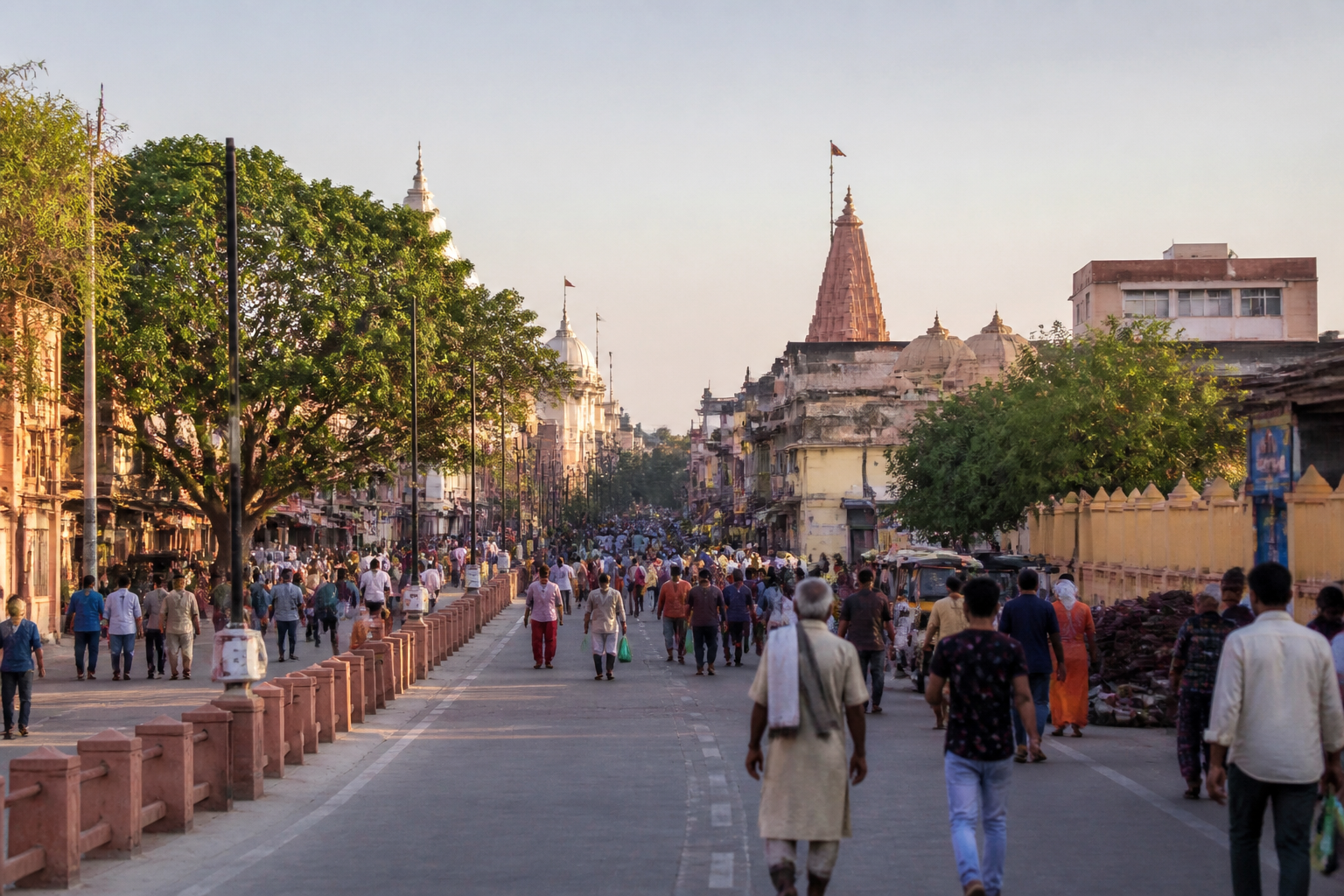
That makes the announcement more than a list of public works. It is a test of whether a pilgrimage town can absorb rising visitor numbers, improve access and attract investment without losing the physical and cultural character that makes it significant in the first place. The evidence available in the report suggests that Mathura-Vrindavan is moving towards a new phase of state-led infrastructure development, but it does not yet establish how the projects will be coordinated, operated or integrated with local urban systems.
The projects were announced earlier this month by Uttar Pradesh Chief Minister Yogi Adityanath during Krishna Janmashtami events in the region. According to the report, 229 projects with a combined value of Rs 1,051 crore are being inaugurated or initiated. Of these, 62 projects worth Rs 540 crore have already been inaugurated, while the foundation stones for another 167 projects worth more than Rs 437 crore have been laid. The state has also transferred Rs 72 crore directly to beneficiaries under various housing schemes.
The project mix reveals the government’s approach. It is not limited to temple precincts or visitor-facing beautification. A Rs 251-crore four-lane highway is planned to connect the Yamuna Expressway directly with Vrindavan. The road is intended to address congestion on narrow access routes used by pilgrims leaving the expressway and will include dedicated lanes and LED lighting.
A new two-lane bridge over the Yamuna is expected to provide an alternative to older bridges and pontoons while improving links between rural areas and hospitals and markets in Mathura. In Chhata, an Rs 86-crore, 30-metre master-plan road is intended to divert freight traffic away from village lanes and create space for commercial activity. A Rs 44-crore flyover is also planned at the junction of the expressway link road and the Mathura-Vrindavan highway.
These connections are important because pilgrimage towns experience highly uneven demand. Large festivals such as Janmashtami, Holi and Radhashtami bring sudden increases in visitors, placing pressure on roads, parking, sanitation, accommodation and public safety. A road designed for ordinary daily traffic can become inadequate during festival periods, while a town planned primarily for peak demand may carry financial and spatial costs during the rest of the year.
The proposed facilities also show an effort to address visitor accommodation and municipal capacity. A 12-storey tourist hostel is being built inside the Nayara Police Lines campus at a reported cost of Rs 47 crore. In Vrindavan, a Rs 31-crore civic training centre is intended to train municipal staff in cleanliness, smart services and pilgrim management. The report also identifies mega parking projects and a proposed ropeway as projects on the horizon.
The emphasis on municipal training is significant because infrastructure does not operate independently of institutions. Roads and public spaces can improve access, but the visitor experience will also depend on waste collection, traffic management, water supply, sanitation and the ability of local authorities to manage exceptional crowds. The supplied material does not provide operating plans or performance targets for these services, leaving implementation capacity as an unresolved part of the transformation.
The development programme also includes a Rs 35-crore upgrade of Chhatikara Road, described as the main gateway into Vrindavan from NH-19. The work is expected to include landscaping, footpaths, cycle tracks and underground wiring. Such elements can make a gateway more legible and improve pedestrian movement, but they also raise questions about continuity. Improvements on a major approach road will have limited effect if internal streets, parking areas, drainage and pedestrian routes remain unable to handle the same level of activity.
The proposed Raya Urban Node, a Surdas Brajbhasha Academy and Saurabhi Van add another layer to the state’s vision. Saurabhi Van is described in the report as a 400-acre city forest and is being presented as Asia’s largest. The report does not provide details on its implementation, land status, ecological design or operating agency. Those details will matter because large green areas can serve as public amenities and climate buffers, but only if they are protected, accessible and maintained over time.
The government has also indicated plans for grand temple complexes in Mathura-Vrindavan on a scale comparable with those in Ayodhya and Kashi. The chief minister described the proposed development as being aligned with the faith and sentiments of the people and linked it to the region’s spiritual and cultural importance. This places religious infrastructure at the centre of the region’s urban development strategy.
Ayodhya is an important reference point in the report because its transformation has been associated with increased visitor activity, accommodation demand and real estate interest. The same pattern is now being discussed in relation to Mathura and Vrindavan. Better highways and junction improvements may reduce travel friction for visitors from Delhi, Noida and Greater Noida, while new accommodation and public facilities could support longer stays and larger festival crowds.
The real estate implications described in the report extend beyond conventional housing. Improved access can increase demand for guest houses, service apartments, small hotels and second homes. The Chhata road could also support warehousing and retail by improving freight movement and opening land for commercial use. Vrindavan is additionally described as an emerging retirement and long-stay destination for people seeking a religious setting while remaining connected to urban centres.
These possibilities should not be confused with established outcomes. The supplied material records expectations from the infrastructure push and a positive assessment from Ankit Aggarwal, director of Devika Group, but it does not provide transaction data, land-price figures, hotel occupancy data or evidence of completed real estate absorption. The connection between public investment and private development will depend on land regulation, permissions, infrastructure capacity and the ability of authorities to prevent unplanned expansion.
Aggarwal described the programme as a new phase in the evolution of the Braj region, highlighting connectivity, civic amenities, tourism and cultural infrastructure. He also argued that the region’s development should preserve its distinctive identity and called for attention to internal connectivity, parking, sanitation, water management, green spaces and heritage conservation. His comments identify the central planning challenge: Mathura-Vrindavan is not an undeveloped site waiting for a new city to be built.
Vrindavan’s narrow lanes, historic temples, ghats and established pilgrimage practices are part of the destination’s value. A road-widening or beautification programme that treats these features only as obstacles could make movement easier while weakening the character that attracts visitors. Conversely, a preservation approach that does not address access, sanitation and crowd management could leave residents and pilgrims exposed to the same pressures that the new infrastructure is intended to solve.
This tension is common in religious tourism economies. Public investment can improve connectivity and expand economic opportunity, but it can also raise land values and encourage development that is disconnected from local needs. The report links the state’s infrastructure plans to the possibility of greater interest from second-home buyers, hotels and commercial users. It does not, however, establish how housing affordability, local livelihoods or displacement risks will be handled.
The programme’s institutional structure will therefore be as important as its headline value. The state has announced a large portfolio spanning highways, bridges, municipal training, tourist accommodation, urban roads, cultural facilities and green infrastructure. Each category involves different agencies, funding arrangements, construction schedules and maintenance responsibilities. Without coordination, separate projects may improve individual locations without creating a coherent urban system.
The available information also distinguishes between what has already happened and what remains at the proposal or foundation-stage level. Sixty-two projects worth Rs 540 crore have been inaugurated, while 167 projects worth more than Rs 437 crore have had foundation stones laid. A foundation ceremony signals administrative intent, but it does not by itself establish completion, service quality or long-term use. Monitoring will need to focus on delivery dates, operating arrangements and whether the promised facilities function during peak pilgrimage periods.
For Mathura and Vrindavan, the larger question is not whether infrastructure investment is necessary. The scale of pilgrimage activity and the region’s existing transport pressures make improved public systems relevant. The question is what kind of urban growth the investment will produce. A connected pilgrimage region could support tourism, employment and better municipal services. It could also generate fragmented expansion if roads and commercial development move faster than land-use planning, heritage protection and basic utilities.
The Rs 1,051-crore programme therefore marks a significant policy direction, but not a completed transformation. The evidence confirms a state-backed push to improve access, civic capacity, accommodation and cultural infrastructure, alongside an ambition to create temple complexes on the scale associated with Ayodhya and Kashi. What remains uncertain is how the projects will be implemented, how growth will be regulated and whether the region’s historic urban fabric will be treated as infrastructure to protect rather than space to replace. Future milestones will include project completion, the rollout of the proposed ropeway and parking facilities, progress on the Raya Urban Node and the functioning of the new municipal and tourist infrastructure during major festivals.
