


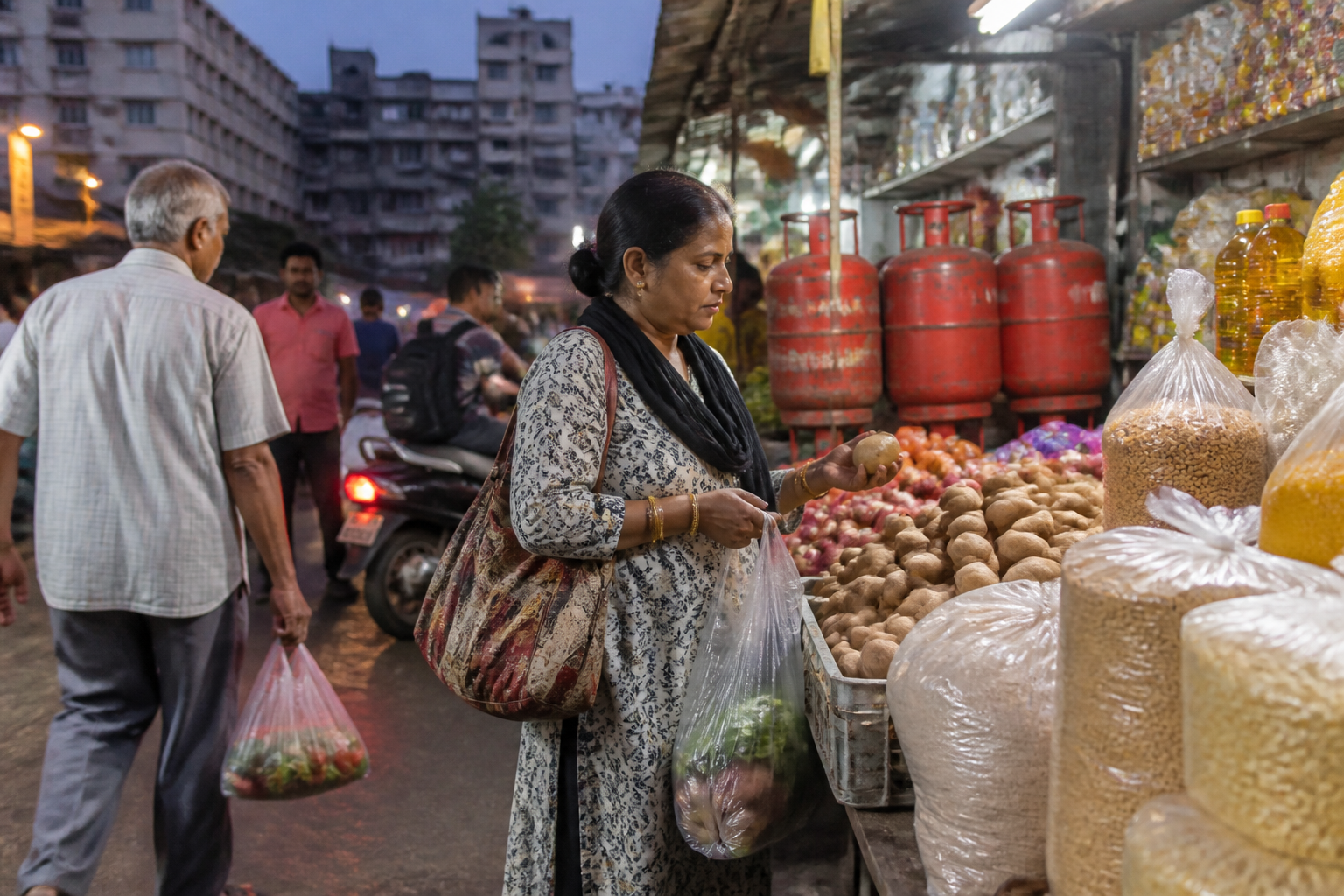
India’s inflation outlook is turning more uncomfortable for households as food and fuel prices push consumer inflation towards a projected 20-month high. A Reuters poll of 44 economists expects annual consumer price inflation to rise to 4.80% in August from 4.45% in July, keeping inflation above the Reserve Bank of India’s 4% medium-term target for a third consecutive month.
The estimate, reported by Economic Times, is not yet an official inflation reading. The August data are due on September 14. But the forecast highlights a pressure point that is particularly important in cities: the cost of essentials is rising through products that households cannot easily postpone, substitute or eliminate. Sugar, cereals, milk, edible oils, eggs, meat, fuel and cooking gas all sit close to the daily operating costs of urban households.
The larger issue is not simply whether headline inflation reaches 4.80%. It is how a food-and-fuel-led increase moves through the urban system, from household kitchens and transport budgets to small businesses and wage negotiations. The available evidence indicates that this pressure is being driven more by supply disruptions and energy costs than by a broad acceleration in underlying demand.
### A forecast shaped by food and fuel
The Reuters poll, conducted from September 3 to 9 among 44 economists, placed the expected August inflation rate between 4.40% and 5.05%. The median forecast of 4.80% would represent an increase of 0.35 percentage points from July’s 4.45% reading and the highest level in 20 months.
An erratic monsoon disrupted food supplies, according to the report, contributing to higher prices for sugar, cereals, milk, edible oils, eggs and meat. The disruption matters because food occupies a significant and unavoidable place in household budgets, even when consumers attempt to reduce discretionary spending elsewhere.
Fuel is the second major pressure point. Global crude prices were nearing $100 a barrel, while cooking-gas prices were also contributing to inflationary pressure. Kanika Pasricha, chief economic adviser at Union Bank of India, said the increase was expected to be driven primarily by elevated food prices together with a further rise in fuel inflation.
For urban households, the two categories can reinforce each other. Higher cooking-gas prices directly raise the cost of preparing food, while fuel costs also affect the movement of food and other goods through supply chains. The supplied material does not establish the size of that pass-through, but it identifies food and fuel as the central sources of the expected increase.
### Why the headline number does not tell the whole story
The forecast remains within the RBI’s 2%-6% inflation target band, even though it is above the central bank’s 4% medium-term target. The distinction is important. Remaining within the band gives the RBI room to hold its policy rate, while moving further above the medium-term target keeps pressure on monetary policy and household purchasing power.
The RBI held interest rates last month. Minutes of its latest meeting, as described in the report, indicated that the central bank was prepared to tighten policy if price pressures broadened. At the same time, economists did not expect a rate increase until next year. A separate Reuters poll conducted the previous month projected a 25-basis-point increase in the second quarter of 2027, followed by another increase in the fourth quarter, taking the policy rate to 5.75%.
That expected policy path shows the difference between a short-term supply shock and a wider inflation problem. Food and fuel prices can lift the headline index even when demand remains contained. The policy concern becomes more serious if the increase spreads to other goods and services and becomes embedded in expectations, wages and business pricing.
The poll expected core inflation, which excludes volatile food and fuel components and is used as an indicator of underlying demand pressure, to rise to 4.1% in August. India does not publish an official core inflation measure. That limitation means the headline figure and the available estimates must be read carefully: the reported increase is largely tied to volatile categories, while the core estimate suggests some pressure beyond those components but does not provide an official measure.
### The urban cost-of-living channel
Inflation becomes an urban governance issue when it changes how residents use, access and pay for the city. Food prices affect every household, but the consequences are not uniform. A household with limited room in its monthly budget may respond to higher prices by reducing consumption, changing food choices or cutting spending on transport, education and other needs. The source material does not quantify these responses, but the exposure is clear from the categories identified in the forecast.
Fuel and cooking gas also have a wider built-environment connection. Cities depend on continuous flows of energy and goods to keep homes, shops, restaurants, delivery networks and local services operating. When energy prices rise, the pressure is not confined to the fuel bill. It can reach the operating costs of businesses that depend on transport, refrigeration, cooking or regular deliveries.
The report does not provide city-level inflation data or break down the impact by income group, so it cannot establish which cities or households would face the greatest burden. It also does not establish whether urban food supply systems are experiencing a uniform disruption. What it does show is that the expected rise is concentrated in essential categories with direct household and operational relevance.
### Sugar, trade controls and supply management
Sugar provides one of the clearest examples of how supply management can interact with inflation. Sugar prices reached a record high in August and were expected to add at least 15 basis points to headline inflation, according to Pasricha. The government’s ban on sugar exports, introduced in May to cool domestic prices, was scheduled to remain in place until the end of September.
The measure illustrates the administrative choices available when domestic prices rise. Export restrictions can increase supplies available in the domestic market, but the supplied material does not assess the policy’s effectiveness or its effects on producers, traders or consumers. It only records that the restriction remained in place while sugar prices were still identified as an inflationary pressure in August.
This is also where the distinction between a price intervention and a structural solution becomes relevant. The reported drivers include an erratic monsoon, global crude prices and cooking-gas costs. An export restriction on one commodity cannot address all three. The evidence therefore points to a wider inflation challenge in which different pressures require different institutional responses.
### Wholesale prices point to continued pressure
Consumer inflation is not the only indicator moving higher. Wholesale price inflation was forecast to edge up to 9.89% in August from 9.78% in July, remaining around 10% for a fourth consecutive month, according to the poll.
The wholesale figure does not translate automatically into an equivalent increase in retail prices. The two measures cover different stages and components of the economy. However, their simultaneous elevation is an important signal because it suggests that price pressure is not confined to a single retail category in the forecast period.
The available material does not identify the components driving wholesale inflation or explain how quickly those prices may pass through to consumers. It does, however, place the consumer forecast alongside a wholesale inflation estimate that has remained close to 10% for several months. That combination is one reason the RBI is monitoring whether price pressures broaden beyond food and fuel.
### What the evidence confirms—and what remains uncertain
The evidence currently supports five conclusions. August consumer inflation was expected to rise from July’s 4.45% to 4.80%; the forecast would mark a 20-month high; inflation would remain above the RBI’s 4% medium-term target for a third month; food and fuel were expected to be the principal drivers; and wholesale inflation was projected to remain close to 10%.
It does not yet confirm the final August consumer inflation reading. It also does not establish the precise effect on individual cities, household-income groups, rents, transport fares or local business costs. Those questions would require the official data and more detailed price information than the supplied report contains.
For urban India, the next important milestone is the official inflation release due on September 14. That figure will determine whether the projected rise materialised and whether the increase remained concentrated in food and fuel or broadened into core components. The RBI’s response will depend not only on the headline number but also on whether the underlying pressure begins to spread. Until then, the forecast is a warning about the vulnerability of urban household budgets to disruptions in food supply and energy prices—especially when both pressures rise at the same time.
