


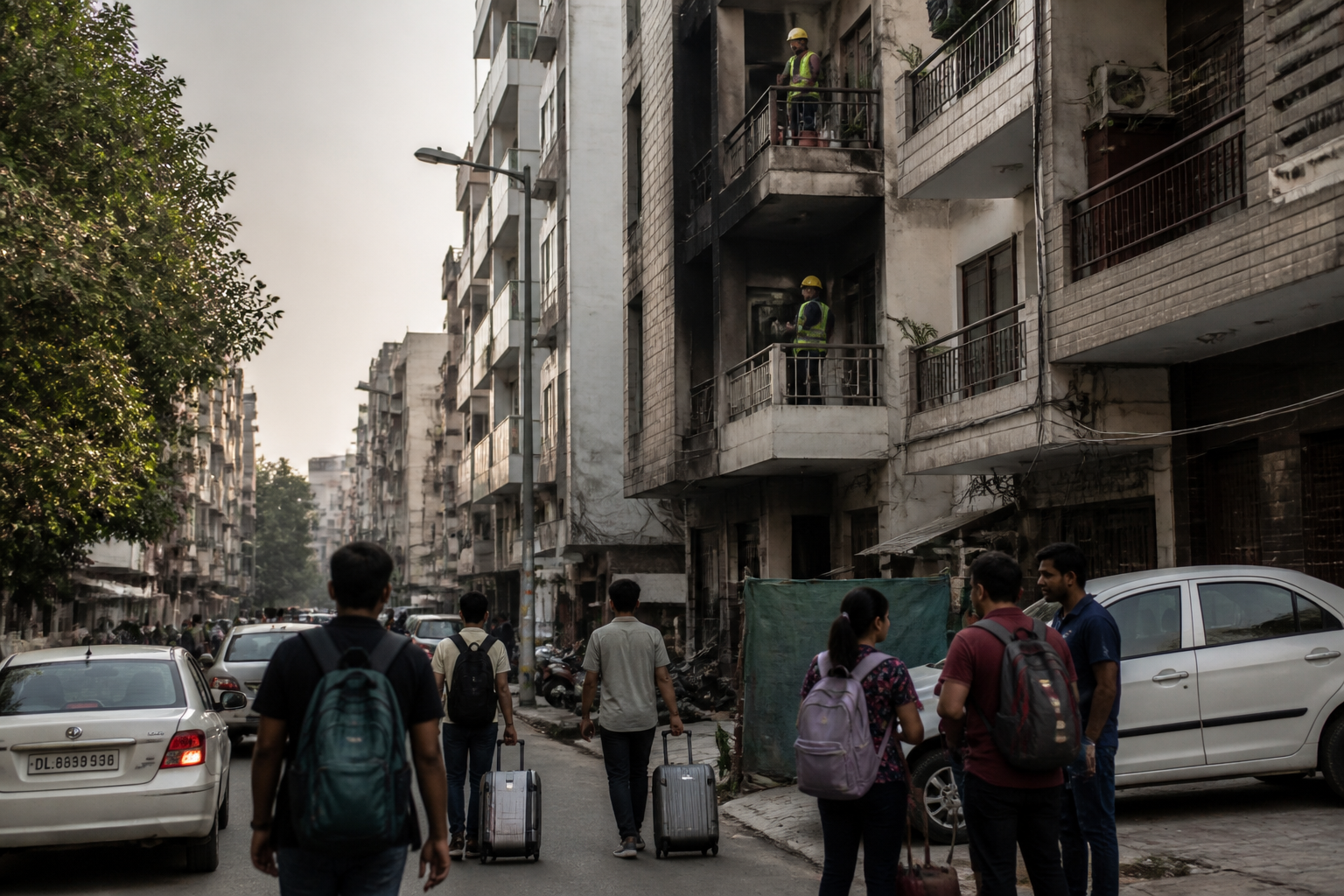
Delhi’s PG safety crisis has moved beyond one collapsed building or one fatal fire. In Hauz Rani, the aftermath of a June 3 fire at the Flourish Stay B&B has emptied accommodation facilities and weakened the local economy. In Satya Niketan, the collapse of a five-storey paying guest building has driven students out of rooms they once considered affordable homes. Together, the two neighbourhoods show how Delhi’s low-cost accommodation markets can grow faster than the systems meant to regulate them.
The two incidents were different in form. The Hauz Rani tragedy was a fire in an accommodation facility serving medical tourists and their relatives. The Satya Niketan tragedy involved the collapse of a student PG. Yet the consequences have converged. Residents, students, shopkeepers and transport workers are now dealing with a loss of trust in the buildings around them. The immediate emergencies ended after rescue and firefighting operations. The urban disruption has continued through sealed properties, empty rooms, displaced tenants and businesses waiting for customers to return.
In Hauz Rani, the fire killed 23 people, including 14 foreign nationals. The Delhi Police chargesheet cited in the report alleges that the B&B was licensed for six rooms but was operating at least 25 rooms across four floors, a basement and an improvised rooftop facility. The property allegedly lacked a fire NOC and an emergency fire exit. Investigators alleged that the fire began in the kitchen after an oil fryer was left unattended and that dense smoke travelled up the central staircase, trapping guests on the upper floors.
The sequence described in the chargesheet illustrates the difference between formal approval and actual urban use. Firefighters reached the site seven minutes after the first distress call at 8.48am, but narrow and congested lanes made access difficult. Between 9am and 11.30am, they rescued 48 people. By noon, the fire was under control, but 23 people had died. The chargesheet names B&B owner Lovkesh Bajaj, manager-cum-accountant Jay Mishra and cook Kesar Negi as accused. The allegations remain part of the investigation and legal process.
The neighbourhood’s economic life has not recovered at the same pace as official operations. Police barricades were removed and some footfall returned, but several homestays and B&Bs were sealed. A building opposite the fire site was found deserted, with flats locked from outside, while a local autorickshaw driver told the report that customers would not return while accommodation facilities remained closed. Shopkeepers who depended on medical tourists and their relatives are therefore experiencing the fire not only as a safety event but also as a disruption to the local demand cycle.
Satya Niketan presents a different regulatory problem. The collapse of a five-storey PG killed seven people, including five students and two labourers. The building was reportedly around 40 to 50 years old, with additional floors added over time. Construction work had also been underway for about two weeks before the collapse. The report says students have raised concerns about neighbouring buildings, including poor ventilation, dangerous staircases and inadequate fire-safety provisions. One adjoining building was being vacated for demolition, while others were identified as unsafe.
The response of students shows how building safety becomes a housing affordability question. Some moved to friends’ or relatives’ homes; others spent nights inside college campuses after being forced out of their PGs. One student cited in the report paid Rs 8,000 for accommodation, a relatively low rent for Delhi, but lived in a room without ventilation or air conditioning. His parents wanted him to move after the collapse. For students from outside the capital, leaving a risky building is not a simple decision: a safer room may be farther from college, more expensive or unavailable.
That constraint is intensified by the limited supply of institutional accommodation. Around 71,600 new undergraduate students were admitted to Delhi University in 2026-27, while the university has around 7,000 hostel seats, according to figures cited by officials. The gap has helped produce a large private PG market around college clusters such as Satya Niketan. Private accommodation is not merely an alternative for a small group of tenants; it is part of the city’s practical housing infrastructure for students who cannot access university hostels.
The same relationship between demand and weak compliance appears in Hauz Rani. The B&B reportedly served people seeking inexpensive accommodation close to hospitals. Its alleged expansion from six licensed rooms to at least 25 operational rooms indicates how commercial pressure can alter the physical use of a property. In Satya Niketan, the addition of floors and construction activity allegedly changed the risk profile of a building used by students. In both cases, the demand for centrally located and affordable accommodation was clear. What was less visible to tenants was whether the buildings had retained the approvals, capacity and safety systems required for that use.
This is the institutional gap now facing Delhi. Accommodation may be marketed as a B&B or PG, but its regulation can involve several responsibilities: licensing, land-use compliance, structural safety, fire prevention, construction permissions and local enforcement. The report does not establish that every authority failed in either case, nor does it resolve the legal liability arising from the incidents. It does show how difficult it is for residents to identify which agency has verified a building’s safety before they move in.
The proposed administrative response is a framework for PG accommodation. Urban development minister Ashish Sood has promised comprehensive legislation and regulations within two months. The proposed framework is expected to include mandatory licences, zone-wise rent bands, structural and fire-safety audits and a central portal listing rents, amenities and compliance details. Students have separately demanded a web portal where PG owners would disclose rents, facilities, meal plans and structural-safety information, along with pre-monsoon audits, structural certifications and regular fire-safety inspections.
A public listing system could address one specific problem identified by the two tragedies: the information imbalance between property operators and tenants. Students and medical visitors often choose accommodation based on price, distance and immediate availability. The supplied report does not establish whether tenants were shown valid licences, fire clearances or structural certifications before occupying the properties. A disclosure system would not by itself make a building safe, but it could make compliance visible and give authorities a clearer inventory of the accommodation market they are expected to regulate.
The proposed reforms also reveal the scale of the policy challenge. Zone-wise rent bands would connect housing regulation with affordability. Structural and fire-safety audits would require technical assessments rather than only paperwork. Mandatory licensing would have to account for properties operating across mixed residential and commercial settings. A central portal would need current information on the status of each listed property. The details of the legislation, its enforcement authority, funding and penalties have not yet been established in the supplied material.
Delhi’s temporary response has relied partly on institutions that were not designed to function as emergency housing. After the Satya Niketan collapse, Delhi University colleges opened classrooms and other facilities as temporary shelters. Mattresses were placed in health centres, staff rooms and guest rooms, while colleges arranged food and counselling. Student volunteers searched for classmates who may have been living in the collapsed building. This helped address immediate displacement, but it also underlined the absence of sufficient formal accommodation when private housing becomes unsafe.
The data available in the report points to a structural mismatch rather than an isolated failure of demand. Delhi University had around ten times as many new undergraduate admissions as hostel seats in 2026-27. In Hauz Rani, a property licensed for six rooms allegedly operated at least 25 rooms. One figure describes a citywide accommodation shortage; the other describes the intensity with which individual properties may be used to meet that shortage. Together, they show how a limited supply of affordable rooms can increase pressure on buildings and tenants alike.
For the city, the central question is not only who will be held accountable after a fire or collapse. It is whether residents can know, before signing a rental agreement or checking into a room, that the building is legally authorised, structurally assessed and equipped for the number of people it houses. Hauz Rani’s empty accommodation facilities and Satya Niketan’s departing students show the social cost when that information arrives only after a disaster.
The evidence currently confirms three things: both tragedies produced consequences beyond the immediate sites; affordable accommodation markets are carrying demand that formal institutions cannot absorb; and Delhi is preparing a regulatory response for PG housing. What remains uncertain is the final content of the proposed legislation, the status of inspections across neighbouring properties and whether displaced students and accommodation-dependent businesses will return. Those developments will determine whether the response becomes a durable safety system or remains a post-disaster intervention.
