


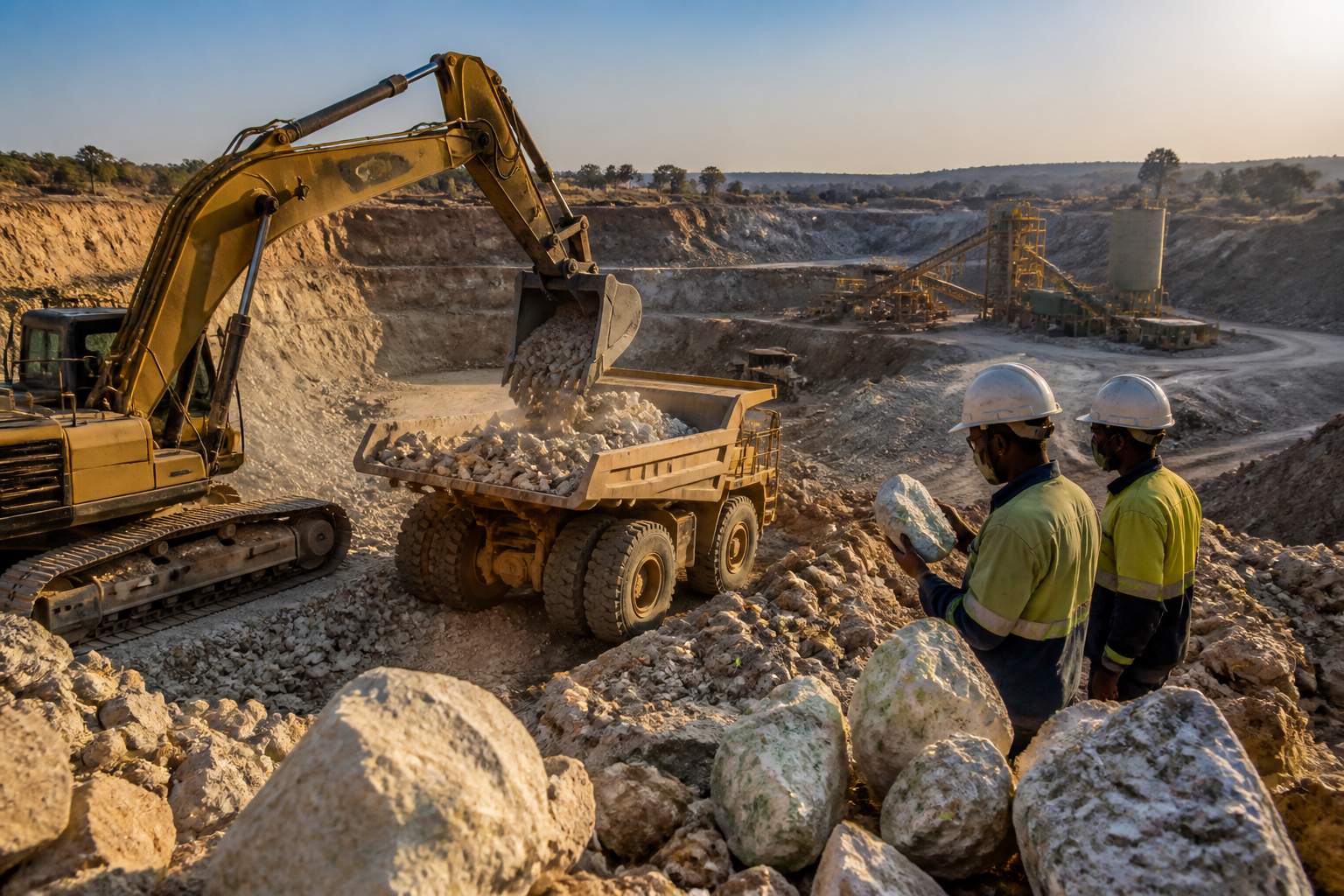
LOHUM’s move into Zimbabwe lithium mining is more than an overseas resource acquisition: it is an attempt to connect an African mine, processing capacity in Zimbabwe and refining and downstream battery-materials production in India. The company has started mining across 10 spodumene-bearing blocks and is targeting annual lithium carbonate production of about 30,000 tonnes within the next two to three years. Whether that ambition becomes a functioning supply chain will depend on how quickly each link is built and connected.
The company’s first ore dispatch from Zimbabwe, announced on Wednesday, marks the beginning of its first mining operation outside India. Founder and chief executive officer Rajat Verma told Business Standard that LOHUM had secured rights to 10 blocks covering about 1,100 hectares. Drilling and blasting had begun, with excavation of the first ore scheduled shortly after the interview. The company said the move makes it the first Indian company to start lithium operations globally.
That claim is significant because the project is structured around a division of functions across two countries. Mining and initial processing will take place in Zimbabwe. The material will then be converted in India into lithium carbonate, a battery-material input. LOHUM is also setting up a cathode active material facility, which could allow the company to consume some of its own lithium carbonate before the material reaches cell manufacturers.
The arrangement points to a larger shift in how Indian companies are approaching critical minerals. Rather than treating mining as an isolated upstream activity, LOHUM is seeking to control several stages of the value chain: access to the ore, early-stage processing, chemical conversion and potentially the manufacture of cathode materials. The company already has customers in India and overseas for its lithium carbonate, according to Verma, and is in discussions with domestic companies.
The key question is therefore not simply how much lithium exists in Zimbabwe. It is whether the company can turn mining rights into reliable material flows, and then create sufficient conversion and downstream capacity in India to absorb them.
### From mining blocks to lithium carbonate
LOHUM said the 10 initial blocks are expected to support production of approximately 300,000 tonnes of lithium carbonate equivalent over the life of the assets. At prevailing lithium carbonate prices, the company estimated the deposits’ in-situ value at approximately $7 billion. These figures describe the potential resource position, not realised output or revenue. The company’s stated annual capacity across mining, conversion and refining is about 30,000 tonnes.
The difference between a resource estimate and annual production capacity is important. The first establishes the scale of the asset as described by the company; the second reflects the infrastructure and processing system that LOHUM intends to build. The company has said it expects the first batch of ore to emerge shortly after mining began, but the full 30,000-tonne target is projected for the next two to three years.
LOHUM has not announced the location of its new Indian lithium refinery. That leaves a major operational component of the proposed chain unspecified. The refinery will determine where the Zimbabwean material is converted into lithium carbonate, but the supplied information does not establish its construction schedule, investment size, approvals, technology provider or commissioning date.
The company’s description of the process begins with spodumene-bearing ore. After mining and initial processing in Zimbabwe, the material is expected to be converted into crude lithium sulfate and ultimately into pure lithium carbonate in India. The planned cathode active material plant would extend the chain further downstream, although details on its location, capacity and timeline have not been announced.
### Why the overseas asset matters to India
India’s battery-materials supply chain cannot be built only through domestic refining or cell manufacturing. It also requires dependable access to mineral resources. LOHUM’s project reflects one corporate response to that challenge: secure an overseas mining asset and link it to processing and manufacturing capabilities in India.
The company’s approach also reveals the time pressure it associates with overseas mineral acquisition. Verma said firms evaluating assets abroad must address three issues at the same time: acquire the asset at the right price, bring it into production quickly and create value locally. He said LOHUM focuses on assets that can begin generating throughput within one to two years, rather than projects that require a decade or longer to develop.
This is a commercial strategy, but it also has an institutional implication. An overseas mining right has limited value for Indian manufacturers unless ore can be extracted, processed, transported, refined and converted into usable material at a viable pace. The project’s relevance lies in that chain of dependencies. A delay at the mine, the Zimbabwe processing stage or the Indian refinery would affect the performance of the complete system.
Verma also described competition from Chinese companies as a factor in overseas resource acquisition. According to him, Chinese companies may already operate in resource-rich countries where Indian companies are seeking assets, increasing competition for available resources. LOHUM’s stated response is to prioritise assets that can move into production quickly and support local value addition.
### The missing links in the proposed chain
The announcement provides a clear outline of LOHUM’s intended supply chain, but it does not yet establish that the chain is fully operational. Mining has commenced and the first ore has been dispatched. Initial processing in Zimbabwe is part of the plan. The Indian refinery and the cathode active material facility are still being set up, and their locations and detailed schedules remain undisclosed.
This creates a distinction between starting operations and achieving integration. The first ore dispatch demonstrates that the upstream project has moved beyond acquisition and into production. It does not, by itself, confirm the availability of Indian conversion capacity or the timing of battery-material output.
The company’s target of 30,000 tonnes per year also combines several stages: the amount mined, the quantity converted into crude lithium sulfate and the volume ultimately refined into lithium carbonate. The supplied information does not provide stage-by-stage capacity figures, expected recovery rates or the volume of ore required to reach the final annual output. Those details will be important for assessing how the target translates into actual refined material.
The project’s downstream ambition may help address another structural issue: the need for domestic demand alongside domestic supply. LOHUM has said that growth in cathode active material manufacturing capacity will be important for creating additional Indian demand for lithium carbonate. Its planned facility could provide an internal customer for some of the material, while cell manufacturers would remain the eventual downstream users.
That model could reduce dependence on a single external buyer, but the source material does not establish the plant’s output, customer commitments or commissioning date. It also does not specify how much of the planned lithium carbonate production will be sold to existing customers, used internally or supplied to domestic companies under discussion.
### A wider resource position may follow
The initial 10 blocks may not represent the full extent of LOHUM’s intended presence in Zimbabwe. Verma said the company has preferred rights over an additional 90 blocks, giving it the right of first refusal before those blocks can be offered to other buyers. These rights could provide an avenue for expansion, but they are not the same as ownership or confirmed production capacity.
That distinction matters because the company’s current plans are already ambitious. Expanding from 10 blocks to a larger resource position would increase the potential scale of the operation, but it would also create additional requirements for mining, processing, logistics and refining. No decision on the additional 90 blocks has been stated in the supplied material.
Zimbabwe is also LOHUM’s first mining asset outside India. The company has partnerships with mines in several countries where it processes concentrates produced by those mines, but the Zimbabwe project is its first instance of acquiring mining assets itself. This marks a change in the company’s role within the minerals chain, from processing material supplied by mining partners to taking direct responsibility for an upstream asset.
LOHUM said it is continuing to explore opportunities in other critical minerals, particularly nickel and nickel-copper ores. The Zimbabwe lithium operation is therefore presented as the first part of a broader overseas asset strategy rather than a standalone project.
### What the project will reveal
LOHUM’s Zimbabwe venture offers a concrete test of whether an Indian company can build an integrated critical-minerals supply chain across jurisdictions. The project combines an overseas mining asset with planned processing in Zimbabwe, refining in India and possible cathode-material manufacturing. Its success will depend less on the headline resource value than on the delivery of each connected capacity.
The evidence currently confirms that mining has begun, the first ore has been dispatched, 10 blocks covering about 1,100 hectares have been secured and the company is targeting 30,000 tonnes of annual lithium carbonate output within two to three years. It does not yet establish the location or commissioning schedule of the Indian refinery, the detailed capacity of the cathode facility or the terms under which the additional 90 blocks may be taken up.
Those are the milestones to watch as the project develops. The next stage is the movement from first ore dispatch to sustained mining and initial processing in Zimbabwe, followed by the construction and commissioning of the Indian refining capacity. Only then will the proposed cross-border supply chain begin to show whether its promised integration can be delivered at scale.
