


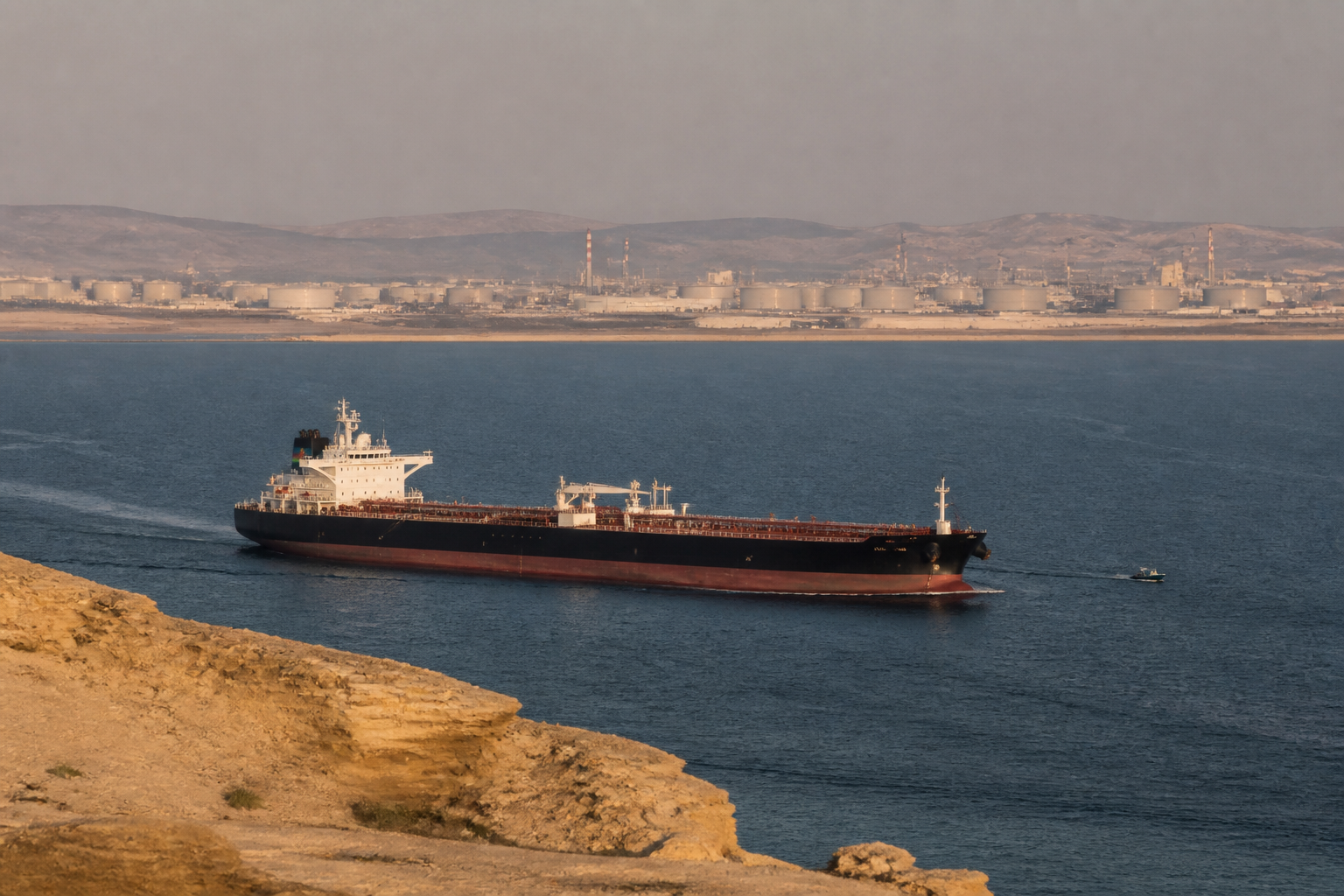
Brent crude has moved close to $100 a barrel as attacks on Saudi energy facilities, threats between Iran and the United States and falling tanker traffic through the Strait of Hormuz raise the risk of wider disruption to global oil supplies. The immediate market event is financial, but its consequences extend into the urban systems that depend on fuel: transport, logistics, construction, utilities and household consumption.
By 0800 GMT on Tuesday, Brent crude futures had risen by $2, or 2.06%, to around $99 a barrel. Brent briefly reached $99.22, its highest level since July 24, according to the report. US West Texas Intermediate crude gained $2.93, or 3.2%, to $94.41, after touching $94.60, its highest level since June 8.
The price movement reflects more than a short-term reaction to military developments. It combines concerns about actual supply tightness with what market analysts call a geopolitical risk premium: the additional amount traders are willing to pay when the probability of future disruption rises. Tim Waterer, chief market analyst at KCM Trade, said both factors were pushing prices higher, although geopolitical risk was currently having the greater effect.
That distinction matters for cities. A temporary increase caused by market sentiment can reverse if security risks ease. A disruption to physical shipments, however, can affect refinery operations, fuel availability and the cost of moving goods. The report does not establish that a global shortage has occurred, but it shows that markets are beginning to price in the possibility that access to a critical oil route may remain constrained.
The Strait of Hormuz is central to that concern. Before the conflict began in late February, around one-fifth of the world’s daily oil and liquefied natural gas supplies passed through the waterway, according to the report. Tanker traffic has since fallen well below normal levels as the conflict and security risks have intensified.
For urban economies, the Strait is not an abstract maritime chokepoint. Oil and gas shipments feed the fuel and energy networks that support the daily movement of people and goods. Public and private transport systems, freight operators, construction fleets, emergency services and generators all operate within an energy-cost environment. When crude prices rise, the effects can move through those systems at different speeds, depending on contracts, inventories, subsidies, taxes and the degree of dependence on imported fuel.
The current risk is not limited to the possibility that tankers will be attacked. Shipping can also slow because operators avoid a route, wait for security guarantees or use more expensive alternatives. Iran has warned that it would retaliate against further US attacks and has said it would create a new shipping corridor in the Strait of Hormuz. The report says this could make tanker traffic more difficult as the conflict continues.
Analysts do not expect shipping through the Strait to return quickly to pre-war levels. Daniel Hynes of ANZ said a full return to earlier shipping levels may not occur until late in the first quarter or early in the second quarter of 2027. That assessment is not a forecast of a guaranteed supply shortage. It is an indication of how long the market may treat the security problem as an operating constraint.
The distinction between price and supply is important. Oil can become more expensive even when physical barrels remain available if buyers, traders and shipping companies believe future deliveries are less secure. In that situation, the price increase can influence urban budgets before any complete interruption reaches consumers. Transport companies may face higher operating costs, contractors may revise fuel assumptions and businesses dependent on freight may absorb or pass on additional costs.
The security concerns were reinforced by a fresh attack linked to the Iran-backed Houthis in Saudi Arabia. Saudi authorities said the attacks wounded 73 people and described them as a dangerous escalation. Some operations at energy facilities were halted, according to the report. Saudi Arabia’s Jizan refinery was also targeted. The refinery has crude-processing capacity of about 400,000 barrels per day and has previously been targeted by Yemen’s Houthi forces, according to Oilprice.com, as cited in the report.
The significance of the Saudi incidents lies in the vulnerability of energy infrastructure as well as in the immediate loss of operating capacity. Refineries, export terminals, pipelines and storage facilities are concentrated assets. Damage or temporary shutdown at one facility can affect regional supply balances, even if production elsewhere continues. For cities, that concentration creates a difference between the apparent abundance of global resources and the reliability of local fuel access.
Iran-US tensions have added another layer of uncertainty. Tehran said it had fired an advanced missile at US warships and warned Washington about the consequences of further attacks. Mohsen Rezaei, secretary of Iran’s Supreme National Security Council, said Iran could respond with a maritime exclusion zone across the Persian Gulf if the United States continued what Tehran described as economic warfare. The latest threats followed further exchanges involving ships in the Persian Gulf, according to the report.
The United States has also carried out strikes on Iranian oil tankers. US Central Command said US forces struck three Iranian oil tankers on Saturday, including one near Kharg Island, Iran’s main oil-export hub. These developments increase the possibility that shipping and energy infrastructure will remain part of the conflict rather than being treated as separate commercial systems.
That possibility is reflected in longer-term price assumptions. Goldman Sachs raised its oil-price forecasts because of expected shipping disruptions. Its December 2026 forecast was increased by $5, putting Brent at $85 a barrel and WTI at $80. The bank also raised its 2027 forecasts to $80 for Brent and $75 for WTI, based on the assumption that Middle East shipping problems would continue into the following year.
These figures are not predictions that prices will move in a straight line. They show how analysts are incorporating the possibility of persistent disruption into their planning. Market expectations can change if shipping resumes, diplomatic progress reduces the risk of escalation or alternative supply becomes more available. They can also move higher if attacks spread or the Strait becomes more difficult to navigate.
The report says investors have increased their net long positions in Brent crude as hopes for a quick peace deal have weakened, citing ING analysts. This indicates that financial-market positioning is reinforcing the physical-security concerns. Speculative buying does not by itself create a supply shortage, but it can amplify price movements when the market is already sensitive to disruption.
For urban policymakers, the episode highlights the exposure of city systems to events far beyond municipal boundaries. A local government may control roads, public transport or emergency planning, but it cannot control the security of an international shipping route. Its ability to manage the consequences depends on the resilience of fuel procurement, the diversity of transport modes, the efficiency of public services and the financial capacity of households and businesses to absorb higher costs.
The supplied report does not provide city-level data on fuel prices, public transport fares, construction costs or household impacts. Those effects therefore cannot yet be quantified from the available evidence. What is established is that crude prices have risen sharply, tanker traffic through the Strait has fallen below normal levels and analysts are considering disruption that could persist into 2027.
The larger urban question is how much energy insecurity is built into the operation of cities. Transport and logistics systems often appear local, but their costs are connected to global supply chains. When a strategic waterway becomes contested, the consequences can reach refineries, freight networks, construction sites and household budgets through a sequence of decisions made by shippers, traders, governments and energy companies.
The evidence currently confirms a substantial geopolitical risk premium and renewed concern about physical supply routes. It does not confirm a sustained global oil shortage or establish the final effect on urban consumers. The developments that require monitoring are tanker traffic through the Strait of Hormuz, the operating status of Saudi energy facilities, further military action involving Iran and the United States, and whether analysts continue to extend elevated price assumptions into 2027.

