


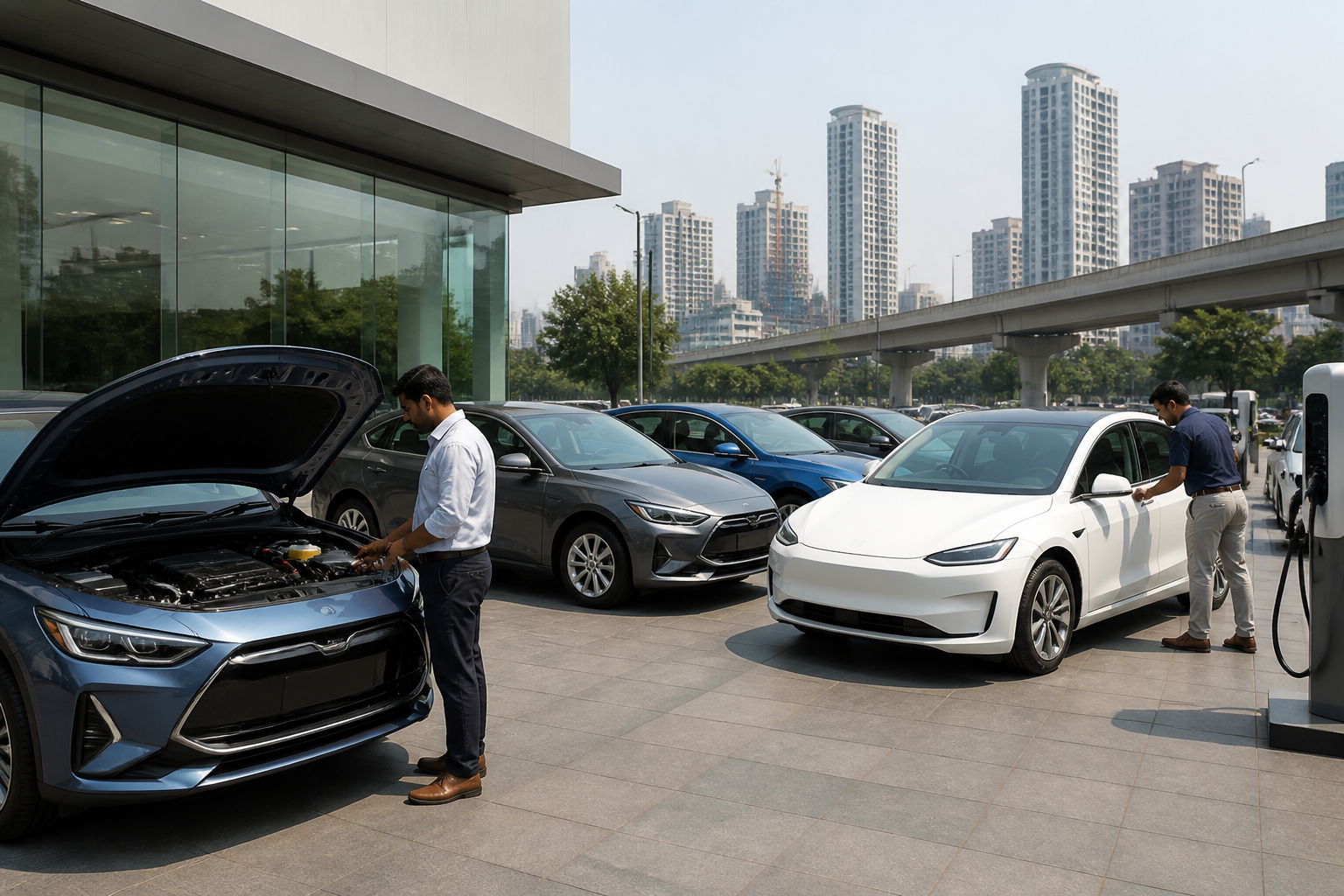
India’s passenger-vehicle market has reached a point at which the transition away from petrol can no longer be described as an electric-vehicle story alone. In August, CNG, hybrid and electric cars together accounted for 41.9% of passenger-vehicle retail sales, edging past petrol-powered cars at 40.8%, according to figures from the Federation of Automobile Dealers Associations (FADA) reported by The Times of India.
The change is important not because one technology has replaced another, but because buyers are increasingly choosing between several alternatives to petrol. CNG, hybrids and electric vehicles address different concerns: running costs, fuel efficiency, charging access and the expected duration of ownership. The data therefore points to a more complicated mobility transition, in which the urban vehicle market is being reshaped by use case rather than by a single dominant technology.
CNG remained the largest contributor within the alternative-fuel group, with a 25.2% share of passenger-vehicle retail sales. Hybrids accounted for 9%, while electric vehicles made up 7.6%. Petrol remained the largest individual fuel category, but its lead over the combined alternative-fuel group disappeared during the month. Diesel cars accounted for 17.2% of retail sales.
The figures also show why the shift should not be interpreted as a straightforward movement from internal-combustion engines to battery-electric vehicles. Electric cars are expanding, but they represented less than one-fifth of the combined alternative-fuel share in August. CNG and hybrid vehicles together made up the larger portion of that basket, indicating that affordability, refuelling convenience and consumer uncertainty remain central to purchase decisions.
The reported change is especially significant because it reflects retail sales rather than only manufacturer announcements or model launches. Retail data captures the choices buyers are making at dealerships. Those choices are shaped by upfront prices, expected running costs, access to fuel or charging, maintenance concerns and the practical requirements of daily travel. The August numbers suggest that consumers are not waiting for one definitive replacement for petrol. They are selecting different technologies according to the conditions in which they expect to use their vehicles.
CNG’s position at the top of the alternative-fuel mix underlines the continued importance of operating economics. FADA attributed the movement towards CNG, hybrids and electric vehicles partly to running-cost considerations. For households using cars frequently, the cost of each kilometre can influence ownership decisions as much as the purchase price. CNG has consequently become the most prominent alternative to petrol in passenger vehicles, even as electric cars receive greater attention in policy and industry discussions.
The market concentration within the different technology segments also matters. Maruti Suzuki held around 71% of the CNG passenger-vehicle segment, according to the reported figures. Tata Motors led electric passenger vehicles with around 43% share. These numbers suggest that the transition is not only dividing consumers across fuel types; it is also producing distinct competitive structures among manufacturers. A company’s strength in one powertrain category does not automatically translate into leadership across the entire alternative-fuel market.
Hybrids occupy a different position from both CNG vehicles and electric cars. They offer improved efficiency while reducing dependence on charging infrastructure, a consideration for buyers who want lower fuel consumption but remain uncertain about charging access. The report also cited hesitation around the E20 transition as one factor influencing consumer choices. The available figures do not establish how much of the shift can be attributed to that concern, but they indicate that fuel compatibility and transition uncertainty are part of the purchase environment.
This matters for cities because passenger vehicles are used within an urban system that includes roads, parking, fuel stations, charging points and electricity networks. A change in the fuel mix affects more than vehicle manufacturers. It can alter the infrastructure required at homes, workplaces, commercial locations and public facilities. The August data does not provide a city-level breakdown of charging or refuelling demand, but it establishes that several powertrains are gaining ground at the same time. Urban infrastructure planning therefore cannot assume a single transition pathway.
The wider vehicle market reinforces that point. In two-wheelers, electric-vehicle penetration rose to 10.7% in August from 7.7% a year earlier. The reported increase took electric scooters past the 10% mark in a non-festive month for the first time. Two-wheelers are particularly important to urban mobility because they serve daily commuting, short-distance travel and commercial delivery. Their transition can therefore have implications for a much larger number of routine trips than passenger-car sales alone indicate.
Three-wheelers are further along the electric transition. Electric vehicles accounted for 65.3% of three-wheeler sales in August, up from 56.6% a year earlier. This is a substantially higher penetration level than in passenger cars or two-wheelers. It suggests that where vehicle duty cycles, operating economics and commercial use align with electric powertrains, adoption can move more rapidly. The category’s performance also shows why vehicle electrification cannot be assessed through private-car sales alone.
Commercial vehicles, by contrast, remain at an earlier stage. Their electric share more than doubled to an all-time high of 5.2% from 2.1%. The base is smaller, but the increase indicates that electrification is beginning to extend beyond pilot projects and into fleet purchases. The data does not specify the types of commercial vehicles involved, the locations of the purchases or the operating models supporting them. Even so, the rise provides an early indication that fleet decisions may become an important part of the next phase of the transition.
Across all vehicle categories, electric-vehicle retail sales reached 2.98 lakh units in August, a 52.9% year-on-year increase, according to the figures reported by The Times of India. That growth is substantial, but it exists alongside the continued expansion of other alternatives. The combined passenger-car data and the category-level figures point to two simultaneous developments: electric vehicles are growing quickly, and consumers are also adopting non-petrol options that are not fully electric.
This distinction is relevant to how mobility policy is designed. A policy framework focused only on electric cars could overlook the reasons buyers are choosing CNG or hybrids. Conversely, a market in which CNG and hybrids are expanding does not remove the need to build charging infrastructure for electric vehicles. The sales data indicates that the transition is plural, with each technology responding to a different combination of price, infrastructure and operating requirements.
It also complicates the idea of a single national timetable for vehicle-market change. Passenger cars, two-wheelers, three-wheelers and commercial vehicles are moving at different speeds. Within passenger vehicles, CNG, hybrids and electric cars are also performing differently. These variations reflect differences in vehicle use, ownership economics and available support systems. The figures do not show that one technology is destined to dominate every category; they show that adoption is being distributed across categories and use cases.
The evidence remains limited in several ways. The reported August data provides market shares and year-on-year comparisons, but it does not include a detailed city-wise split, model-wise pricing, infrastructure availability or the relative cost of ownership for each powertrain. It also does not establish whether the passenger-vehicle crossover will persist in subsequent months. The immediate conclusion must therefore remain narrow: in August, the combined share of CNG, hybrid and electric passenger vehicles exceeded petrol’s share, while electric adoption increased across several vehicle categories.
That narrow finding nevertheless carries a broader urban implication. India’s mobility transition is no longer organised around a simple choice between petrol and electric vehicles. Buyers are assembling a new vehicle market from several technologies, each supported by a different infrastructure and economic logic. For cities, the task is to understand how those choices affect roads, parking, energy demand, fuelling networks and daily travel patterns.
The August figures confirm that alternatives to petrol have moved beyond a niche position in passenger-vehicle sales. They also show that the transition is uneven: CNG leads the alternative-fuel car market, hybrids are gaining ground, EVs are expanding across categories, and three-wheelers are already substantially electric. The next developments to monitor are whether the passenger-vehicle crossover continues, how the different powertrains perform in later retail data and whether urban infrastructure expands in step with this increasingly diverse vehicle market.
