


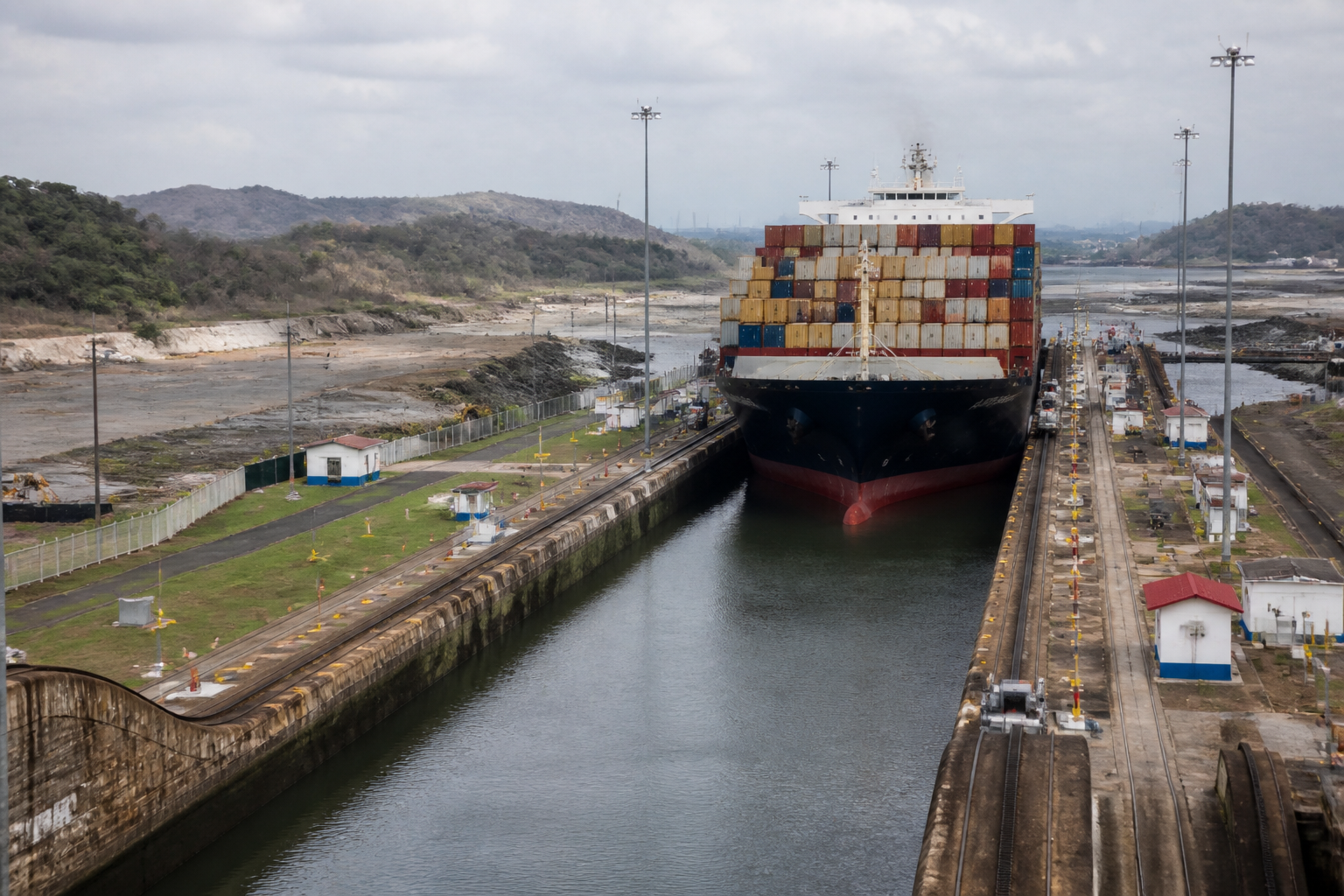
The Panama Canal’s growing dependence on uncertain rainfall is turning a water-management problem into a test for global trade infrastructure. The canal’s incoming administrator, Ilya Espino de Marotta, has warned that severe water shortages could reduce daily ship transits from the current 32 to as few as 27 in the coming months, according to an interview with the Financial Times reported by Aaj Tak Business.
The warning comes as shipping routes elsewhere are already facing disruption linked to conflict, including reported pressure on traffic through the Strait of Hormuz and the Bab el-Mandeb. The supplied report does not establish how long any additional Panama Canal restrictions would last or whether the reduction to 27 daily transits has been formally announced as an operating decision. It presents the figure as a worst-case scenario based on modelling using 1997 rainfall patterns, described as the canal’s driest year in its history.
That distinction matters. A canal transit limit is not simply a transport-sector adjustment. It affects how many vessels can move between the Atlantic and Pacific each day, how shipping companies plan their schedules and how much capacity is available on a route that avoids the much longer journey around South America. Any reduction can therefore create pressure elsewhere in the maritime network, even before the effects reach ports, manufacturers or consumers.
The Panama Canal is an approximately 82-kilometre artificial waterway in Panama. It connects the Atlantic and Pacific oceans through a lock system that raises ships to Gatun Lake before lowering them towards the opposite coast. Ships use the canal to avoid travelling around the southern tip of South America, saving time and fuel on routes linking Asia, the Americas and Europe.
The canal’s physical design also explains its exposure to rainfall patterns. The lock system requires large quantities of freshwater to raise and lower vessels. The supplied report says the canal relies heavily on rain to maintain water levels and that lower rainfall forces operators to restrict ship movements in order to conserve water. The canal is therefore not only a maritime passage; it is also a large-scale water-management system whose commercial capacity depends on the condition of its watershed.
Espino de Marotta, speaking shortly before taking the oath of office as administrator on Monday, identified climate change as the most important issue facing the canal. “Climate change is the most important issue because we can see that dry years are increasing,” she was quoted as saying. The report also states that water shortages are becoming a problem roughly every three years because of climate change, although it does not provide a longer rainfall series or an independently cited hydrological dataset.
The warning illustrates a structural vulnerability in infrastructure that is often viewed primarily through its engineering dimensions. The canal is a fixed connection between two oceans, but the number of vessels it can accommodate depends on an environmental resource that varies over time. When rainfall falls below the level needed to sustain lake and canal operations, the infrastructure’s designed capacity becomes less useful than its water supply allows.
This is a different kind of disruption from a damaged port, a blocked channel or a security incident. In those cases, the immediate cause may be visible and concentrated in a particular location. A water-constrained canal can face a gradual loss of operating capacity, with restrictions introduced to protect the system from a deeper decline. The supplied material does not describe a single emergency closure. It describes the possibility of further reductions in daily transits as water availability becomes more difficult to manage.
The canal’s importance amplifies the effect of that constraint. According to the supplied report, it handles more than 3 percent of global trade. That figure is presented without a separate source citation in the material, but it underlines why the canal’s operating decisions are relevant beyond Panama. A change in daily transits can influence vessel queues, booking decisions, route selection and freight costs. The report says shipping companies are concerned that further cuts could raise cargo transport costs and cause delivery delays.
Those effects would not be distributed evenly. Companies with flexible schedules or the ability to shift cargo between routes may have more options than operators serving time-sensitive supply chains. Some cargo could be delayed at origin or held at ports while carriers reassess available transit slots. Other shipments could be redirected around longer routes, increasing sailing time and fuel use. The supplied material does not quantify these outcomes, and it does not identify specific commodities, ports or companies that would be affected.
The current warning also arrives in a maritime system already dealing with disruption. The report links pressure on global trade routes to the Iran war and separately mentions interruptions around Hormuz and Bab el-Mandeb. It does not provide detailed traffic figures for those routes or establish a combined forecast for global shipping costs. Even so, the overlap is significant at the infrastructure level: when several strategic routes face constraints at the same time, shipping companies have fewer straightforward alternatives.
The Panama Canal’s history shows why its role extends beyond a commercial shortcut. France began construction in 1881, but the project failed because of technical difficulties. The United States later completed the canal, which opened to traffic in 1914. Control was fully transferred to Panama in 1999. These milestones established the canal as both a major engineering project and a nationally administered strategic asset.
Its dependence on water has always been embedded in its operation. The current challenge is that rainfall variability is being presented as more frequent and more consequential. If dry years occur more often, restrictions that were once treated as exceptional may become a recurring feature of canal management. That would change the way shipping companies plan capacity and the way governments and infrastructure operators assess resilience.
The policy question is consequently larger than whether five daily transits will be removed in a particular period. It concerns how a canal authority balances shipping demand against the need to preserve water levels for the system’s continued operation. The supplied report says experts believe alternative water sources and better management will be needed in response to the long-term effects of climate change. It does not identify a specific water project, funding mechanism, implementation timetable or approved expansion plan.
That absence is important because water infrastructure interventions can involve competing demands. The report establishes that canal operations depend on rainfall and that reduced water availability can limit transits. It does not provide evidence about the relative use of the canal’s water by shipping, communities, ecosystems or other sectors. Nor does it establish which alternative sources are technically or institutionally available. These remain questions for further reporting through Panama Canal Authority documents and public water-management records.
The evidence supplied does, however, establish a clear relationship between climate conditions and commercial capacity. The canal can continue to exist physically while handling fewer vessels. Resilience, in this context, is not only about preventing structural damage. It is about maintaining dependable service when the environmental system supporting the infrastructure becomes less predictable.
For global trade, that distinction could become increasingly important. A route that is geographically efficient may not remain operationally reliable at its historical level if its water supply is unstable. Shipping networks can respond through scheduling, rerouting and capacity adjustments, but each response may carry additional time, fuel or financial costs. The supplied report does not show which response is likely to dominate, and no prediction can be made from the available evidence alone.
What the Panama Canal warning confirms is narrower but consequential: water availability is already being treated as a constraint on a globally important transit route, and the canal’s administrator has raised the possibility of reducing daily transits from 32 to 27 under a worst-case rainfall scenario. The developments to monitor are whether the Panama Canal Authority formally changes its transit rules, how rainfall and lake levels evolve, whether alternative water-management measures are announced and how shipping companies respond to any confirmed restrictions.

