


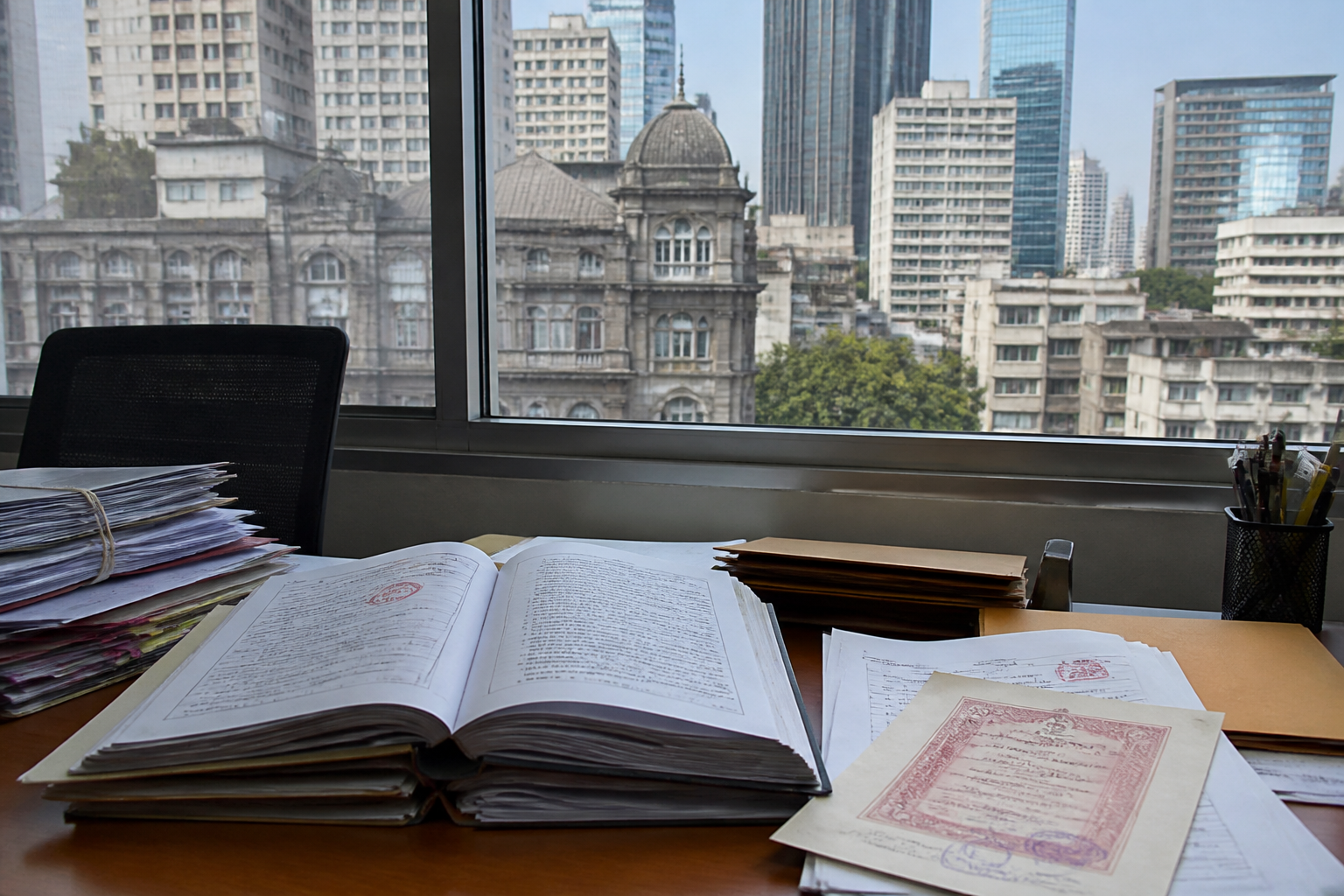
A Bombay High Court order directing the State Bank of India to pay Rs 5,000 a day after losing a borrower’s original property documents does more than resolve a dispute between a bank and a Mumbai-based firm. It places the custody of title papers within a broader chain of responsibility: once a loan is cleared, the lender must not only release the documents but also preserve, identify, retrieve and return them.
The case, In Vogue Creations vs State Bank of India, concerns two properties whose original papers were deposited with SBI as security for loan facilities in 1979. The loan was fully repaid in 2003. Yet the documents were not returned, and the bank later admitted that it could not trace them. The court’s order, as reported by the Times of India, applies the daily compensation mechanism from December 1, 2023, until the title records are reconstructed and the required supporting documents are provided.
The significance of the ruling lies in the gap between clearing a secured liability and obtaining usable proof of ownership. A borrower may have paid every rupee owed, but the practical ability to sell, mortgage, transfer or otherwise deal with a property can remain impaired if the original title chain is incomplete. The case shows how a problem that begins as a records-management failure inside a bank can become a real-estate and ownership problem outside it.
The dispute began with properties connected to In Vogue Creations. The firm had purchased Units or Gala Nos. 317 and 318 at Bussa Industrial Premises Co-operative Society in Prabhadevi, Mumbai. The agreements for the units were dated December 4, 1973, and August 3, 1978. In 1979, the firm handed over the agreements and share certificates to SBI’s Commercial Branch at Dadar as security for loan facilities.
The firm had also entered into a registered lease agreement with the Maharashtra Industrial Development Corporation on March 22, 1979, for a plot at W-154, Taloja, Panvel. The lease deed and related papers for that property were also deposited with the bank. SBI disbursed the loan facilities in 1979, and the borrower cleared the entire outstanding amount on August 28, 2003.
The bank issued a No Dues or No Claims Certificate on July 27, 2023, confirming that the loan had been fully repaid and that it had no remaining claim or mortgage over the properties. The certificate resolved the question of the outstanding debt, but not the location of the original title papers. SBI subsequently acknowledged that it could not find the documents and informed the relevant authorities in letters dated December 5 and December 7, 2023.
That distinction is central to the case. A lender’s claim over secured property may end when the loan is repaid, but the lender’s responsibility for documents held in its custody does not disappear merely because the branch has moved, records have been transferred or staff have changed. The court rejected SBI’s argument that the borrower’s delay in seeking the documents relieved the bank of responsibility.
SBI argued that the firm had not asked for the return of the documents immediately after repaying the loan. According to the bank, the request came more than 15 years later, by which time the branch premises had shifted. The bank said it had made efforts to locate the papers but was unsuccessful. It also challenged the application of the RBI’s September 13, 2023, circular to a loan repaid in 2003.
The court accepted one part of that argument. The RBI circular could not be applied retrospectively from the date on which the loan was repaid. Its directions apply where the release of original property documents becomes due on or after December 1, 2023. That meant the Rs 5,000-per-day rate could not run from 2003.
But the limitation did not eliminate the bank’s responsibility. The court held that the compensation rate would apply from December 1, 2023, in view of SBI’s admitted loss of the documents and the continuing prejudice suffered by the firm. The compensation will continue until the bank provides certified copies of the missing papers and completes reconstruction of the title records, including necessary endorsements, affidavits, indemnities and other supporting documents.
The ruling therefore separates two questions that are often treated as one. The first is whether the RBI compensation rule operates retrospectively. The second is whether a bank remains accountable for documents it lost and for the consequences of that loss. SBI succeeded on the first question but not on the second.
The RBI framework cited by the court requires regulated entities to release original movable or immovable property documents within 30 days after a loan account is fully repaid or settled. Where the delay is attributable to the lender, the circular provides for compensation of Rs 5,000 for every day of delay. It also requires the entity to help the borrower obtain duplicate or certified copies when the originals are lost or damaged, and to bear the associated costs.
In this case, the bank took steps to reconstruct at least part of the record. The firm published a newspaper advertisement about the missing documents, filed a complaint with the Dadar Police Station and approached the Banking Ombudsman. SBI later lodged an FIR and published notices in two newspapers. For the Taloja property, MIDC supplied true copies or photocopies of some documents, which SBI handed over to the firm.
Those measures did not, according to the firm’s position, resolve the entire title problem. It argued that the replacement papers were incomplete and that issues relating to stamp duty remained unresolved. The dispute illustrates why simply producing a photocopy is not always equivalent to restoring a property’s documentary chain. The usability of a title record depends on the completeness of the underlying agreements, registrations, endorsements and supporting evidence.
The court’s reasoning also addresses institutional memory. Banks routinely reorganise branches, move premises, transfer records and change personnel. These are internal administrative events, but property documents do not lose their importance when the institution holding them changes its systems. By placing responsibility for preserving, identifying, retrieving and returning the papers on the bank, the court refused to treat internal record-keeping difficulties as a risk that could be transferred to the borrower.
The case also gives practical meaning to the idea that title is not only a legal entitlement but a usable documentary chain. A property owner may possess the property and have repaid the loan, yet face difficulty completing a sale or obtaining new finance if the original documents cannot be produced. In commercial properties, the consequences can extend to transactions involving industrial units, cooperative premises and leasehold land held through development authorities.
The court’s order does not declare that every historic failure to return property documents automatically attracts the RBI’s daily compensation from the date of the original repayment. Its approach is narrower. The circular’s rate begins from the date specified in the framework, while the bank’s underlying obligation to deal with the missing documents continues because the loss and its effects remain unresolved.
The Banking Ombudsman had earlier advised SBI to pay Rs 1 lakh to In Vogue Creations on November 21, 2024. The firm did not accept that amount, although SBI deposited it into the firm’s account on November 22, 2024. The High Court directed that the Rs 1 lakh already deposited be adjusted against the compensation payable under its order.
SBI has been given 12 weeks to complete the exercise. That timetable makes the reconstruction of the title records the operative test of compliance. The eventual resolution will depend not only on the production of copies but also on whether the documents, endorsements, affidavits, indemnities and related materials together restore a sufficiently complete record for the properties to be dealt with.
The evidence in the case confirms three points. First, repayment of a loan ends the lender’s secured claim but does not reduce the importance of the documents held in custody. Second, the RBI’s post-2023 framework creates a defined compensation mechanism for delayed release and document loss, subject to its stated date of application. Third, replacement documents must address the continuing title problem rather than merely demonstrate that a search was conducted.
What remains specific to the case is the final form of the reconstructed records and the extent to which they resolve the firm’s concerns over completeness and stamp duty. The next development is therefore administrative as well as legal: SBI must complete the reconstruction within the period set by the court, after which the compensation calculation can be finalised against the delivery of the required documents.
