


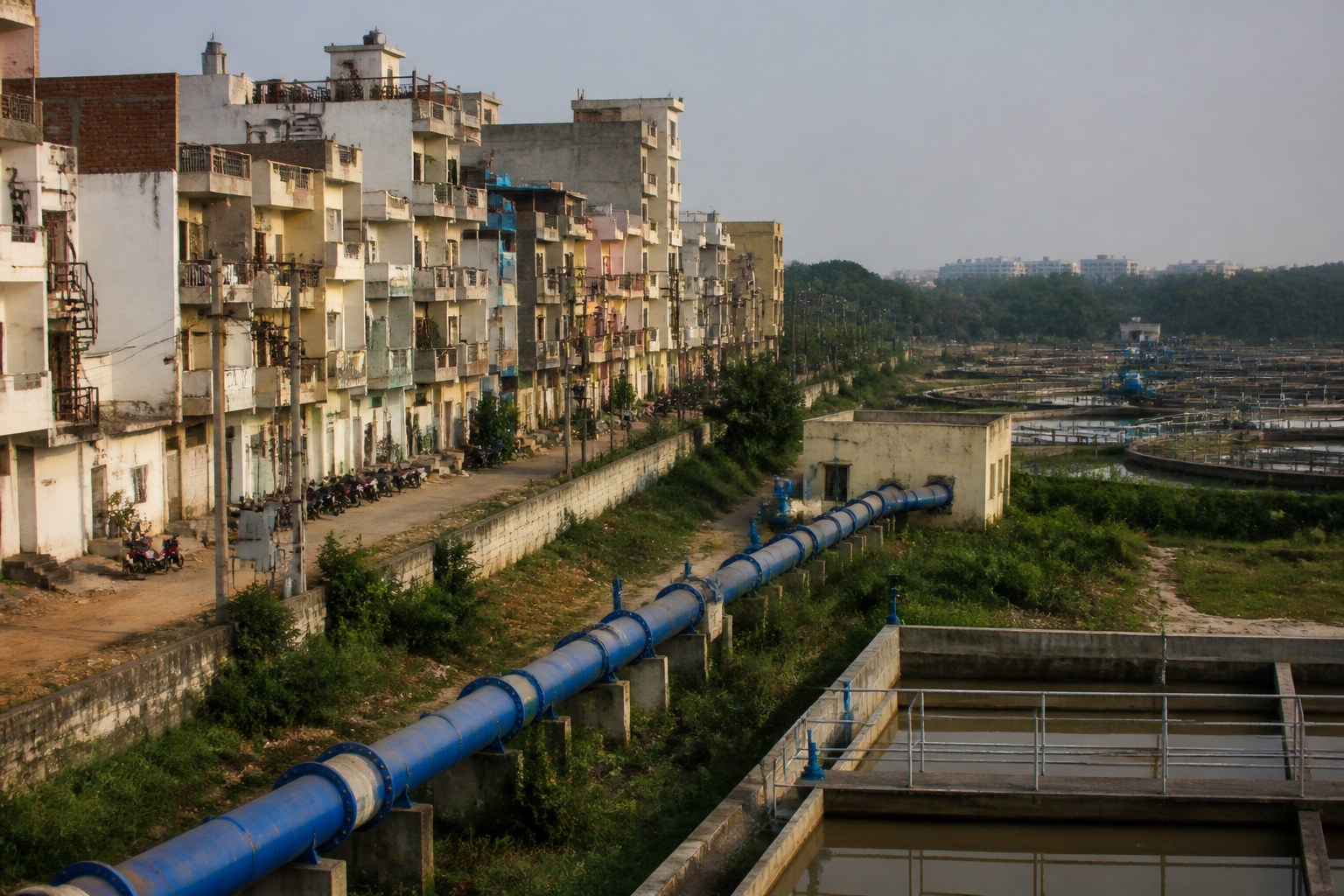
Bengaluru’s water-security strategy is entering a more complicated phase. The Bangalore Water Supply and Sewerage Board (BWSSB) is pursuing additional Cauvery supply, while also trying to reduce losses in its distribution network, expand rainwater harvesting and persuade industries to use treated wastewater. The combination reflects a basic constraint facing the city: increasing supply alone will not resolve a system shaped by groundwater dependence, uneven distribution infrastructure and limited reuse of treated water.
The immediate policy context is the water crisis Bengaluru experienced in 2024. According to BWSSB Chairperson Manjula N, poor monsoon rainfall in 2023 depleted groundwater levels and contributed to severe scarcity, even as Cauvery water continued to reach the city. The experience has pushed the utility towards measures intended to improve both the volume of water available and the efficiency with which it is delivered and consumed.
In an interview with Deccan Herald, Manjula identified augmentation of available water as the board’s first long-term priority. Cauvery Stage V has been rolled out, helping meet the needs of people on the city’s periphery and reducing dependence on groundwater. BWSSB is also working on Cauvery Stage VI, while water from Yettinahole is expected to provide a further source of supply in the longer term.
These projects indicate that Bengaluru’s water planning continues to rely substantially on expanding formal supply. Cauvery Stage VI has received Cabinet approval and clearance from the Central Government, according to the BWSSB chairperson. The project is expected to cost around Rs 7,000 crore, with BWSSB expecting a Rs 5,000-crore loan from the Japan International Cooperation Agency. The information supplied does not establish the project’s implementation timeline or the additional volume it is expected to provide.
The significance of the expansion is clearest at the city’s edges, where Stage V is already intended to serve residents and reduce reliance on groundwater. Yet the interview also shows why supply augmentation cannot be treated as a complete water-security policy. Once water enters the network, the utility still has to manage treatment, distribution losses, illegal connections and demand across a large and changing urban area.
### The efficiency gap in the network
BWSSB puts unaccounted-for water close to 30 percent. The figure includes water that is lost through leakages or is not reflected accurately in the billing system. Manjula said transmission-level leakage is almost absent and that most losses occur in the distribution network. That distinction matters because it shifts the operational challenge from the main supply lines to the local network that carries water into neighbourhoods.
The board is evaluating ground-level reservoirs and pipelines and prioritising areas based on complaints and reported leakages. Technology is being used to identify leaks, while the District Metered Area network is being expanded to locate places with higher losses and support corrective action. BWSSB is also acting against illegal connections, with the stated aim of reducing unaccounted-for water and bringing more households into the billing system.
A 30 percent unaccounted-for-water level means that efforts to secure Bengaluru’s supply must operate on two fronts. New sources can increase the amount of water entering the system, but distribution improvements can increase the amount that is measured and reaches users without requiring an equivalent expansion of raw-water supply. The supplied material does not provide a monetary estimate of these losses or a target date for reducing them.
This creates an important distinction between physical availability and usable urban supply. A city may receive more water through a major project while still facing local shortages if pipelines, reservoirs and connections do not function effectively. BWSSB’s emphasis on District Metered Areas and leak detection suggests that the board is treating network performance as a central part of water planning, rather than only as a maintenance issue.
### Reuse remains an unfinished part of the strategy
The second major component is treated wastewater. BWSSB is working to increase its capacity to treat wastewater and promote the use of treated water, but the uptake has remained limited. The chairperson attributed part of the hesitation to apprehension about using secondary-treated water, particularly among potential industrial users.
The proposed response is not a single reuse model. BWSSB is exploring arrangements in which industries treat the water further themselves, as well as systems in which the utility carries out additional treatment and supplies the water through dedicated pipelines. The board is identifying industrial clusters where co-investment or other arrangements could support reuse, while mapping sewage treatment plants against those clusters.
The approach links water reuse to geography and infrastructure. Treated water is more likely to be used if it can be supplied reliably to facilities that need it, at a quality suitable for their processes and through a financially workable arrangement. BWSSB is therefore considering both the treatment standard and the delivery system. It is also looking at upgrading sewage treatment plants to increase treatment capacity.
The interview does not establish how much treated water is currently being reused, how many industrial clusters have been identified or when the proposed models will be operational. Those gaps are important because the success of reuse will depend not only on persuading industries to accept treated water but also on building the pipelines, quality-assurance systems and institutional arrangements required to make supply dependable.
### Rainwater harvesting as a short-term buffer
For the next summer, BWSSB is focusing on measures that can be implemented more quickly than large water-supply projects. Around 1,000 rainwater-harvesting structures have been installed, and the board plans to expand them in government properties and community spaces, including parks, schools and hospitals.
At the household level, BWSSB is promoting water conservation and the use of aerators. The chairperson said a large number of aerators had already been installed. The board has also penalised people found using water irresponsibly for cleaning and other purposes. The supplied account does not specify the number of penalties, the volume of water saved through aerators or the expected contribution of the harvesting structures.
These measures serve a different purpose from the Cauvery projects. They do not replace large-scale supply augmentation, but they can reduce demand on the formal network and improve local capture of rainfall. Their effectiveness will depend on maintenance, correct installation and continued use. The 2024 crisis demonstrated how a weak monsoon can expose the city’s dependence on both groundwater and managed supply, making decentralised conservation part of the short-term response.
### Water planning is also an institutional problem
BWSSB’s plans extend beyond water engineering. Coordination with city agencies has been a recurring issue, particularly when roads are opened for utility work and not fully restored. Under an agreement described by Manjula, BWSSB will reconstruct roads up to the wet-mix level so they are motorable, while the Greater Bengaluru Authority will subsequently undertake complete restoration as part of its action plan.
The agencies are also expected to be brought onto a common portal being developed for the city. Every work taken up in Bengaluru will be mapped on the platform, allowing agencies to coordinate and avoid duplication or unnecessary excavation, according to the interview. The portal’s launch date, operating authority and enforcement mechanism are not established in the supplied material.
This administrative layer is directly connected to water security. A pipeline replacement, reservoir project or leakage repair does not operate in isolation from roads, drainage and other utilities. Poor coordination can delay works, increase disruption and make future maintenance more difficult. A common map could improve visibility of projects, but its value will depend on whether agencies update it consistently and use it before taking up new work.
Bengaluru’s water strategy, as described by BWSSB, is therefore a portfolio rather than a single project. Cauvery Stage V and the proposed Stage VI address supply augmentation. Yettinahole is identified as a future source. Treated-water reuse addresses demand from industries and the treatment system. Rainwater harvesting and aerators target conservation. Leak detection, District Metered Areas and action against illegal connections address the gap between water supplied and water accounted for.
The evidence confirms the direction of policy but not yet its final results. The city has an identified unaccounted-for-water level close to 30 percent, about 1,000 rainwater-harvesting structures installed, a proposed Cauvery Stage VI project costing around Rs 7,000 crore and a planned JICA loan of Rs 5,000 crore. It does not establish how quickly losses will fall, how much treated wastewater will be reused or when the next supply project will become operational.
That makes implementation the central issue to monitor. Bengaluru’s water security will depend on whether new supply is matched by a functioning distribution network, whether treated wastewater can move from treatment plants to industrial users, whether conservation measures are sustained and whether city agencies can coordinate their infrastructure works. The plans now outlined by BWSSB show that each of these systems has to work together for additional water to translate into more reliable urban supply.
