


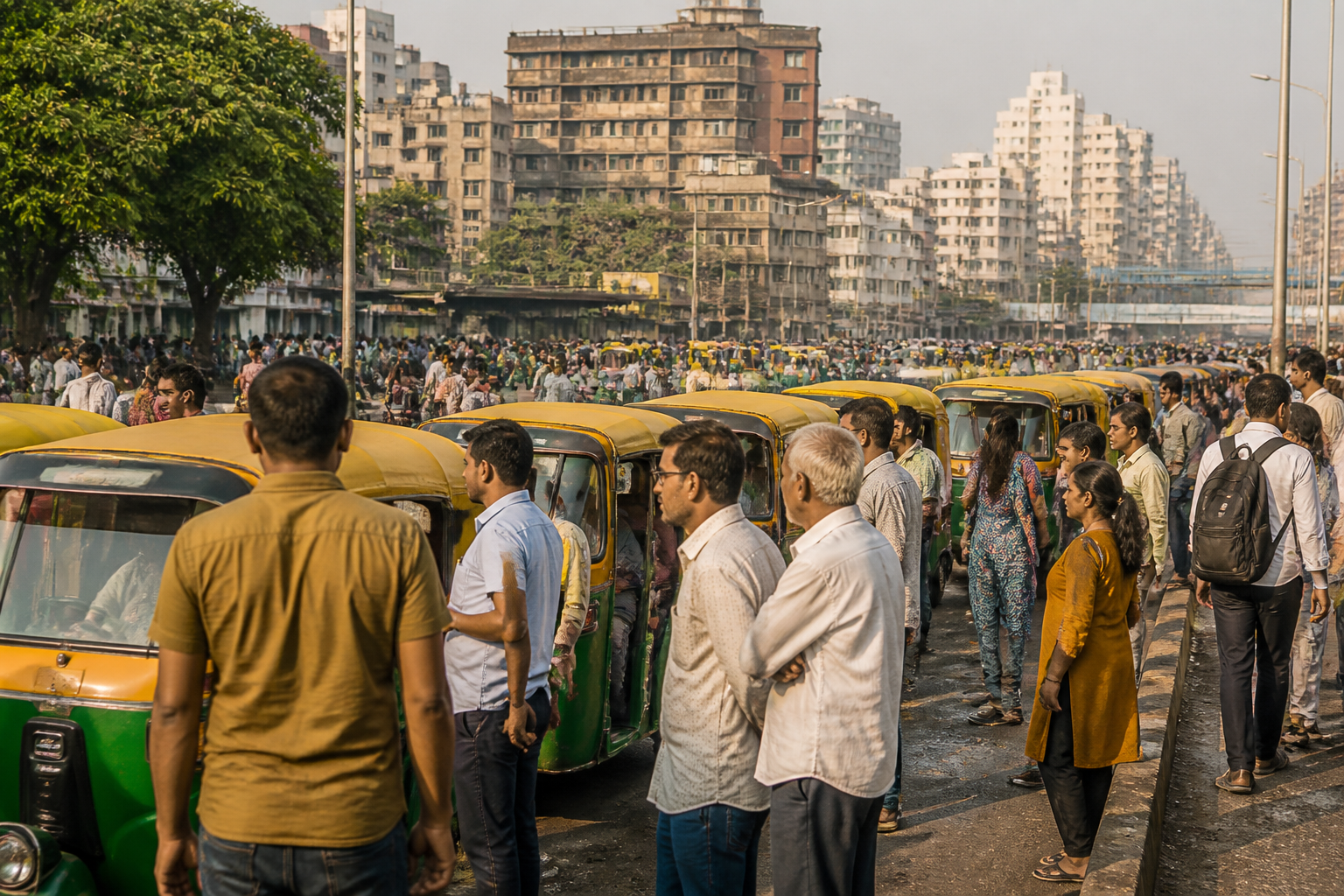
A dispute over passenger refusals at Kalyan West’s Lal Chowki auto stand is being presented as a local inconvenience. But the reported pattern points to a wider problem in last-mile urban mobility: when shared-auto operations are organised around the most profitable destination rather than the travel needs of all passengers, a railway station can remain physically connected yet functionally difficult to leave.
According to a report published by Loksatta – Thane, passengers arriving at Kalyan railway station and seeking autos for Lal Chowki are increasingly being made to wait while drivers prioritise passengers travelling farther to Shree Complex in the Aadhaarwadi area. The report says commuters may wait between 15 and 20 minutes at the stand before finding an auto willing to accept the Lal Chowki fare. The issue is reported to have continued for several months after a period of relative calm.
The geography described in the report is important. Kalyan West railway station, Shivaji Chowk, Sahajanand Chowk, Lal Chowki and Shree Complex lie along a direct route. Lal Chowki comes before Shree Complex on that route, allowing an auto carrying passengers to the latter destination to pick up or drop off passengers travelling to the intermediate stop. Yet passengers say drivers frequently call out specifically for Shree Complex commuters and decline those seeking Lal Chowki, where the fare is reportedly lower.
This turns a shared route into a selective service. The problem is not simply that a passenger has to negotiate with one driver. The report describes a chain of refusals in which one driver points the passenger towards another, while the next driver repeats the gesture. Four or five drivers may reject the Lal Chowki fare before the passenger finds a vehicle. During that time, autos for Shree Complex may wait until enough passengers are available for the higher-value trip.
The resulting delay is especially significant because the auto stand is connected to a major railway station. The report says Lal Chowki contains schools, colleges, hospitals and private establishments. Walking from the station can take about half an hour, while an auto journey takes roughly 10 to 15 minutes. For commuters transferring from local trains to work, education or healthcare, the difference is not marginal. A short urban trip becomes a daily waiting exercise whose burden falls most heavily on people with fixed reporting times or limited travel alternatives.
The report also highlights the gendered dimension of station-to-neighbourhood mobility without providing separate data on the number of women affected. Women commuters are specifically mentioned among those who need to reach workplaces on time. That detail matters because the quality of a transport system is shaped not only by whether a route exists, but by whether passengers can access it predictably and without repeated confrontation at a busy interchange.
At the centre of the dispute is the economics of shared-auto operation. The account suggests that drivers prefer Shree Complex because the fare is higher than the Lal Chowki fare. If a vehicle fills with passengers travelling only to the intermediate destination, the driver earns less than on a trip to the farther location. The incentive is therefore clear at the individual-vehicle level: maximise the value of each departure, even if that means refusing passengers whose destinations fall along the same route.
But an urban transport service cannot be assessed only by the revenue logic of the operator. A shared auto stand exists to aggregate demand and provide access to several destinations along an approved or customary corridor. When drivers treat the route as a choice between profitable and unprofitable passengers, the stand’s public function weakens. The passenger is left to absorb the cost through waiting time, uncertainty and, potentially, a decision to take a more expensive or less convenient alternative.
The reported situation also raises questions about how stands are managed. The source account does not establish whether the Lal Chowki stand has a formal queue system, a displayed fare structure, route allocation, a passenger grievance mechanism or routine enforcement. It does, however, show that passengers believe drivers are able to refuse fares openly and repeatedly. That perception alone indicates a gap between the existence of a transport stand and the effective regulation of the service operating there.
The institutional responsibility is divided. Traffic authorities are concerned with road operations and movement around the stand, while the Regional Transport Office is responsible for regulatory action involving permit conditions and passenger service obligations. The report says passengers have asked traffic and RTO officials to conduct surprise inspections during morning and evening peak periods, when the alleged refusals are most disruptive.
The account further states that traffic and RTO officials had taken action against drivers for similar conduct several months earlier. However, the reported recurrence suggests that enforcement, if it occurred, did not permanently change the operating pattern. That does not establish why the behaviour returned. It does indicate that one-time action may be insufficient where the underlying incentive remains: drivers can earn more by waiting for a group travelling to Shree Complex than by accepting an earlier, lower-value trip to Lal Chowki.
A durable response would depend on facts that are not included in the report, including the applicable fare rules, the permits governing the stand, the number of autos assigned to the route and whether shared trips are formally regulated. It would also require the authorities to clarify whether refusal of an intermediate destination is a violation, and how passengers can document and report such refusals. Without that information, the dispute remains a contest between commuter complaints and driver-level economic calculations.
The response from the Kalyan city rickshaw drivers’ owners’ association is significant. Santosh Navale, the association’s working president, is quoted as saying that drivers should drop passengers at their requested destinations and that the association does not support drivers who refuse fares. He also called for appropriate punitive action by the RTO. This separates the association’s stated position from the conduct being attributed to individual drivers, but it does not resolve whether enforcement has been effective at the stand.
The Lal Chowki case illustrates a familiar weakness in station-area transport planning. Railways move large numbers of passengers efficiently along fixed corridors, but the final kilometre is often governed through informal practices at the kerb. A station may have autos, roads and nearby destinations, yet passengers still lack a dependable connection if vehicles can select trips without visible accountability. The physical network is present; the service contract is uncertain.
The immediate evidence supports three conclusions. First, passengers are reporting repeated refusal of shorter Lal Chowki fares at a busy Kalyan West interchange. Second, the reported delay is concentrated during the morning and evening periods when commuters are most time-sensitive. Third, earlier enforcement is said to have taken place, but similar complaints have resurfaced. The report does not establish the scale of the problem across all autos or confirm the authorities’ current position.
Those unanswered questions are central to what happens next. The RTO and traffic authorities would need to verify the complaints through peak-hour inspections, review the operation of the stand and state the applicable passenger-service rules. A transparent complaint process and clear information for passengers could also show whether the problem is isolated to particular vehicles or embedded in the stand’s operating system. Until that evidence is available, the Lal Chowki dispute remains a small but revealing example of how last-mile access can fail even where a route appears straightforward on the map.
