


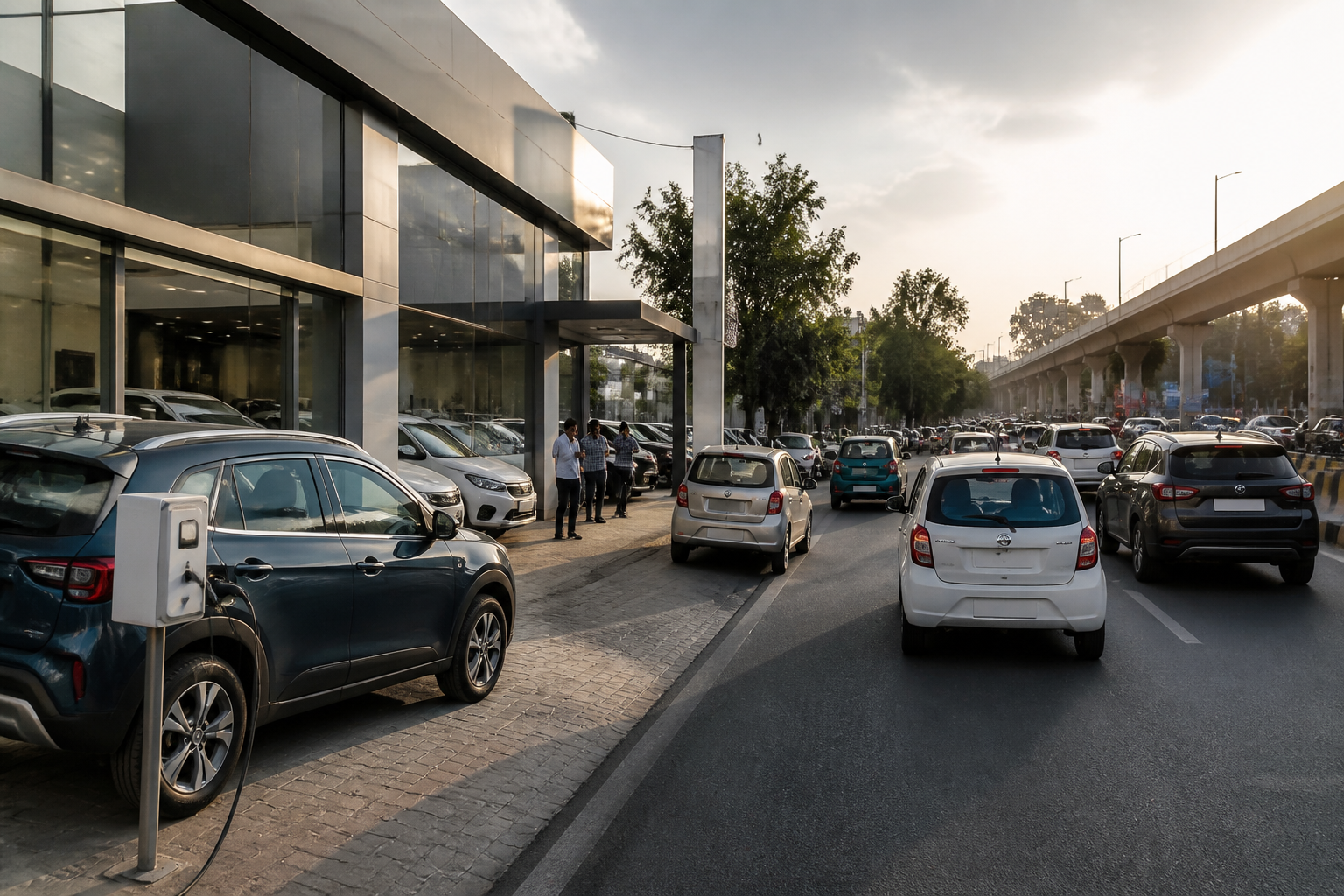
CNG, hybrid and electric vehicles together accounted for 42 per cent of India’s passenger-vehicle sales in August 2026, overtaking petrol’s 41 per cent share for the first time, according to an Equirus Securities report cited by ANI and reported by The Times of India. The shift is being presented as a change in consumer preference, but the numbers also reveal a more complicated transition: India’s move away from petrol is being led most strongly by CNG, while hybrids and electric vehicles are expanding at different speeds and for different reasons.
The immediate significance of the figures is not that petrol has disappeared from the market. Petrol still represented 41 per cent of passenger-vehicle sales in August. The more important development is that its share fell from 46 per cent in August 2025, while the combined share of alternatives reached 42 per cent. CNG alone rose from 21 per cent to 25 per cent over the same period. That makes CNG the largest contributor to the change in the fuel mix, ahead of the gains recorded by electric vehicles.
The shift took place as overall passenger-vehicle retail sales grew 16 per cent year-on-year in August. The report linked the broader increase to improved affordability after GST rate cuts. This matters when reading the fuel-share data: the market was not simply shrinking around petrol. More vehicles were sold overall, while the composition of those sales changed. The available figures therefore describe both a growing market and a redistribution of demand within it.
Electric vehicles recorded the fastest percentage growth among the alternatives mentioned in the report. EV sales rose 52 per cent year-on-year to 30,700 units in August, lifting their penetration to 7.7 per cent from 5.9 per cent a year earlier. Yet August’s penetration was below the 8.1 per cent recorded in July 2026. The sequence suggests that EV growth is substantial but not uniform from month to month. A rising annual share can coexist with a month-on-month decline, particularly when registrations are affected by product launches, fleet purchases or changes in the wider vehicle market.
The report attributed some of the movement towards CNG, hybrids and EVs to buyer hesitation around the E20 transition. The reference is to the shift towards petrol blended with 20 per cent ethanol, but the supplied material does not establish how many consumers changed their purchase decisions for that reason. What it does show is that the report’s analysts regarded the transition as one factor supporting demand for alternatives. That distinction is important: the E20 issue is identified as an explanation in the report, not independently demonstrated by the sales figures provided.
The market-share data for EV manufacturers also shows that the electric-car segment is becoming more competitive rather than moving in a single direction. Tata Motors’ share recovered to about 43 per cent in August, its highest level since December 2025, compared with 42 per cent in July and 41 per cent a year earlier. The report linked the recovery to Tata’s broad EV portfolio and the recent launch of the Tiago EV. The figures indicate a modest year-on-year improvement for Tata, but they do not by themselves establish whether the change reflects pricing, availability, model demand or other factors.
JSW MG Motor’s EV market share, by contrast, fell to about 15 per cent in August from 28 per cent a year earlier, amid intensifying competition, according to the report. Mahindra & Mahindra’s share slipped to about 21 per cent from 23 per cent in July. Maruti Suzuki, which has recently entered the EV segment, captured about 5 per cent of the electric-car market. Together, these movements point to a segment in which established manufacturers, new entrants and expanding model portfolios are competing for a still-growing but relatively small share of total passenger-vehicle demand.
The national EV penetration figure also conceals major geographic differences. Delhi recorded the highest electric-car penetration in August at about 19 per cent, according to the report. However, fleet registrations, including vehicles supplied by VinFast for taxi operations, inflated the headline figure. After excluding those registrations, Equirus estimated Delhi’s underlying EV penetration at around 12 to 14 per cent. Even the adjusted estimate remains significantly above the national level of 7.7 per cent.
That distinction between headline and underlying demand is central to understanding the urban dimension of the data. A city’s EV share can rise because private households are buying more electric cars, because commercial fleets are registering vehicles, or because both trends are occurring simultaneously. The supplied evidence confirms the effect of fleet registrations in Delhi, but it does not provide a national breakdown between private and commercial purchases. As a result, the national figure should not be treated as a direct measure of household adoption alone.
Delhi’s position also illustrates why vehicle-sales data has implications beyond manufacturers. Passenger vehicles are part of the urban transport system, and changes in their fuel mix can affect the way cities think about energy demand, charging provision and fleet operations. The evidence supplied here does not quantify those effects, nor does it establish whether charging infrastructure or fuel availability is driving the regional differences. It does, however, show that the market transition is already uneven across locations and vehicle-use categories.
The rise of CNG is particularly important in that context. CNG accounted for 25 per cent of passenger-vehicle sales in August, its highest recorded share in the report, while EVs reached 7.7 per cent. The two technologies are often grouped together as alternatives to petrol, but the sales data shows that they occupy different positions in the transition. CNG has a much larger current share, while EVs are growing faster year-on-year from a smaller base. Hybrids form part of the combined 42 per cent, but the supplied material does not provide a separate hybrid-sales figure.
This means the phrase “shift away from petrol” should not be read as synonymous with an immediate shift to electric mobility. The August figures describe a diversified transition in which CNG, hybrids and EVs collectively gained ground. The largest measured share among those alternatives belonged to CNG, while EVs supplied the clearest growth rate and the most visible regional variation. The data does not establish that one technology is replacing all others or that the market has settled on a single pathway.
The affordability context adds another layer. Overall passenger-vehicle retail sales grew 16 per cent year-on-year after GST rate cuts improved affordability, according to the report. The supplied information does not specify the size of the tax change, how affordability was measured or whether the benefit was distributed evenly across vehicle types. It nevertheless suggests that purchase economics were important during the month. Fuel preference and technology choice were therefore operating alongside broader price and market conditions rather than in isolation.
For policymakers and urban authorities, the immediate lesson from the figures is that vehicle transition needs to be read through several indicators at once. Petrol’s falling share is one indicator. CNG’s record 25 per cent share is another. EV sales growth, monthly penetration, fleet registrations and manufacturer competition provide additional signals. Looking at only EV penetration would miss the scale of CNG’s role; looking only at the combined alternatives would conceal the difference between private-market adoption and fleet-led registrations in Delhi.
The evidence also places manufacturers under different pressures. Tata Motors’ recovery, JSW MG Motor’s decline, Mahindra’s slight reduction and Maruti Suzuki’s initial 5 per cent share show that competition is being reshaped within the EV segment. The report’s attribution of Tata’s performance to its portfolio and the Tiago EV provides one explanation, but the supplied information does not allow a broader conclusion about which product, pricing or distribution strategies will prevail.
What the August data confirms is a change in direction, not a completed transition. Petrol’s share reached a reported record low, while alternatives crossed 42 per cent collectively. CNG currently carries the largest portion of that alternative share. EVs are expanding rapidly in annual terms but remain at 7.7 per cent nationally and are affected by the composition of registrations. Delhi’s adjusted EV penetration is higher, yet the role of fleet purchases means the city’s headline figure requires careful interpretation.
The developments that deserve monitoring are therefore specific: whether the alternative-fuel share remains above petrol in subsequent months, whether CNG continues to lead the shift, whether EV penetration recovers from August’s month-on-month decline, and whether private purchases begin to account for more of the growth seen in markets such as Delhi. The supplied report establishes the August pattern, but longer-term sales data will be needed to determine whether it represents a durable restructuring of India’s passenger-vehicle market.
