


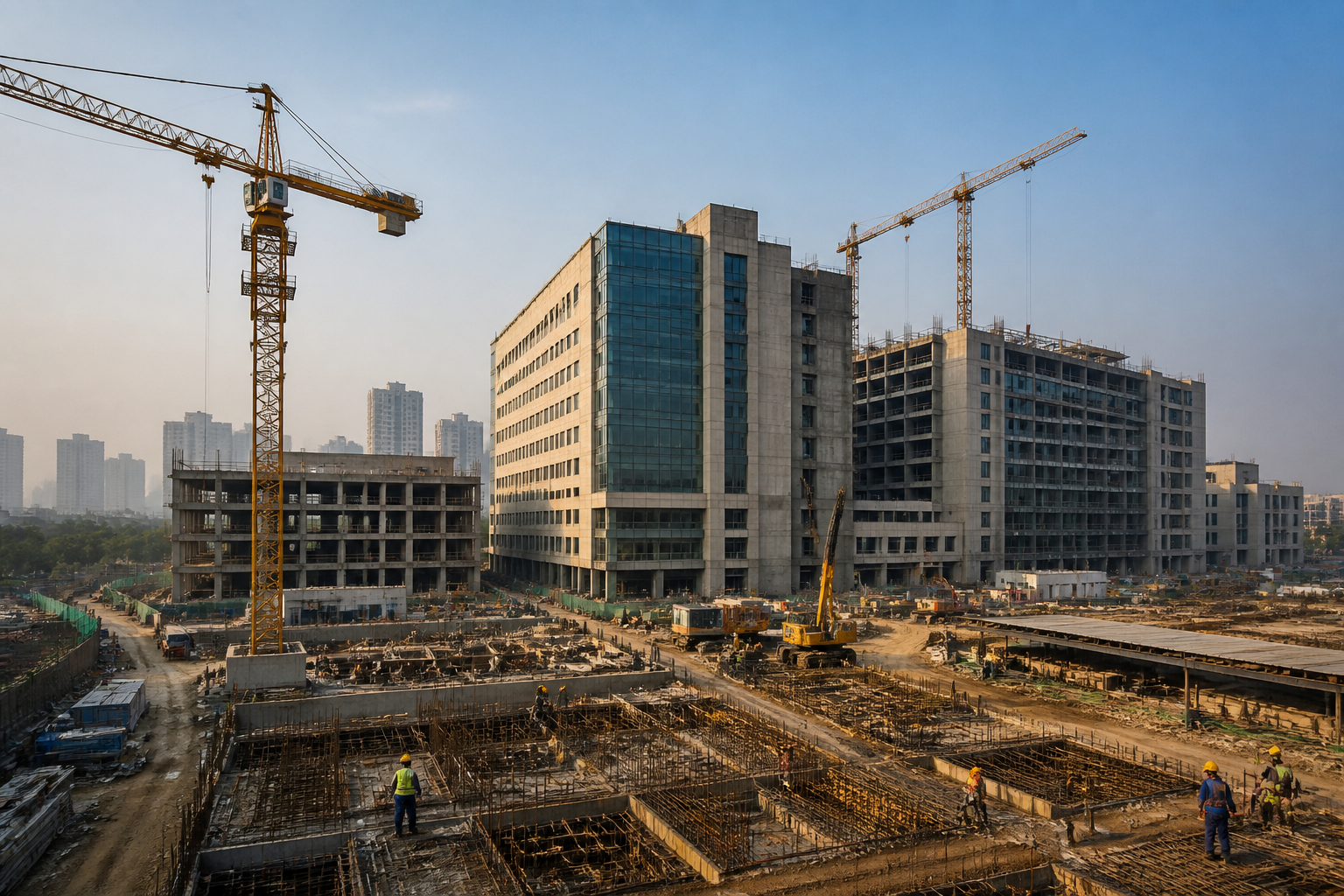
Manipal Hospitals’ expansion plan is shifting the company’s growth model from acquisitions towards building hospitals from scratch. The chain has identified 2,426 additional beds for development by 2030, with 1,943 planned through greenfield projects and 483 through brownfield expansion. That mix makes new construction, rather than hospital acquisitions, the defining feature of its next phase of growth.
The plan, disclosed in Manipal Health Enterprises’ first annual report after its public listing on August 5, places greenfield beds at 80.1 per cent of the identified pipeline. The company intends to focus primarily on markets where it already operates, including Karnataka, Maharashtra, Goa and eastern India. It is also evaluating acquisitions in Delhi-NCR, Telangana, Kerala, Andhra Pradesh and Chhattisgarh, indicating that construction and consolidation will continue in parallel.
The distinction matters because the two routes create different demands on urban systems. An acquisition provides access to an operating facility, an existing patient base and established local relationships. A greenfield project requires land, construction, medical equipment, technology, staffing and time to build demand. For a hospital chain, the decision to put four-fifths of its planned beds into new facilities represents a substantial commitment to physical infrastructure rather than only balance-sheet expansion.
The Mumbai-Pune corridor has been identified as a key growth opportunity, while Delhi-NCR is being considered for further consolidation through acquisitions. The company’s stated geography places its expansion within some of India’s largest and fastest-growing urban markets, as well as in regions where it already has operating experience. The supplied disclosures do not specify the locations, land parcels, construction schedules or commissioning dates for individual greenfield hospitals, so the precise urban footprint of the pipeline remains unresolved.
The capital requirement is already visible in the company’s own operating benchmarks. Dilip Jose, managing director and chief executive officer of Manipal Hospitals, had earlier told Business Standard that a greenfield hospital of about 250 beds typically requires an investment of ₹380 crore to ₹390 crore, excluding land and building costs. Medical equipment, technology, information technology and interiors add approximately ₹1.5 crore per bed, according to the same disclosure.
Applied to the planned 1,943 greenfield beds, the equipment and fit-out component alone implies an indicative investment of about ₹2,915 crore. That calculation excludes land and building costs and is not a company-provided project budget. It nevertheless shows why greenfield hospital development is materially different from buying an operating asset: a large share of the spending arrives before the facility can generate revenue.
Manipal’s existing capacity also helps explain the company’s approach. Its operational beds increased 20.2 per cent to 6,227 in FY26 from 5,179 a year earlier, while occupancy declined to 64.5 per cent from 67.1 per cent. The company generally begins assessing additional capacity when a hospital approaches 70 per cent occupancy, allowing time for construction before existing facilities become constrained.
That threshold introduces a timing question into the expansion strategy. A hospital cannot be planned only around current occupancy. Construction, approvals, equipment installation and clinical commissioning take place before the additional beds become available. At the same time, occupancy below the company’s stated assessment point means that not every existing facility is immediately capacity-constrained. The available information does not establish how the 2,426-bed pipeline is allocated between hospitals with rising demand and markets where future capacity is being positioned ahead of need.
The expansion follows a period in which Manipal relied heavily on acquisitions. Between FY21 and FY26, it added 5,548 beds through the purchases of Columbia Asia, Vikram Hospitals, AMRI, Medica Synergie and Sahyadri Hospitals. The Sahyadri transaction, completed in stages beginning in October 2025, added 10 hospitals and 1,606 licensed beds in Maharashtra.
Manipal paid about ₹5,255 crore during FY26 for a stake of nearly 90 per cent in Sahyadri and committed a further ₹574 crore for another tranche. The acquisition helped increase the group’s operating scale quickly, but it also expanded the company’s financial obligations and asset base. The new greenfield strategy therefore begins from a larger platform than the company had at the start of its acquisition cycle.
The financial results show both the operating benefit of scale and the cost of funding it. Consolidated revenue from operations increased 25.4 per cent to ₹10,335.75 crore in FY26 from ₹8,242.26 crore a year earlier. Earnings before interest, tax, depreciation and amortisation rose 22.1 per cent to ₹2,644 crore. However, the Ebitda margin narrowed to 25.6 per cent from 26.3 per cent, while profit after tax fell 15.3 per cent to ₹916.59 crore from ₹1,081.67 crore.
Finance costs rose 68.9 per cent to ₹864.29 crore, partly because of higher borrowings, including non-convertible debentures raised for acquisitions and expansion. Depreciation and amortisation increased 34.1 per cent to ₹679.55 crore as the asset base expanded following the Sahyadri acquisition. Tax expense also increased, reaching ₹261.51 crore from ₹160.64 crore.
The result was a rise in net debt, including lease liabilities, to 3.7 times Ebitda in FY26 from two times in FY25. Return on capital employed declined to 22 per cent from 27 per cent. These figures do not establish that the greenfield plan will produce a particular financial outcome, but they show the balance-sheet context in which the company is moving towards another capital-intensive growth phase.
Operational indicators remained positive. Average revenue per occupied bed increased 8.8 per cent to ₹68,900 per day from ₹63,300. Inpatient volumes rose 19.9 per cent to 527,227, while outpatient volumes increased 16.2 per cent to 5.48 million. The company’s six combined specialties—cardiac sciences, oncology, neurosciences, gastro sciences, orthopaedics and renal sciences—accounted for 64.3 per cent of gross inpatient revenue, up from 62.6 per cent in FY25. Oncology recorded the strongest growth among these specialties.
Those numbers point to a model in which hospital infrastructure is not simply measured by bed count. The commercial performance of new capacity will depend on occupancy, case mix, specialty demand, pricing and the ability to recruit clinical staff. The supplied material provides current group-level operating figures, but not forecasts for the new hospitals or a market-by-market assessment of demand. It therefore supports an analysis of the expansion strategy, not a conclusion about whether every proposed project will be viable.
The company’s public-market transition adds another layer to the strategy. Manipal’s ₹9,275.21-crore initial public offering comprised a fresh issue of ₹8,000 crore and an offer for sale of ₹1,275.21 crore. Its shares listed at ₹652 on the National Stock Exchange, a 10.5 per cent premium to the issue price of ₹590, and closed at ₹725.20 on September 4. The market performance is part of the company’s post-listing context, but it does not by itself indicate how the expansion pipeline will be financed or sequenced.
For cities, the plan highlights the growing role of private hospital networks in shaping healthcare infrastructure. New hospitals influence land demand, transport access, employment, utilities and the distribution of specialised medical services. Yet the source material does not provide details on local planning approvals, public-private arrangements, land acquisition, accessibility standards or the relationship between the proposed facilities and municipal infrastructure. Those questions will become more concrete when individual projects are announced.
The immediate evidence confirms a clear strategic shift. Manipal Hospitals has identified 2,426 additional beds by 2030, and most of them are expected to come from greenfield facilities in existing and targeted markets. The company is entering this phase with higher revenues and patient volumes, but also higher debt, depreciation and financing costs following its acquisition-led expansion.
What remains uncertain is where the new hospitals will be built, how their construction will be scheduled, how much land and building expenditure will be required, and whether the company will use internal cash, fresh borrowing or other funding routes. The next meaningful milestones will be the identification of specific projects, their approval and construction timelines, and evidence of how Manipal balances new capacity with occupancy, clinical staffing and financial leverage.
