


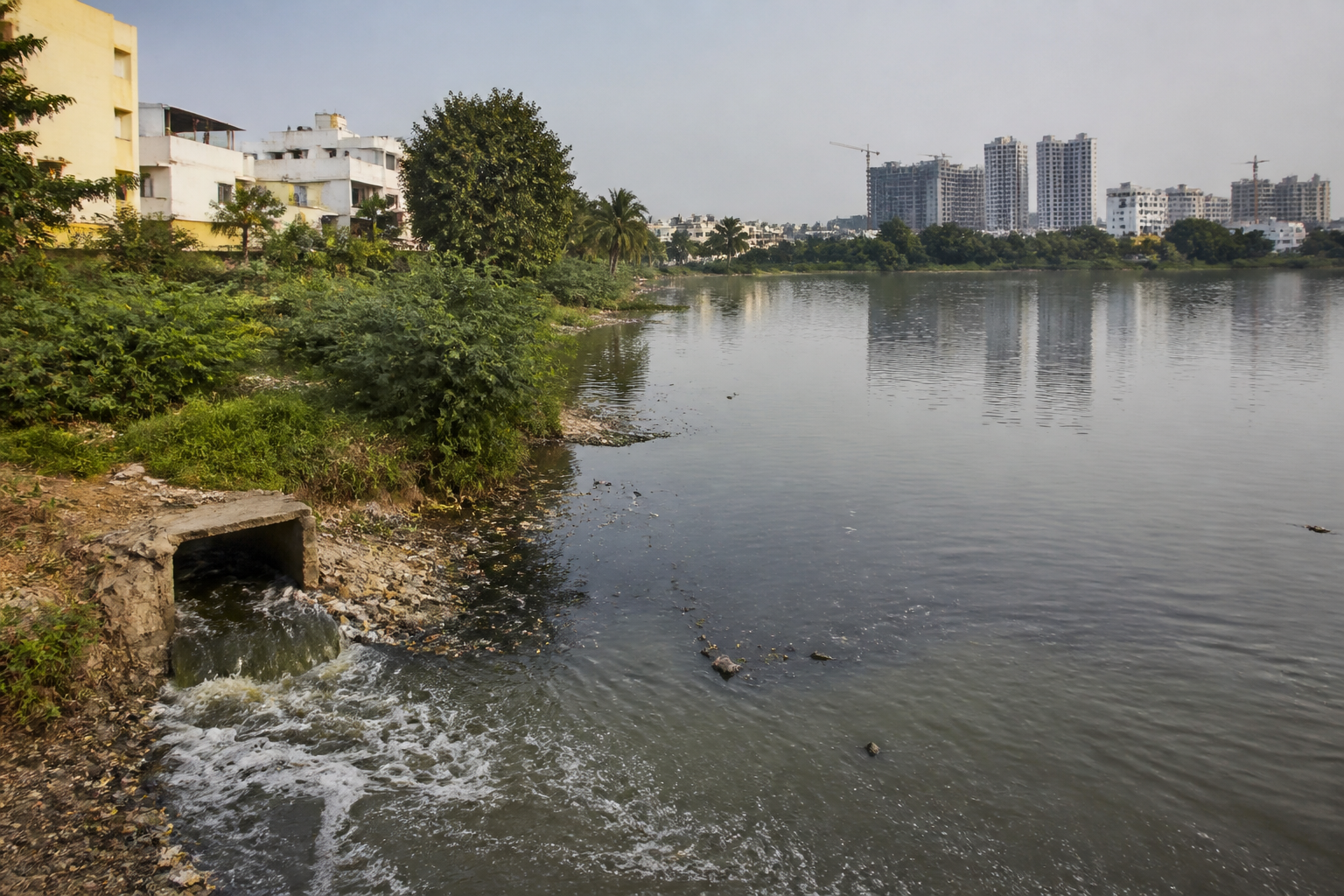
Three lakes in north Bengaluru are showing different symptoms of the same urban problem: pollution is entering water bodies faster than the systems meant to prevent it can contain it. A Bangalore University analysis of Dasarahalli, Madavara and Chikkabanavara lakes, conducted in April and May 2026, found elevated levels of several indicators associated with sewage, organic contamination, nutrient enrichment and urban runoff.
The findings do not describe a single contaminated lake or an isolated waste incident. They show how pollution pressure varies across a connected urban landscape. Madavara Lake recorded the highest nutrient overload and chemical oxygen demand, while Dasarahalli Lake showed the highest levels of several indicators linked to domestic sewage inflow. Chikkabanavara Lake had comparatively better water quality, but researchers reported encroachment and waste accumulation there as well.
Together, the results point to a wider governance problem: the health of an urban lake depends not only on what happens within its boundary, but also on the quality of drainage, sewage management, waste collection and land-use control across its catchment.
The study assessed pH, turbidity, electrical conductivity, total dissolved solids, hardness, nutrients, dissolved oxygen, biochemical oxygen demand and chemical oxygen demand. Researchers found that pH, electrical conductivity, chloride, fluoride and nitrate levels were within permissible limits. However, total dissolved solids, turbidity, hardness, phosphate, biochemical oxygen demand and chemical oxygen demand were elevated at some locations.
That distinction matters. A lake can remain within permissible limits for some parameters while showing serious stress through others. The combination of high turbidity, elevated solids, increased nutrient levels and higher oxygen demand indicates that pollution is not simply a visual problem. It reflects changes in the chemical and ecological conditions of the water body.
Madavara’s results were particularly concerning. Researchers recorded the highest levels of phosphate, sulphate and nitrate among the three lakes, along with the highest chemical oxygen demand. The combination indicates severe organic pollution and nutrient enrichment. Excess nutrients can alter the balance of an aquatic ecosystem, although the supplied study does not quantify the longer-term biological impact on each lake.
Dasarahalli showed a different pattern. It recorded the highest electrical conductivity, total dissolved solids, hardness, turbidity, chloride, fluoride, sodium and biochemical oxygen demand. Researchers associated these readings with a high inflow of domestic sewage. The lake therefore illustrates how the source and composition of pollution can differ even between water bodies located in the same broad urban region.
Chikkabanavara, by comparison, recorded relatively better water quality. That does not mean it is secure. The study also identified encroachment and waste accumulation as pressures on the lake. Its comparatively better readings show that water quality is not a fixed condition; they do not remove the need for protection, especially when surrounding urbanisation and inadequate waste controls continue to place pressure on the water body.
The three lakes are part of the Madavara Lake Series in north Bengaluru. Their downstream connection gives the findings significance beyond the immediate neighbourhoods around their shores. According to Dr Raghavendra M of the Department of Environmental Science at Bangalore University, outlet water from the lakes joins the Arkavathi River, which eventually reaches Tippagondanahalli Reservoir, a source of drinking water for some parts of Bengaluru.
This connection changes the way lake pollution should be understood. The lake is not the end point of the problem. It is one stage in a wider water system. Wastewater entering a lake, nutrients accumulating in its water or solid waste obstructing its channels can affect downstream flows and reservoirs. The study does not establish the precise pollutant contribution from each lake to Tippagondanahalli Reservoir, but it identifies the route through which local failures can acquire wider public significance.
The researchers’ explanation places the problem in the geography of north Bengaluru. A large part of the area is peri-urban, with some locations undergoing rapid urbanisation. At the same time, the area lacks an underground drainage system, according to Dr Raghavendra. This combination creates a basic mismatch: urban activity and waste generation are increasing, while the infrastructure required to collect and treat wastewater has not expanded at the same pace.
Where an underground drainage network is absent or incomplete, wastewater can move through open drains, informal channels or stormwater routes. The supplied study attributes the deterioration observed in the lakes to urban runoff, solid waste dumping and nutrient enrichment, while the researchers link Dasarahalli’s readings to domestic sewage inflow. These pathways are different, but they can converge in the same water body.
This is why lake clean-ups alone cannot resolve the problem. Removing waste or weeds from the visible surface may improve appearance, but it does not stop sewage or nutrient loads from entering through the catchment. Researchers specifically warned that addressing pollution only after it reaches the lakes is a temporary solution. Their emphasis is on source-level controls, including effective sewage management and prevention of direct wastewater discharge.
The policy challenge is therefore distributed across several responsibilities. Sewage has to be collected and treated. Solid waste has to be prevented from entering drains and lake premises. Encroachment has to be controlled. Lake boundaries and inflow channels have to be protected. Water quality has to be monitored regularly. Community participation is also required, according to the researchers.
These measures are connected rather than interchangeable. Regular monitoring can reveal deterioration, but it cannot replace sewage treatment. Removing solid waste can clear a lake surface, but it cannot address dissolved pollutants. Enforcing environmental laws can establish accountability, but enforcement is difficult if drainage and waste systems do not provide residents and establishments with viable alternatives.
The findings also show why a single water-quality score can conceal the character of an urban lake’s decline. Madavara’s strongest signal was nutrient overload and chemical oxygen demand. Dasarahalli’s was a combination of high solids, turbidity, hardness and biochemical oxygen demand associated by researchers with domestic sewage. Chikkabanavara’s relative advantage coexisted with encroachment and waste accumulation. Each lake therefore requires attention to its specific pollution pathways, even though the broader institutional problem is shared.
The study’s timing provides a snapshot rather than a complete long-term record. Sampling was carried out during April and May 2026, and the supplied material does not provide a multi-year trend line, seasonal comparison or detailed readings for every sampling location. It therefore confirms current stress but does not establish how quickly each lake is deteriorating or how conditions vary during other parts of the year.
That limitation is important for public decision-making. A lake’s condition can change with rainfall, runoff, wastewater flows, waste accumulation and management interventions. The researchers’ call for sustained monitoring addresses this gap. Without repeated assessments, authorities and communities may know that a lake is polluted without knowing whether a particular intervention has reduced the pollution or merely shifted it elsewhere.
The evidence nevertheless establishes three clear points. First, pollution pressure is present across all three lakes, though its form and intensity differ. Second, the pressure is linked to human activity, including urban runoff, solid waste dumping, domestic sewage, encroachment and rapid urbanisation. Third, the lakes form part of a wider drainage and river system connected to a reservoir that supplies drinking water to some parts of Bengaluru.
The larger urban question is whether Bengaluru treats its lakes as isolated properties or as working components of a connected water infrastructure. The study’s findings favour the second view. A lake cannot be protected effectively if the drains, neighbourhoods, construction activity and waste systems around it remain outside the management framework.
For the three north Bengaluru lakes, the next steps identified by researchers are clear: strengthen sewage treatment, prevent direct wastewater discharge, control encroachment, remove solid waste and invasive weeds, conduct regular water-quality monitoring, reduce nutrient loads and involve communities in protecting the water bodies. What remains uncertain is the timeline and institutional mechanism for implementing those measures. That is the point at which a study of pollution becomes a test of urban governance.
